Avatar photo About James Hendrickson

James Hendrickson is an internet entrepreneur, blogging junky, hunter and personal finance geek. When he’s not lurking in coffee shops in Portland, Oregon, you’ll find him in the Pacific Northwest’s great outdoors. James has a masters degree in Sociology from the University of Maryland at College Park and a Bachelors degree on Sociology from Earlham College. He loves individual stocks, bonds and precious metals.

Tuesday Shopping Tips

All,

Inflation is rearing its ugly head all over the US. Since money supply issues and interest rates are usually outside the bounds of what most people can influence, I thought I’d share some savings tip to help you limit your expenses.

These are all about grocery shopping:

1) Don’t shop more than once a week.  Fewer shopping trips means fewer opportunities to impulse spend at the grocery store, and less` money spent on gas getting there.

2) Make a shopping list based on a menu plan and stick to it.  Sixty percent of all items purchased at the grocery store are impulse buys.  Avoid the expensively priced items at the check out.  These are usually highly priced on a per unit basis.

3) Too busy to pack your lunch every day?  Make one big brown bag with all your stuff and take it to office.  Just get all your snacks, lunch fixing, etc. and put them in a single bag and take it to the office.  You’ll likely save about $4 per day relative to buying your lunch at a local restaurant or food cart. Even if you do buy a mini-fridge for the office, you’ll still come out ahead after a couple of months.

4) Don’t get sliced lunch meat at the deli counter.  Instead, get a whole chicken, bake a ham or make your own lunch meat to freeze.  Doing this often gives you better tasting meat that’s healthier and less expensive on a per serving basis.

Do you have any more savings tips to share? If so, leave us a comment below! 

Forgot Your Coupon? Grocery Store Customer Service May Redeem Them Anyways

Tip Of The Day: Save Your Plastic Shopping Bags

Money Saving Tip Of The Day: Go Generic

Money Saving Tip Of The Day: Turn Off The Lights

 

It’s Not About Money, It’s About Values

ts not about money its about values

Here is a quick thought.

A major cause of conflict in marriages is money. However, an important factor to remember is that most issues around money, aren’t really about the money at all. Instead what people are having conflict around is aligning different value systems each person brings into the relationship.

So, when a couple is having conflict around budgeting or the like, what is happening is they are actually trying to reconcile the different values that each person brought into the relationship. The values are important, and in a lot of cases asking your partner to give up their fundamental values is a non-starter. It won’t happen. It’s like asking someone to give up an internal organ.

This is because values give us the importance we place in our financial decisions. For example, one partner may place a huge importance on security and planning. When the other may value thing like freedom or new experiences. So, the first person may want to maximize savings, and adhere strictly to a budget. The other person may want to spend more on vacations, a car or better quality food.

So, disagreements about money are often not about the money – they’re about values.

For more great Dinks articles, read these:

What Dave Ramsey’s Take On Marriage is Missing

Four Suggestions For Newly Married Couples

Getting Together, Getting Hitched

The Wisdom Of Ben Franklin

the wisdom of ben franklni

“Remember, that money is of the prolific, generating nature. Money can beget money, and its offspring can beget more, and so on. Five shillings turned is six, turned again it is seven and threepence, and so on, till it becomes a hundred pounds. The more there is of it, the more it produces every turning, so that the profits rise quicker and quicker. He that kills a breeding sow, destroys all her offspring to the thousandth generation. He that murders a crown, destroys all that it might have produced, even scores of pounds.”

Benjamin Franklin, Advice to a Young Tradesman, 1748

Stock Up Your Emergency Fund

Stock up your emergency fund

Stock up your emergency fund

I don’t know what it is about the headlines, but they’ve been consistently bad for the last three years.   First, it was the Covid-19 pandemic ruining the economy, and more recently Russian President Putin has been threatening nuclear war with the west.  Now the Fed is raising interest rates which threatens to undermine the economy.

In short, things are looking pretty risky right now.  You might be thinking its time to start saving a bit more.

So, if you’re looking to stock up your emergency fund, here are some guidelines that might help.

1) Shoot for 8 months of living costs.  You want 8 months of savings because during the last recession it took at least 8 months for people to find new jobs if they got laid off.  Having 8 months of savings will give you peace of mind.

2) Put the cash in a Federally insured bank or credit union.  What you want to do is check the banks website or the door of the bank to see if it says FDIC, or NCUSIF.  These acronyms stand for the Federal Deposit Insurance Corporation and the National Credit Union Share Insurance Fund respectively (here, and here).  If your financial institution fails, these programs cover up to $250,000 of your money.

3) Don’t risk the money.  I used to put my savings in the stock market – which was a mistake.  Back in 2008, some of the stocks I put money into lost 90% of their value.  So, if I had lost my job during that time period I would have been stuck.  So, instead of putting your money into something risky, like stocks, or bonds, just put it in a savings account and accept the fact that you’ll lose a bit of money from inflation.

4) Be careful about the type of account you get.  The FDIC and NCUSIF only insure deposit accounts.  If you buy into a mutual fund or open a brokerage account through a bank or credit union, you won’t be covered if you loose money.  Only deposit accounts at banks or credit unions are covered.

5) Don’t loan anyone money if it comes out of your emergency savings.  Most people’s natural impulse is to help others.  But don’t lend or give anyone money if makes a substantial dent in your emergency fund.  You don’t want to jeopardize your own financial health.

So there you have it, five things to consider if you’re stocking up your emergency fund.

Need Money For Your Emergency Fund?

Incidentally, if you want a painless way to get some extra money for your emergency fund, consider selling your spare bandwidth.  There are at least three good companies in the space worth trying:

Packetstream => Pays about $5 per month.

Earn App => Pays about $5 per month.

Pawns.App => Pays about $5 per month.

These are easy.  You just install the software and, check the totals periodically and make withdrawals.

For more on stocking up your emergency fund, consider reading: 

Save, Invest and Reinvest To Build Wealth

Stack Cash, Low Cost Ideas To Get Extra Money

Saving $1,000 – A Case Study

Hat tip: Suze Orman’s Dos And Don’t Of Money.

Disclaimer: Some of the links in this article are affiliate links.  If you click on them and download or use the products, Dinksfinance will get a commission.

High Impact Wealth Building – A Personal Experience

High Impact Wealth Building

High Impact Wealth Building

All,

In an effort to be of use to DINKs readers, I wanted to share a few things that I’ve done to consistently build wealth.

This article is purely from my own personal experiences.  I don’t know if all of these will work for everyone – they’re just what’s worked for me.  The article is sorted into high impact wealth building activities and low impact wealth building activities.

High Impact Wealth Building Activities 

  1. Investing in Stocks: I’ve been investing in stocks on and off for couple of decades. Of all asset classes, stocks in the US have generally had the highest returns. This has been a major driver of the wealth I’ve been able to get so far. The Federal government lets you make contributions to tax advantaged accounts like IRAs – and I’ve historically been able to max these out, which has provided tax advantages and a de facto boost to my wealth building.
  2. Investing in Real Estate: For the last 20 years I’ve also consistently owned real estate. This has been great as real estate in the US has traditionally received favored tax treatment, along with advantages like leverage and passive income flows from owning rentals. Its been a great asset class. I’ve also got some shares of a handful of smaller real estate investment trusts (REITS) – specifically Fundrise, HappyNest, and StReitWise.
  3. Marrying Well: Marrying well has helped me. Most of the data shows that a healthy happy marriage with an economically productive spouse helps build wealth.  Marriage has a number of beneficial effects – including economies of scale, specialization, emotional support, etc. Getting and staying married is an excellent wealth accelerator.
  4. Starting a side business/having a profitable side hustle: Depending on their profitability this can really be a great way to accelerate your wealth building.
  5. Budgeting/Cutting Spending: Budgeting isn’t sexy, but its necessary.  The simplest way to gain wealth is spend less than you earn. If you run a surplus consistently you should be able to gain wealth more quickly than if you’re just breaking even.

These are all high impact activities.

Low Impact Wealth Building Activities

Here are some of the lower impact, but still useful methods I’ve used:

First, I’m using use rebate sites. Rebate sites are an old, but tried and true method than can give you 1 to 17% back. These are the ones I’m using:

Second I’m scanning my receipts. These are the apps I’m using. I’ve sorted them in order of hassles & payout, from best to worst.

  1. Pogo
  2. Bitmo
  3. Receipt Pal
  4. Fetch
  5. Coinout
  6. Receipt Jar
  7. Receipt Hog

These are all low payout, low impact plays. But they do work to reduce the practical costs of your purchases by about 1%.

Third, I’m also shopping way more with coupons, negotiating, and comparison shopping to look for cheaper alternatives.

Fourth, I’ve gone hard on selling my personal data and unused internet bandwidth. I’m using the following software:

  1. Nielsen Opinion Rewards
  2. Savvy Connect
  3. Reklaim

The whole data sales sector has been in a bit of downturn – several of the projects that were in this sector have stopped operations, such as Upvoice, or cut their payments – such as Reklaim. There is still money to be made but regulation and the low profitability of the model appear to be driving the weaker players out.

Selling my spare internet bandwidth, using:

  1. Earn App
  2. Packetstream
  3. Honeygain
  4. Peer2Profit

At this point I’m plowing all my extra money into my emergency fund.  I’m also focusing on saving enough money to stake a crypto node or two.

For More On The Mechanics Of Wealth Building, Consider These:

Building Wealth on $600 Per Month

What To Do With Your Money In Case Of War 

How To Make Money Off Your Old Laptop

List Of Months With Three Paychecks – And What To Do With The Money

My Grandfather’s Budget – 2022 Sure Isn’t 1941

Hi All,

So here is a bit of an interesting personal finance story for you all.

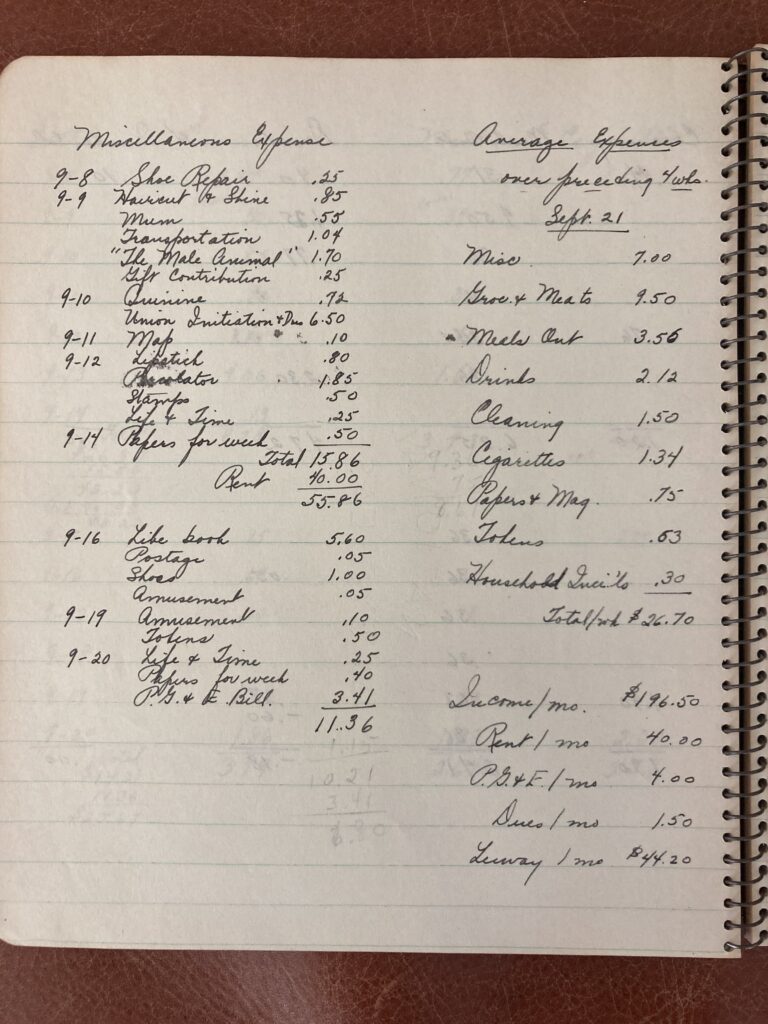
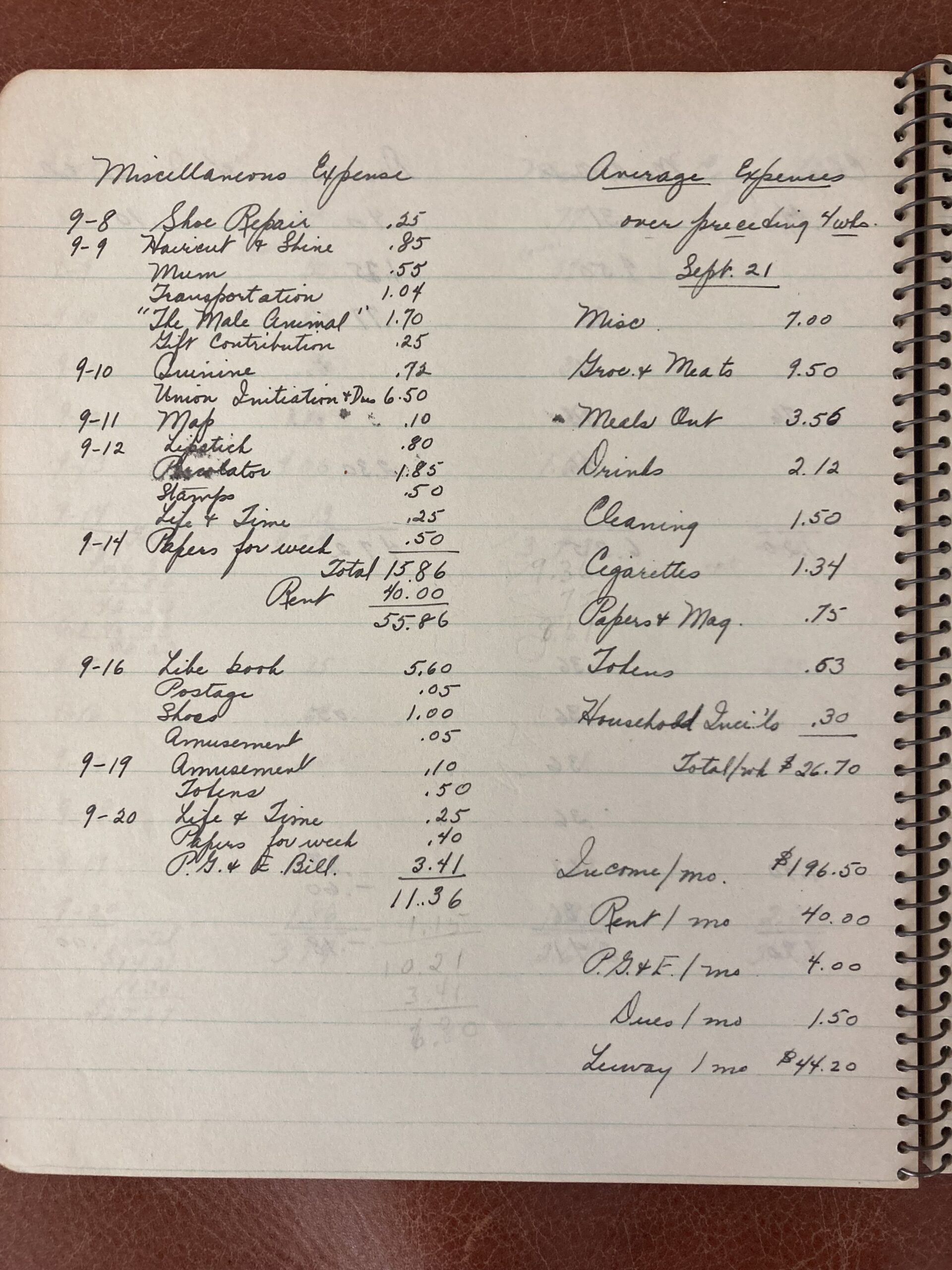
Earlier this week, I went to my uncles house. He had a bunch of stuff from my late grandfather…including his weekly budget from 1941. Being a huge personal finance fan, I thought I’d share it here.

He was using old fashioned cursive writing, so the writing is a bit hard to make out, but the prices are pretty amazing. In September of 1941 my grandfather received $196.50 in income. He paid 40 dollars in rent, 5 cents for postage, $1.34 for cigarettes, $2.12 for drinks and $1.50 for dry cleaning.

There are also some medical expenses, such as 72 cents for quinine, and some grooming expenses like 85 cents for a haircut and shoeshine.

What’s interesting is about my grandfather’s budget is, he wrote down everything.  And, a lot of the thing he spent money on such as shoe repair and periodicals, are significantly less popular these days.

For More Great Articles, Read These: 

Building Wealth on $600 Per Month

What’s The Best Time to Buy And Sell Mutual Funds To Make The Most Money?

Ten Factors Affecting Your Wealth


Five Financial Tips For Thursday

Hi All,

As you may know, Eric Tyson is a prolific writer and personal finance columnist. We have a copy of his book Personal Finance For Dummies, and have found it consistently useful for several years. Among other things, Tyson gives the following five points of advice:

1) Prepare for Lifes Changes: The more you live within your means, build up a cushion of emergency savings and keep your expenses low, the better off you will be financially and emotionally when your life changes. An emergency fund of three two six months is good for most people.

2) Read Publications That Have High Quality Standards and that Aren’t Afraid to Take a Stand to Recommend Whats In Your Best Interest. In this case, you should probably take publications by brokerage companies with a grain of salt. Skepticism is required especially in publications advertising their in-house mutual fund’s performance. Very often the advertisement will select years in which the fund did well, but ignore years where it lost money. If you took the advertising at face value, you would get a distorted picture of the fund’s actual performance. Since your money is on the line, you should know what you’re getting into.

3) Prioritize Your Financial Goals and Start Working Towards Them: This is good advice, but I’d go further to say your goals should be measurable and achievable.

Regarding Measurement. It makes sense to avoid vaguely stated goals like “financial freedom”, because its hard to know when you’ve achieved “financial freedom”. – It simply means different things to different people. For a homeless person, it might mean having a job. For a family of four it might mean building up an emergency fund. Instead, try to put your goals in a metric that helps you to know if you achieved your goal or not. For example, your goal might be to “achieve net worth of $100,000” or “buy 9 savings bonds”. In both of these cases, you know if you made the goal or not. That is, either you bought the 9 bonds or you didn’t – its not subject to interpretation.

About Achievability: You should be able to reasonably meet or surpass your goal. For example, lets say you set a goal of becoming a millionaire in 1 year, but you only have 20 dollars in your pocket. Unless you are Warren Buffett, the chances of meeting your goal are not very good given that all you’ve got it is 20 bucks. When you make unachievable goals you are setting yourself up for failure. Don’t do that.

4) Hire Yourself First. Tyson says you are the best financial person you can hire. Amen. It never makes sense to abdicate control of your finances to a financial manager. Instead, it is probably best to work in partnership with them.

5) Invest in Yourself and Others. Invest in your education, your health, and your relationships with family and friends. Personally, I’m a bit of nerd when it comes to investing, but I also find it very rewarding to spend time with friends and family. In fact, the older I get, the more family becomes important. So, Tyson is right on with this final point as well.

Hope some of this helps.

For more great Dinks articles, read these:

Nine Ways To Make Extra Money

Spyro Contogouris, Hedge Fund Hitman

List of Microincome and Microsavings Apps

Huckster Tai Lopez Is At It Again, Buyer Beware

Tai Lopez at it again

Evidently notorious huckster and marketer Tai Lopez is at it again.

Here is what the guy is selling as of today.  On Facebook, he’s put out an offering for accredited investors.  The main idea here is Lopez is advertising for investors willing to put down $300,000 and in return they’ll receive $60,000 in annualized “preferred dividends”.

Tai Lopez at it again
Tai Lopez Facebook Ad advertising 20% returns.

There are a number of problems with Lopez, as well as with this offer in particular.

First, Misleading Sales Tactics

Lopez has a history of using sales tactics that are borderline materially false. This has been covered thoroughly here, here and here. In particular the homes and automobiles Lopez uses in his YouTube advertisements have been shown to be leased. This suggests his apparent level of success is illusory.  Given this history, one wonders if the terms of the offer above should be trusted.

Second, Track Record of Disappointed Customers

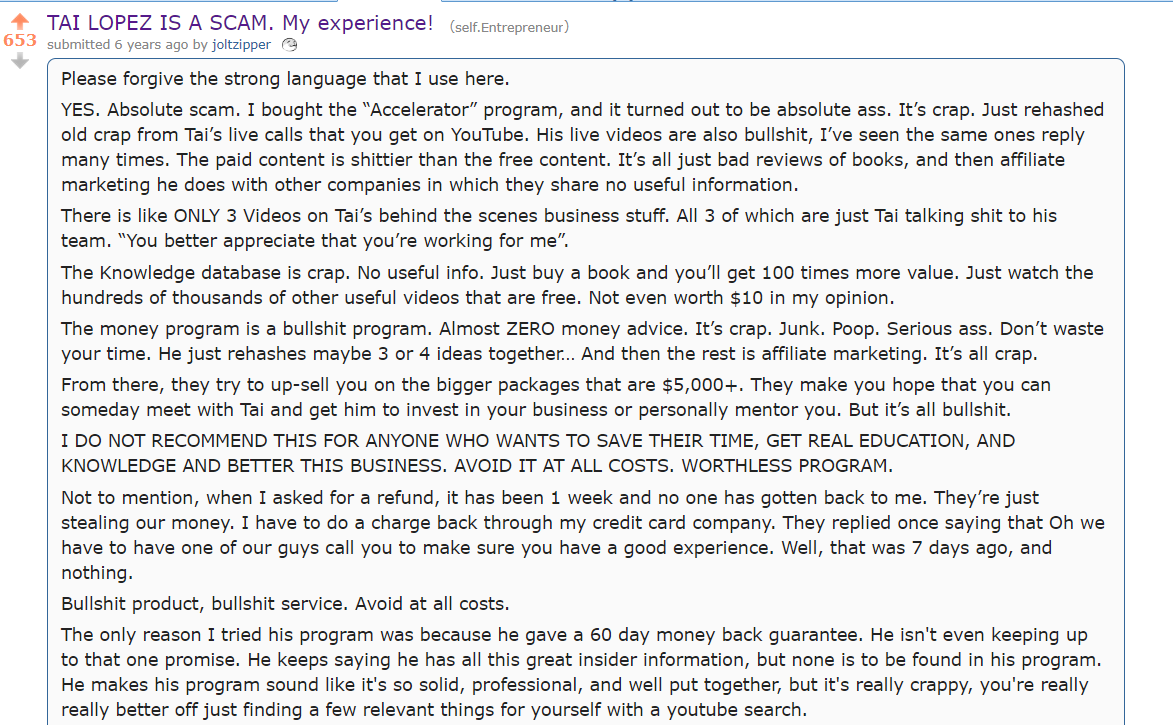
Lopez has a reputation for not providing value for his customers. Here is one person’s classic response to a product he/she bought from Lopez.

tai lopez is a scam, my experience

In reading this, one wonders if a stronger condemnation would be possible using the English language.

But, it’s not an isolated incident. Lopez has a long term pattern of this sort of behavior.  He evidently got his start in high end dating websites – many of which had so many complaints that he needed to change the names (here).  In addition, Lopez’s companies have demonstrated a pattern of failing to pay refunds when demanded, and or only paying when customers complain to industry watchdogs such as the Better Business Bureau (here).

3) Long Term Returns of 20% Are Hard to Sustain

Absent some sort of tax advantaged structure or temporary market conditions, 20% returns are very difficult to sustain over the long term.  Some companies are able to do it, such as Costco, but this is the exception.  Even real estate investment trusts (REITS), which are obligated by law to return 90 percent of their income to their shareholders, only return between 6% and 8% on an annualized basis.  And, long run returns of most of stock markets in the western world typically yield around 10% on an annual basis.  In other words, the advertised returns seem too good to be true.

So, what does all this add up to?  Tai Lopez is at it again.

If you want to find a good way to make ads, check advertisement maker.

For More Great Dinks Articles, Read These: 

Spyro Contogouris, The Story of A Hedge Fund Hitman

Here Are Ten Of The Most Expensive Court Cases In History

The Checkered Legal History of Robert Kiyosaki

Here Are 420,439 Ways To Make Money On The Internet

420439 ways to make money on the internet

420439 ways to make money on the internet

Actually….

I don’t even know if there are 420,439 ways to make money on the web.

What I do know is there are a lot of tried and true ways accumulate some side income.  Here are three.

  1. Sell Your Personal Data. Things like browsing history, spending, etc. all have economic value. If don’t mind profiting from selling your data, there are tons of ways to make a few extra bucks on the side. Reputable companies that aggregate and sell your data are: Nielsen Rewards, Savvy Connect and Reklaim. A lot of people are concerned privacy…but selling your personal data is already happening in big tech, so you might as well get paid.  Data isn’t worth much – each of these platforms will pay you like $5 per month.  But, once you get the platforms set up, the money is basically passive.
  2. Sell Your Spare Internet Bandwidth.  Your computing resources also have economic value.  Specifically if you have a solid wireless connection you can always sell the gigabytes of bandwidth you aren’t using.  There are three reputable apps that do this and actually pay you. These are EarnApp, Packetstream and Honeygain.  I’ve had all three installed on my machines at home since March of this year and all have been working mostly fine.  However, of the three Honeygain has the most problems. Honeygain’s software requires the most babysitting, it pays the least per gigabyte and the company has the most consumer complaints.  EarnApp and Packetstream are both solid and pay regularly if not modestly. I’d get them both installed in your computer and just check them every 60 days or so.
  3. Invest In Stocks.  Investing is a classic way to make money.  A lot of people don’t seem to get into this – per Gallup just 58% of the country owns stock. This is a shame as stock is an excellent way to build long term wealth on the internet. I’ve been using brokerage companies Charles Schwab, Stockpile, as well as number of smaller ones.  If you don’t have much money, you can always find companies that will give you free stock – Savingadvice has a good list.  Otherwise, its probably a good idea to maximize your 401(k) contributions and get as much money into the markets as you possibly can.

Of course, there are tons of other ways to make money on the web, these are just a few that I’ve been looking at recently.

Finally, an acquittance of mine that I met on Facebook has produced a really nice little list of passive income sources.  It,s not 420,439 ways to make money on the internet, but its good. Its up on google docs, here.  Its worth a read if you want to find ways to make passive income in crypto.

For More Sweet Dinks Finance Articles, Read These:

Getting Ahead On $600 Per Month

List of Ways To Make Extra Money

Here is The Dinks Review of Credit Check Total

What Would You Do If You Won The Lottery?

All,

Saw this on social media last week.  Its a posting asking the question “what would you do if you won the lottery”, so its got me thinking.  I really don’t believe I’m going to win the lottery because I don’t play, but I’m curious to see what dinks readers have to say.

All, if you’re so moved to answer, please leave a comment below.

You cannot copy content of this page