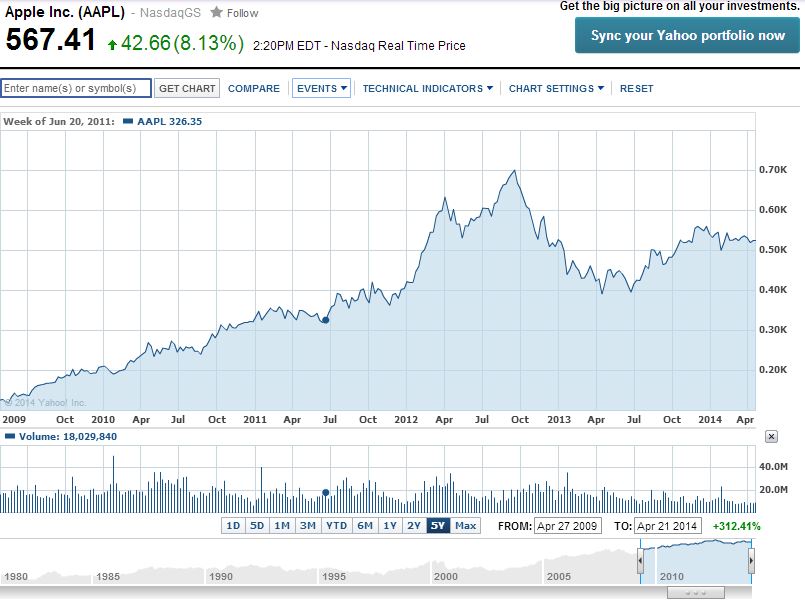
When I initially bought AAPL in July of 2011, James was a naysayer in that he felt the stock was too expensive. We’ve gone round and round about this, but my strategy is that it doesn’t matter how “expensive” the stock is, only how much it will go up in value. My initial purchase was for $331 per share and I added more to that at the start of 2012 at $423.
While I had watched the stock climb in that six month period, I also felt that I’d kick myself later if I didn’t buy more. With the price now around $568, I’m pretty happy to have cost averaged, even if that means I’ve cumulatively made less per share. My initial investment has gone up by 70% and my second batch by 35%.
My overall investment of around $20k, in 53 shares, is now at over $30k. Both chunks of cash are in retirement mechanisms, 2/3 in my ROTH and 1/3 in a rollover account. It will be interesting to see where things go, but I don’t mind have 371 to watch the show!
I bought where the dot is!
Anyone else out there happy to have a piece of the AAPL?
We just took a big step in selling one of our rental properties. This was actually James’ baby, which he purchased in August of 2003, four months before I moved out to Washington. This studio apartment, in the heart of Dupont Circle and a whopping 336 sq ft, was what we initially cut our teeth on for managing rental properties. Since then we’ve purchased two more rental properties in the neighborhood (in 2005 and 2010).
We’ll be the first to tell you that being a landlord is not for the meek at heart and shouldn’t be entered into lightly. You may not know that you aren’t cut out for it until you are neck deep into owning a property, so take some time to consider all of the pros and cons.
When it comes to rental properties, this unit was about as easy as it comes. It was like one of those babies that make it look so easy, but you know well enough that they are not all created equally. In the ten years we owned the property we had only three renters, for 1, 4 and then 5 years a piece. The few times we did find renters was also astoundingly easy. The first time it turned over the renter moved out on Saturday with the place in perfect condition, we had over 20 prospective renters lined up on Sunday, and it went to the second showing. The next time we actually had our renter begging us to pick him, giving us his whole story (including a Purple Heart earned in Iraq) and he was a fabulous renter for the next five years. In sum the landlord calls amounted to dealing with a minor faucet issue and a replacement of a space heater that the tenant took care of when we were out of the country and just deducted from his rent.
To sell the unit we did all the calculations with the market as to whether we should do renovations. In the end we opted to move forward and partially renovated (replacement of the studio kitchen, the parquet floor with bamboo, and light fixtures, while leaving the pink bathroom nearly as is). Most first time home buyers looking for a studio don’t have the means to do a renovation, so we felt this would broaden the pool of buyers. We did admittedly go through a phase of appliance purgatory while suffering through the harsh DC winter, but more of those hassles were with out other rentals and our place than this renovation.
The unit was on the market for only two weeks before we had a ratified contract, but it actually took another three weeks to jump through the hoops of the buyer’s tax abatement loan that is offered through the District. We closed last Friday and walked away with a nice check and glad to be done with the process. In truth, James was a bit disappointed with not getting full asking price ($259k) and having things take awhile, but I felt that we came out pretty good in the end.
Purchased in 2003: $130K Sold in 2014: $254k
Nearly doubling in value in ten years isn’t bad for an investment on a tiny studio.
In sum our rental management tips would be the following: 1) Location, location, location! They say this in real estate, but it is certainly the case for rentals. We would have never seen this kind of appreciation, or had such ease in renting such a small place, if it weren’t for the prime DC location. 2) Pick and keep good renters. This is definitely an art, and often takes some learning, but really will make a difference in the quality of your life as a landlord. For instance in the first transition of renters we picked the nearly 40 year old professional who seemed low maintenance versus a student who would have likely stayed for a year and moved on. 3) Play your strengths. Not everyone has the advantage of managing rental properties as a couple, but we highly recommend it. Over the years we have learned what things I’m better at managing, and what things James is better at dealing with. This has helped a great deal in managing rental properties successfully.
If you’re just married, or even if you’re just a couple who are head over heels in love, and are looking for a holiday where you can visit lots of different destinations all in one go, cruises are hard to beat. Working hard to pay the bills is tough, and sooner or later you’ll need a break (and time for each other), but you need to think about costs too.
That’s when cruises come into their own, by giving you plenty of value for money and the chance to really feel as if you’ve gotten away from it all. Med cruises are an especially popular choice.
Getting more from your cruise
Issues such as food and drink are just about taken care of from the moment you step on board, so you don’t have to wander around aimlessly in and out of restaurants comparing prices, offers, etc. (unless you choose to). Then there’s the entertainment. Depending on the cruise liner, you can take a dip in the swimming pool, chill out with a movie at the cinema, cut some shapes at the nightclub or even go ice skating, and a lot of this tends to be at no extra cost. Alternatively, you can just sit in your cabin with a good book, but that’s not much fun, is it!
Taking your pick
Mediterranean cruises offer some of the world’s most desirable (and highly romantic) destinations. You can choose to sail around islands such as Malta, Sicily and Sardinia as well take offshore excursions to Italian cities such as Rome and Naples. You can voyage to Eastern Mediterranean cities including beautiful Split and historic Dubrovnik in Croatia, or even venture out to that majestic city that straddles Europe and Asia: Istanbul.
Dining on the Waves
If your cruise ship offers accommodation with a balcony then prepare to ramp up the romance levels. A cruise liner normally has plenty of restaurants on board for couples to exchange adoring glances as the ship navigates the waters. A candlelit dinner for two with either a sea view or a vista of your city of destination is an incredible sight, especially at night. If you wish for a cabin or suite with a balcony (and if the option is available) you should stipulate this at the time of your booking.
Whichever option you go with, book if you book well in advance you stand a better chance of obtaining the best cruise deal and saving substantial cash. A final bonus, which isn’t financial but is worth its weight in gold, is that on a cruise ship you can follow the sun, meaning gorgeous weather pretty much throughout your vacation. The only question is, which cruise are you booking?!
OK, so you know that you need rental property insurance to protect your investment once your tenant moves in. But do you know how to get the right coverage without spending an arm and a leg?
Fear not! It IS possible to get great rental property insurance at rates that won’t blow your budget up. All you have to do is follow these 5 tips:
1. Make sure you qualify for as many insurance discounts as possible
In many cases, the price you see attached to rental property insurance coverage ISN’T the price you have to pay. If you meet certain requirements, you can get discounts on your monthly premium payments.
Like what?
Having things like smoke alarms, dead bolt locks, an indoor sprinkler system, and a home security system make insurance companies happy. After all, these things are used to prevent catastrophes — or, at the very least, minimize the damage. If your rental property has them, the insurance company will see your property as less of a risk for filing a claim, and they’ll reward you by charging you less!
You can take these discounts one step further and forbid your tenants from smoking inside the house. Having a “no smoking” clause in your lease will also qualify you for a discount on many policies!
Your age may even qualify you for a discount! Some rental property insurance rates are lower for senior citizens, so talk to your agent about anything and everything that could save you money before you sign on the dotted line.
2. Take full advantage of tax deductions
Did you know that the money you spend to generate a rental income — either through owning the property itself or tenating the property — counts as a tax deduction? Luckily, your landlord insurance premiums and deductibles fall into this category! So, when you prepare your tax return, be sure to include all of those expenses. They could wind up saving you a bundle!
Just remember — any money you recover in an insurance payout will count towards your assessable income. So, be sure to take BOTH sides into account when it comes time to file your taxes!
3. Compare a variety of options
Because there are so many different insurance companies and so many different policy options, rental property insurance rates can vary widely from policy to policy. So, just like you would with any other important purchase, be sure to do some comparison shopping before you sign on the dotted line. That way, you won’t have to sit around and wonder if you’re really getting the best deal!
Just be sure that your comparison is a detailed one — meaning that you go beyond the premium price. After all, a sub-par policy may be cheaper now, but if you ever need to file a claim later, it could wind up costing you a fortune!
4. Get your rental property insurance coverage from a company you already work with
Most insurance companies will offer a “loyalty discount” if you buy more than one policy from them. So, if the company that handles your car insurance also offers building insurance for rental properties, talk to them first. If they’re willing to give you a discount, the final price might beat out all of those other rates you’ve seen elsewhere!
5. Make sure you’re covered for malicious damage
At first glance, it may seem strange that ADDING coverage to your rental property insurance would actually make it cheaper, but stay with us. Even if you wind up paying a little bit more in premiums, you’ll wind up saving big money down the road if you ever need to file a claim.
For example, if one of your tenant’s guests steals the TV you’ve provided or damages all of the stainless steel appliances you just had installed in the kitchen, your rental property insurance will foot the replacement bills. But if you didn’t have malicious damage coverage, you’d have to pay for all of these things out of your own pocket!
The tax season is fast approaching. April 15th either marks a day of doom for those who procrastinate, or a day of relief for those who successfully filed those pesky financial details. Regardless of your attitude towards the day, it will come and go as it always does. Taxes are practically a universal concept – so inevitable in fact that Benjamin Franklin once said “the only thing certain in life is death – and taxes”. Pretty much sums up his attitude on the matter.
Taxes have evolved over the years according to the way of life. Common goods like tea, sugar, and alcohol have all been taxed, but some surprisingly odd items have been taxed as well. Read on for 11 strange and unusual taxes that have cropped up over the centuries and learn why a few are still in play to this day
At university, money was always a problem. I was always flat out broke and in order to sustain myself, I had to work, a lot. Bars, shops, coffee houses –anywhere to get some extra cash. At the beginning and end of each month, I remember scrawling manic calculations on the back of notebooks and lecture papers, trying to figure out how I was going to pay my rent or phone bill (if you listen very carefully, you can hear the distant cry of the violins).
Sure, I make it sound a lot worse than it was, but what I’m trying to say is that I got used to skimping on everything. I’d always buy the cheapest thing in the supermarket over the brand I liked. I’d never get the shampoo I wanted, instead opting for the nasty stuff that makes your hair like straw. New clothes were out of the question, so charity shops (thrift stores) became my sanctuary. Being a student, I always bought the cheapest booze available and unsurprisingly, this led to some pretty horrific hangovers.
After graduation, I got a good job and moved in with my boyfriend. I officially became a DINK. However, this student mentality was still very much engrained. The word “new” wasn’t even in my vernacular so instead, a lot of our furniture was handed down from family members – even our television was a broken cast off that we managed to fix up.
This was fine for a while, but as both of us started earning more; it seemed only natural to want to replace some of the crappier furniture with stuff that would last and, more importantly, to address a potential integration of our finances.
Well, for my boyfriend at least. He’s a little older than me and further up the grand path of adulthood. He wants to start buying nice things. A good TV. A comfortable sofa. A car. The possessions that make working hard seem worthwhile. He also wants to talk about important financial decisions like house insurance, life insurance, car insurance, pet insurance. Protections against the unpredictable nature of life.
I, on the other hand, have yet to overcome my fear of spending money – something I hadn’t anticipated. That’s not to say that I’ve got hoards of it saved up – quite the opposite. I’m just so used to being in debt that buying a new anything seems out of the realms of possibility. Insuring it? Out of the question. Although the cost will effectively be halved between my partner and myself, I still carrying this weight around that tells me I shouldn’t buy anything unless it’s absolutely essential.
“It’s common for recent graduates to have a strained relationship with money,” writes Gerry Bucke of Adrian Flux Insurance Services. “After so many years counting the pennies, financial commitments can be difficult.”
It is, and the transition has caused a tension of sorts. For me, it’s a psychological tension between my student mind set and my adult one – the need to reconfigure my spending habits now that I’m earning money. For my boyfriend, it’s a tension between his financial position and my own. I’m still playing catch up, still paying back debt, still in the red. He’s ready to take the next steps into adulthood and gain a little more independence.
“If you’re finding the transition challenging,” Gerry continues, “you need to try and think about it in a different way. Rather than putting you out of pocket, spending money on insurance gives you financial security.”
I think it all comes down to that terrifying concept called growing up. When you’re a student, you think you’re infallible. Things like insurance aren’t even a consideration because there’s always something more important to spend your money on. So you don’t get covered and you live in hope that nothing goes wrong.
Now, my boyfriend and I are slowly working through all of the things we’d like to improve in our life – it’s like levelling up in a videogame. But to truly complete the level known as “DINK,”I need to accept that if I want to nice things, they’re going to cost money and that insurance is a security, not a frivolity.
Insurance products are usually advertised as a way to protect your finances while costing you less than you would pay out of pocket to handle an emergency or unfortunate situation. However, some insurance products are designed more towards increasing the profit of the company offering the insurance than towards giving consumers a necessary protection against potentially devastating loss. It can be difficult for consumers to tell whether a particular type of insurance is a good deal or a waste of money. Here are some insurance products that you should stay away from because they cost you more than they are worth.
Payment Protection Insurance
One insurance product that you should definitely stay away from is payment protection insurance. Payment protection insurance is sold by loan companies, credit card companies and their affiliates to credit card holders as a way to ensure that they would not go into default if they were unable to make payments for a period of time. However, many of these insurance policies were overly expensive and offered consumers little protection as claims were routinely denied. In recent years, many consumers have elected to file payment protection insurance claims against the companies that offered them in order to get their money back.
Overdraft Protection
Overdraft protection is another type of insurance that will cost you much more than it is worth. Overdraft protection is provided by banks and is advertised as a way for the account holder to avoid the embarrassment of having a check returned or a debit card purchase denied due to insufficient funds in their account. What the account holder often fails to realize is that each instance of overcharging may trigger its own fee, leading to a $7 lunch and a $12 convenience store purchase costing the account holder around $89. It is much better to have these debit card transactions denied and to refrain from writing checks from the account unless you are certain you have enough money available to cover them.
Extended Warranties
If you have purchased electronics or appliances lately, the salesperson has probably asked you if you would like to purchase an extended warranty for the item to insure yourself against loss if something unfortunate should happen. These warranties can add hundreds of dollars to the price of the product while offering you little protection for something that is unlikely to happen. If you are really concerned about having a warranty on your new purchase, ask about the manufacturer’s warranty that is available for the item you are looking at. You may decide that it provides more than enough coverage at no additional cost.
As the years have passed, cars have gotten more and more expensive. Today, it can be difficult to purchase a car without some sort of financing that will allow you to pay off the cost of the car over time. People that have a high credit score often have no problem obtaining the financing that they need, but it is harder for people with less than perfect credit to get a car loan. Because they are a greater risk, these people may find themselves paying sharply higher interest rates or be denied a loan altogether.
If you need a car loan and you have less than perfect credit, here are some tips that could help you find success.
Try To Increase Your Credit Score
While blemishes on your credit history cannot be erased, there are some things that you can do to provide a quick boost to your credit score before you apply for a car loan. Any increase in your credit score may be enough to put you above the acceptance threshold and reduce the interest rate that you must pay for the car loan.
Start by reviewing your credit reports for any mistakes that you may be able to get corrected. Then, try to pay any balances you are carrying down as far as possible before beginning to allow lenders to pull your credit information. These two items carry a significant amount of weight in your credit score calculation, so any change in a positive direction may be enough to carry you over the edge.
Shop Around
In many cases, the first offer you receive is not the best offer you can get, so it can be beneficial to shop around to see what type of offers you can get. Different lenders have different types of auto loans available and the differences can either cost or save you a great deal of money. Depending on the lender, you may be able to get prequalified for a car loan that has an attractive interest rate and an affordable payment. To learn more about car finance rates, click here.
Explore Your Options
You must be prepared for the chance that you will not be able to get exactly what you want for a price that you can afford. By leaving your options open, you have some room to maneuver if things do not go exactly as planned. If you are unable to get a loan for the new car that you want, you may need to consider a different brand or buying a used car. If the payments quoted are higher than you can currently afford, you will have to consider other types of financing or saving more money for a down payment on the car.
It is important to resist creating more debt than you can comfortably pay off, so stay within your budget and choose one of the options available to you that meets your minimum requirements for a vehicle.
There has been some great news about health insurance in the media lately. As it turns out, more people are eligible to be covered under health insurance than ever before. If you are considering purchasing health insurance, either for the first time or by choosing a new health insurance policy, now is a good time for you to do it.
Here are some great reasons for you to obtain health insurance as soon as you can.
Health Insurance Protects Your Health
One of the biggest benefits of obtaining health insurance is that it protects your health both for today and in the future. People that have health insurance are more likely to see their doctor for regular checkups and preventative care. The cost of vaccines to prevent sickness are generally covered under health insurance and there is a small co-pay to see a doctor when ill, increasing the chances that you will be treated quickly and will recover faster. In difficult cases, the insurance will pay a significant portion of the cost of medical specialists and repeat treatments. People that have health insurance generally have better health results than those who don’t.
Health Insurance Protects Your Finances
Getting covered is about taking personal responsibility for your health and financial well-being. The cost of an accident or illness can be catastrophic if you do not have health insurance. The cost of a hospital stay can run in the thousands of dollars for only a few days of treatment. If you do not have health insurance, the entire cost of your hospital stay is your responsibility to repay. Many people without health insurance have had to declare bankruptcy after an unexpected illness or accident that resulted in a long hospital stay. Click here to learn more about private health cover.
Health Insurance Protects Your Family
Having health insurance protects your family in a number of different ways. When you have a family, the last thing you want them worrying about when you are ill is how they are going to pay the hospital bill. You don’t want your family to be bankrupted by bills from an accident or an unexpected medical problem. It also helps when starting a family, as health insurance will typically cover prenatal care and costs related to the delivery of the new addition to your family.
There are many benefits to having health insurance that make it a good idea for everyone to have it.
As we work on various improvements to our blog, we thought we’d share a more extensive About Us post. You can look forward to enhanced tabs with better access to some of our best content over the last eight years, as well as other resources we recommend.
DINKs Finance was established as a blog in the spring of 2006 by James & Miel. About three months before our wedding James brought up the idea of starting a finance blog. Miel’s initial response was “what’s a blog?” After discussing various ideas, we felt that as a couple we had a great deal to share with other couples just getting started, setting goals, what to discuss before marriage, and we still abide by our initial guidelines on managing financial differences as a couple.
In the last 8 years we’ve certainly grown along the way, financially speaking. DINKs current net worth is now at $1,065,775. This includes owning our own place in DC, three rental properties in DC, a beach cabin in Oregon, and a quarter of a post office in Oregon. We’ve also paid off our undergrad and grad school loans, totally $125k. For further personal details, or photos, you can check out one of our early about us pages.
We’ve scaled back some on the writing side, now blogging about once a week. We have recruited another DINK, Kristina, who has been blogging for DINKs Finance for the last four years. Kristina is a personal finance blogger and Financial Planner. She enjoys helping people land their dream job, achieve financial success and find personal happiness. She lives with her long time boyfriend and enjoys travelling, reading and yoga. Here on DINKs Finance you can read all about her personal financial journey, get money tips and make a plan to find your own happiness. Drop her a line and say hello on Twitter @TahnyaKristina.

 We’ve been watching the rise of AAPL stock (Apple, Inc.) closely.