

6 Jobs in the Financial Sector That are Popular and Growing

financial sector. job opportunities, popular jobs

wall street signs

[The following is a guest post]

Receiving your finance degree is a great accomplishment. If you are looking to break into a career in finance, you should maximize your earning potential and leverage your skill sets to secure the job of your dreams. The top jobs in the finance sector offer a variety of challenges and opportunities for growth. Hedge fund trader, loan officer, investment banking analyst, financial planner, auditor, and junior tax associate are six jobs in the financial sector that are popular and growing.

The Hedge Fund Trader

Trading positions are the job everyone thinks of when they think about a career in finance. Considered somewhat glamorous, hedge fund traders deal primarily with the transfer of financial assets in the market. Hedge funds are largely unregulated and aim to offer the highest return possible. Jobs as a hedge fund trader are incredibly competitive, but hard work in this field yields high rewards. The right candidate would enjoy a high-stress environment with high earning potential.

The Loan Officer

Less glamorous than the hedge fund trader, the loan officer is responsible for assisting people with getting a loan and determining their level of risk for the financial institution. Given the number of loans available for the general public, a variety of loan officer jobs abound. The U.S. Bureau of Labor Statistics predicts a growth rate of 14% in the next ten years. These positions interact with both banks and the public, so the right candidate would enjoy social interaction and development of customer relationships.

The Investment Banking Analyst

An investment banking analyst provides information to both businesses and clients about investments. Their job includes generating data about stock performance and researching companies to determine their financial status. Investment banking analysts work long hours but the position is a great way to get experience in finance.

Experience as a banking analyst prepares you for many other jobs in the financial sector, such as finance management or consulting. To get a closer look at some of the other management positions available in the finance sector, take a look at the YouTube channel for Fisher Investments. Fisher Investment draws on a variety of experienced financial managers to offer services for their clients.

The Finance Planner

A financial planner is someone who assists individuals and companies with their financial futures. Successful financial planners understand a variety of financial topics, such as taxes and estate planning issues, so that they can make proper investment recommendations. Once you gain more experience, you can work independently or as a consultant. This position is perfect for someone with good interpersonal experience and a wish to continue to learn all aspects of the finance sector.

The Auditor

Taking a step away from the investment side of things, auditors are responsible for examining and analyzing accounting records for clients. This position is great for recent graduates because it allows you to develop strong data processing skills. If you find numbers more inspiring than personal interaction, a job as an auditor is a good fit for you.

The Junior Tax Associate

A junior tax associate is responsible for reviewing the client’s internal fiscal reporting systems. As a junior associate, you need to work alongside someone more experienced, but working with a senior member provides valuable training. The demand for tax associates is great due to ever-changing tax laws and financial legislation. Larger companies will have the best opportunities for recent graduates, but as you gain more experience as a tax associate, you can opt to work as a consultant.

The financial sector offers a variety of jobs for the recent graduate. Six popular finance jobs are hedge fund trader, loan officer, and investment banking analyst, financial planner, auditor, and junior tax associate. Whether you work with numbers or customers, there is a popular and fast-growing finance job that can suit your skills and interests. Once you learn more about these positions, choose the job that helps you achieve your career aspirations.

Where do you see the future of finance jobs growing next?

——
Image via Flickr by Manu_H

Appliance Purgatory

appliance, broken appliance, rental properties

landlord
One of the realities of home ownership is dealing with repairs and maintenance, this is particularly true for managing rental properties. With our three rental properties, our own home, plus a vacation beach rental, we have more than our fair share of home maintenance.

Even with all that we own, more often than not, things are pretty quiet. These last couple of weeks have definitely been an exception to that rule!

Within a day or so of finding out that the microwave was fried at one of our properties, the dishwasher went out in our own place. By the time the repair guys were coming out for both of those fun items, there was suddenly a leak from a radiator in the unit above another unit of ours. Plus, we were already in the process of renovating our third rental property. To add insult to injury, just as we are working on the final repairs from the leak of last week, there was a leak reported this morning in the unit with the microwave issue that had finally been resolved.

Lessons Learned:
1) Divide and Conquer. In sum total, we were dealing with a microwave, dishwasher, leak, and renovation simultaneously. James would admit that I say “we” liberally, as I ended up taking care of the majority of the repairs and coordination myself, since my office is closer and I had the flexibility to deal with things. We have shared the renovation responsibilities, with me doing the design and selection and James managing the contractor. This was enough to keep things manageable throughout the process.

2) Repairs don’t always pay. There are times for simple repairs, but more often than not it seems that buying new may be the cheaper route to take. When considering whether to call the repair guy, you should assess how old the unit may be (guess if you don’t know for sure), what the overall condition is, and what type of an issue is happening. In our case the dishwasher in our place was 15-20 years old and the microwave was 10 years old, both would have cost slightly more to repair than to replace. Many appliances over 10 years old don’t have parts available, so you may not even have the option. If you do try for a repair that leads to needing a replacement, ask your repair person if they have any discounts for a purchase. Sears repairs are $85, but they also give you a coupon for $45-$75 off a new appliance, depending on the price. In our case we paid more for trying to repair the units, as well as the extra time.

3) Be diligent. In managing this process I had to follow up umpteen times with repair guys, contractors, delivery guys, renters, neighbors, rental management folks, you name it. From my experience it pays to be on top of it and follow up as much as it makes sense. Sears was pretty horrible when it came to scheduling folks, rescheduling multiple times. It felt a bit like ground hogs day, until finally they showed up at the wrong property with the wrong appliance after having confirmed three times the address and appliance that was being delivered. However, the very next day Home Depot showed up with zero notice whatsoever, so not much easier. Luckily with the few quirks in scheduling I happened to have a neighbor help in one case, and our contractor happened to be in the neighborhood for the unexpected Home Depot delivery. Whew!

4) Diplomacy pays dividends. In dealing with repairs, it is very easy to get annoyed or worse. From my experience, there is a time for being nice and times when it is helpful to make it clear that you are unhappy. In communicating with folks within a condo, or vendors you have used repeatedly, it is particularly important to be nice and fair. You can build a lot of good will this way. However, there were a few times I had to complain about total lack of service, and this helped to have them take me seriously and help resolve the situation. I also ended up getting an extra $50 gift card from Sears.com for dealing with my hassle.

Any repairs/appliance nightmares to share?

Miel

Many Now Considering Funeral Insurance To Offset Burial Costs

funeral insurance, burial costs

insurance definition

According to the National Funeral Directors Association, the average cost of a basic funeral in the United States today is nearly $7,000. That is a lot of money to come up with unexpectedly and the cost can make a difficult time even tougher to bear. The costs of the cemetery, grave marker and flowers aren’t included in that total.

This high cost is why many families are turning to funeral insurance to help cover the expenses of burying their loved ones. As you get older, purchasing funeral insurance begins to make more and more sense. After all, everyone dies sometime and someone will have to pay for it. Before making the decision of what type of funeral insurance to buy, here are some things that you should consider.

How To Get Funeral Insurance

The terms “funeral insurance” and “burial insurance” generally refer to low-value life insurance policies that are marketed to people who intend to leave their families money to cover final expenses related to their funeral and burial. They are typically marketed to seniors by smaller insurance companies, as most large insurance companies focus on higher-value permanent or term life insurance policies. To see what options are available, you can visit APIA for funeral insurance today. Many of these policies are guaranteed-acceptance policies, meaning that you will not have to answer questions about your health or undergo a medical exam to obtain coverage under the policy.

Tips For Choosing The Right Policy

Read the fine print on any life insurance policy you are considering purchasing. It is important to know what the terms of your policy will be after you have purchased it. Some of these insurance policies only pay out a portion of the benefit if the policy holder dies within a certain amount of time after securing the policy, typically within two years of purchasing the policy. That can be a very unpleasant surprise for a family that has already begun planning a funeral.

You will also want to check the financial rating of the life insurance company before you purchase a policy from them. Choose a company that is reputable and known for making fair payout to the beneficiaries of those who have purchased policies from them. In some states, you can name the funeral home director as the beneficiary of the policy so they can carry out the funeral according to your plans. In other states, this is not allowed so you will have to name someone you trust to carry out your wishes with the funds provided by the policy.

——
Photo by Alan Cleaver

Preparing for the Worst

money-guy[The following is from Crystal at Budgeting in the Fun Stuff.  That’s where she writes about her bills, saving for the future, and making sure to fit in fun stuff along the way.]


I’m married, 31 years old, and we don’t have kids.  We’ve been putting off preparing for the worst for years since we thought it was self-explanatory.  If I die, my husband gets everything.  If he dies, I get everything.  Done.  But, what if we die together?

At our age and in our current health, if we died soon, it most likely would be in an accident.  And we are together a lot.  We live together, work together, and share the same friends.  When I thought about it like that, I decided we should probably have a plan.

Gathering Your Own Data

The hardest part for me was to gather together a solid list of all of our assets and our mortgage info.  Before this, I knew how to access all of our accounts, but I didn’t have a list of account numbers for anyone else’s benefit.  Knowing your login doesn’t help whoever is dealing with your stuff when you are gone.

It’s also important to remember everything – checking accounts, savings accounts, retirement accounts, stocks, bonds, a mortgage account, and titles to paid off property.  Also find your policy information so that those you leave behind can successfully claim your life insurance.  Don’t forget living entities either.  Kids are obvious, but pets are sometimes forgotten.

Deciding What’s Next

Once you have a solid list of your accounts and policies, you’ll need to decide what to do with it all.  My husband and I asked for all of our assets to be liquidated and divided between a handful of people and charities.  If we have a child, we’ll be using a lawyer to help iron out details like estate planning.  In the meantime, just liquidating everything and giving away cash sounds easier for everybody left.

We also included what to do with our remains just in case it wasn’t obvious.  I’ve written about organ donation on my own site and have conversations about it with even random people when the subject comes up, but hey, why make anybody guess?

Choosing Someone to Manage It All

Our last main concern was choosing someone to manage our wishes if we die together.  Our parents would probably be too emotional to have to deal with it all.  My husband is an only child and my sisters are just starting their adult lives.  We ended up choosing a close friend who is super organized.  If we have a kid, we’ll reevaluate our whole plan.

Do you have a plan in case the worst happens?

photo by thethreesisters

Problems you could face while selling structured settlements

[The following is a guest post]

A financial or an insurance arrangement wherein the person with a claim for a personal injury can resolve claim for damages by agreeing to receive regular payments instead of the entire amount as a whole is called a structured settlement.

These can include income tax requirements as well as benefits. They serve as a regular source of income to compensate for your injuries and suffering. But, often when you are in need of cash for unexpected expenses or the periodic payments are not sufficient to make ends meet, you can go for selling your settlement.

No matter what your reason for selling, a structured settlement buyout is not all peach and roses. To be careful and prepared, you should be mindful of some of the problems that you might face:

The transfer process

A transfer is what the sale of a structured settlement is called. This surprisingly is done in court as well. The court judge has the complete authority to decide whether you can continue with the sale of your settlements after verifying that it is the best option available for you. The court arrives at this conclusion after considering several important factors. The court will agree to grant you permission if it is convinced that your financial situation is substantially weak and you need the money on an urgent basis which is why you need to perform the transfer.

Carefully choose the funding company

Choosing the funding company that you are considering selling to can be a matter of concern. Not only is the court responsible for approving the sale but also determines whether the sale is fair or not after a stringent evaluation of the terms of the settlement. The main objective of the court in such cases is to ensure that as a claimant and the owed party, you do not get taken for a ride. The court would accept a deal in cases wherein you get to keep up to 90 % of your due money. The entire responsibility of getting through this problem is in your hands. There are a few factors you must keep in mind while shopping for the right company.

  • You should ensure that the funding company should be bonded, licensed and also insured against any loss.
  • Go through the customer reviews for an unbiased opinion about the company.
  • Don’t just judge the company’s reliability on the quote offered.
  • Make sure the company offers a personal experience. They should take the responsibility to guide you through the entire process. From monitoring investors to helping you do adequate preparation for your hearing, they should be able to answer all your queries and questions.
  • The major thing you need to ensure is that they should offer a closing date guarantee which is a schedule of your payment plan.

Get good legal help

Since you are new to the entire process, it is unwise to just rely on the buyout company for all your information. You should look to getting an attorney who will ensure your settlement has better chance of getting accepted. Their advice can help you choose the right company as well.

How does money change you?

money, finances, money talk, personal finance

We were out at dinner the other night with a couple of close friends. We were discussing stocks, as we often do with this particular group of friends. When we noted that we had surpassed the Million Dollar mark, our friend commented how refreshing it is see that we’ve done so well for ourselves and yet still keep it real.

James and I talked about this a bit on our way home, and it has continued to cross my mind in the last couple of days. While I appreciate the sentiment of our dear friend, it also occurs to me how we have and haven’t changed because of our financial situation.

04.17.12-12PM-Amber-The-DriVen-Class-More-Money-More-Problems

Ways we’ve changed with money
1. With more money comes added responsibility. We now manage three different LLCs and just have a lot more to keep track of financially than we once did.
2. We do have more latitude to respond in emergency situations without as much stress, since there can be money found to manage with various needs (i.e. new HVAC, leak in our place, broken dishwasher, etc.)
3. There isn’t much of a bling factor, but we now more often opt for longer term quality purchases (when we were first together we bought disposable furniture, that was indeed disposable and had to be replaced). We are pretty minimalist in what comes into our house, and what we do have will likely stay around for awhile if it still suits our needs.
4. We’ve also added to our skillset related to financial management, stocks, businesses, negotiation, real estate management, etc.
5. The relativity of money has changed, in what used to feel like a lot no longer does.

What hasn’t changed with money
1. Our day to day expenses haven’t really grown in proportion to our income; there has been a marginal growth in housing related costs (as we moved from a 600 sq ft place to a 950 sq ft place), but otherwise most goes to savings and business endeavors.
2. Our pet peeves about each other’s finance behaviors and perspectives are still about the same as they were a decade ago, though I think we’ve both come to accept what is and don’t often spend much time arguing about finances.
3. We still meet regularly to review our finances and our goals as we did as a new couple.

For more on this, check out our other postings!

Couples Money Mistakes

Three Financial Resources for Couples

Managing Couples Finances

Should Couples Combine Their Finances

Miel

DINKs Net Worth Up 3.1% in Q4 2013

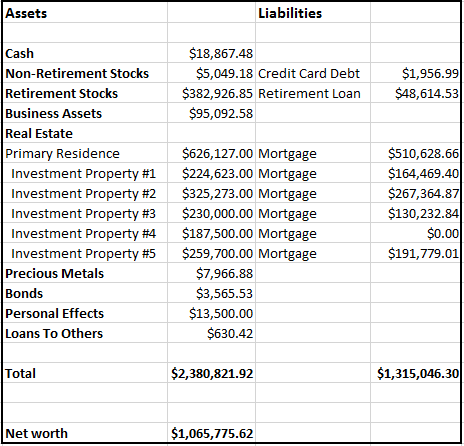
James & I were pretty stoked in October to finally reach the Million Dollar mark!

We were even more fortunate to review our finances at the end of the year and see that we had increased another 3.1% in the last three months, an increase of $33k. Increasing by $10k a month starts to take things to the next level, especially as that starts to compound.

DINKS Dec 2013 Net Worth

This is up a whopping 24% from only last year. Granted, the S&P500 is up 29% this year, so we are actually just shy of keeping up with the market.

Clearly the driver here has been increases in our stock market investments, which are mostly in retirement 401ks and ROTHs.

How often do you review your net worth? Have you seen the needle move this year?

Happy Investing!

Miel

Annual Chore to Keep Our Electricity Bill Affordable

electricity towerThe following is a guest post from Crystal at Budgeting in the Fun Stuff.  That’s where she writes about her bills, saving for the future, and making sure that they fit in fun stuff along the way.

Anyone else feel like they have to keep up the good fight to keep your electric bills from sucking up all of your money?  I look for the best rate possible every time my old contract runs out, which means that I’m locking in new rates every year or two.  I wish I could just blow it off, but just one cent per kilowatt can make a $20 difference to our monthly bills.

Finding a Discount Code

When my husband and I first moved into our own place towards the end of college, I chose an electricity company based on what was suggested.  I never bothered looking for a better rate because I had no idea there were different rates.  Luckily, I learned semi-fast.

Within a year, I figured out that my day job had a special relationship with two different electric providers and used their discount code to get the best rate of the two.  I used that code to lock in a 1 year contract over and over.  Overall, it was a pretty good deal.

Finding the Best Rates

Notice that I didn’t mention that I knew to compare electricity rates at that point?  Yeah, it took a few more years before it dawned on me that just because I had a discount code that gave me a pretty good deal, it didn’t mean that I was getting the best rate possible.  That’s when I went online.  A few quick searches can yield dozens of places to check out the electric providers and rates in your area.  But don’t look only at the per kilowatt rate…

Sneaky Fees

Once I started browsing my options online, I also realized that every company has different policies.  Some companies have amazing rates per kilowatt hour, but they charge little fees for everything.  Company A may charge a fee for using too little electricity each month.  Company B may charge a fee for using too much.  I even saw companies charging fees for making payments or calling with questions.  It’s overwhelming.

Make It Easier

Now I have a system.  I check my current rates before I start popping around online.  I toss anybody that has fees that I consider stupid.  I look at the remaining options, double check for stupid, call my current company to give them a chance to match the better rate if I find one, and then fill out the online form or call to get switched over if I need to.  Overall, it takes me less than 2 hours every 1-2 years to lock in affordable rates.   That’s pretty important here in Houston, TX, where we use our air conditioners from April through November…

How do you keep your rates down?

Photo by lydia_shiningbrightly

10 Bad Money Habits to Avoid in 2014

fancy dinner

Guest post today.

Are you determined to make a commitment to handle your finances better in 2014? If so, there are some easy things you can do this year to avoid financial problems and improve your money situation. These bad habits can trap you in financial stress and make it difficult for you to ever pull yourself out of debt. Below is a list of ten top bad money habits that you should avoid in 2014. Avoiding or breaking these bad money habits will help to alleviate your overall financial stress.

1. Buy Now and Pay Later

Many people tend to buy things on credit and then plan to pay it off later. Over the course of the year, these add up to a lot of interest payments. This is money that you could save or spend on other expenses.

2. Impulse Buying

Buying items on impulse is a problem that many people have. If you find yourself making purchases on a whim rather than thinking them through, you may have to take the temptation away. Remove the credit cards from your wallet so you will not be tempted to buy something you do not need. Spend a few days thinking about the purchase before making a final decision.

3. Dining Out

Do not fall into the trap of eating out too often. Even if you are spending your money at fast food restaurants, it will add up over time. Instead, plan your meals ahead of time and then you will be less likely to want to eat out.

4. Easy Loans

Under all circumstance, you should avoid turning to an easy or bad credit loan, such as payday loans or auto title loans, to help you out. While this may seem like a good solution at first, you will end up spending a lot more money than you initially borrowed. If you are having financial problems, check to see if there is any governmental help available to help you during this difficult time, or see if you are eligible to receive a loan from a bank.

5. Instant Credit Cards

It is always tempting to sign up for a credit card option when the retail store is offering you a certain percentage off your total. This may sound good at first, but another credit card in your pocket is not a good idea. While you may save some money at first, you will more than make up through in interest charges.

6. No Savings Plan

If you have neglected to set up an official savings plan to help you out in case of an emergency, this is the year to start. Have a set amount automatically go into your savings account every payday. Even a small amount will add up over time.

7. Ignoring Debt

While unpaid debt can be overwhelming, it is important that you face your debt and not simply ignore it. Ignoring your debt will only lead to further charges, increase what you owe and damage your credit more. Call those you owe money to and make arrangements to pay it back.

8. Automatic Deductions

Signing up for automatic deductions can be a good idea in some cases. Bills that remain consistent each month or utility bills can be a good idea to pay automatically because it eliminates the possibility of late payments. However, it is vital that you keep track of these bills and make sure all of the charges are correct. Signing up for other type of automatic deductions can be dangerous, especially if you do not keep track of it.

9. No Budget

There is no way to keep your finances in order without have a set budget in place. If you have never had a budget or have not used one for a while, now is a good time to start. Make broad spending categories and determine how much you have available to spend for each category.

10. Minimum Payments

Do not fall into the trap of only making minimum payments on your credit card bill each month. If you do this then you will only be paying mostly interest each month and it will take you a lot longer to pay off. Instead, pay off each month with the total amount you have available to pay.

Photo by ryanrocketship

Is That The One?

momma shopping

[Guest post]

Whenever we are choosing to make a purchase, there is always that moment of indecision. Even on items that we strongly desire, there is that split second of hesitation, that moment where we are not sure if this is the right one for us. Sure it is great value for money, beautiful beyond words, practical beyond belief and will have an eternal life in our *kitchen cupboard/wardrobe/make up bag, (*please delete as appropriate.) But…Is that the one? Is that the right one for me?

Important Purchases

Often the most important purchases that we make are not those born out of desire, they are those born out of need. The need for a roof over our heads, wheels to get us from A to B or finances to keep us on the straight and narrow. Yet these essential purchases often have less of an emotional pull making it harder to get motivated to find the right purchase for you. Particularly if it is something involving numbers and you have hated Maths since you were able to talk!

Getting Started

So let’s start at the beginning shall we? Let’s consider our finances; these are the purchase that make most of us shiver with dread and stammer with indecision, yet things don’t have to be that difficult. Start by finding out exactly what it is that you need. Take loans for example, there are many different types of loans with new terms and conditions being brought out regularly. Do you want your loan secured or unsecured, short term or long term, with one repayment or many repayments?

And Next?

If you aren’t sure what type would be best for you seek advice from online sources such as forums and blogs or make an appointment with a professional such as a financial advisor or your bank. Perhaps speak to your friends and family at this point too. They are not only a great source of support, they may be able to offer advice based on personal experience. Seeking additional opinions helps you to gather a range of information about your potential purchase before you weigh up the pros and cons and form your own opinion.

Finally…

Once you feel like you have all the facts that you need to make your decision, sit down quietly for a while and got through the facts and figures one last time. If everything still adds up, then go for it you’re done! If you’re still not sure then maybe this is not the one for you and perhaps you need to do a bit more digging. Deep breath and of we go to find the right one!

Photo via Flickr: stevendepolo

You cannot copy content of this page