Avatar photo About Kristina Tahnyak

Tahnya is a Certified Financial Planner and former Investment Advisor turned marketing and communications professional She holds a degree from Concordia University, is debt free and currently works in the field of digital marketing.

Friday Roundup: DINKS is Helping You Get Organized!

Good Morning DINKS and Happy Friday.  Today DINKS Finance is helping you get organized both Financially and Personally.  We have rounded up the best posts from around the web about getting organized.

Keep reading for tips and tricks on how to organize your home, your finances, and your life.

Have a great weekend.

– Crazy Sexy Credit helps us organize our paperwork, our finances, and rebuild our credit score in the post “Get Crazy Sexy-Organized Part 4” It is a step by step process to help us get our financial lives in order and improve our financial situation.  Follow her on Twitter @AliLowell

– Minting Nickels talks about organizing her attic and her finances in the post “The Attic, Part 2” Lindy and her husband are big fans of yard sales.  Sometimes they sell their own stuff and sometimes they buy cheap stuff on EBay and resell it at their Yard Sales. Lindy and her husband are a super thrifty family who are always looking for somewhere to make extra money. Follow them on Twitter @MintingNickels

– J. Money discusses how we can organize our money with a personal budget in the post “The Anti Budget, Budget”.  It’s easy to plan a budget, but it’s hard to stick with it.  Be sure to check out this post for ways to help keep your budget on track.  Follow him on Twitter @BudgetsAreSexy

– Yes I Am Cheap shares videos on how to get organized for the upcoming cold winter in the post “Cheapskate Video: Save Money on Home Heating Costs”.  Check out the Home Improvement videos on how to get your home organized for the winter and save money on your heating bills. Follow her on Twitter @yesiamcheap

– Enemy of Debt is currently learning how to get organized in all aspects of his financial life and each week he shares what he has learned with his readers.  Check out the post “Dave Ramsey’s Financial Peace University Week 7” to learn about the importance of Insurance.  Other topics include Cash Flow Planning and Super Saving.  Follow him on Twitter @enemyofdebt

Photo by Striatic

Are the Madoff Family Members Innocent Victims or Willing Accomplices?

Hello DINKS. Today we are discussing a topic that is related to both finance and to couples.  When we are in a couple everything we do or don’t do in our lives is directly or indirectly related to our spouse.  The money we make and the money that we spend affects our spouse.  If we do something wrong in life and it has awful repercussions, we have to be aware that the back lash does not only affect us; it also affects our spouse.


I saw an episode of the Oprah Winfrey show that interviewed the families of convicted Pedophiles.  One of the victims who was abused as a child said that as much as she hates her abuser, she feels bad for his family.  As much as we want to hate on Pedophiles in the media we have to remember that that Pedophile has a wife or a husband.  That Pedophile is a brother or a sister, and they have a family who are also affected by their actions.  This is true for any type of criminal, even financial criminals who commit fraud.

A news topic that we have all been hearing about recently is the trial and conviction of Bernie Madoff and his Ponzi scheme which landed him in jail for the rest of his life. Bernie Madoff’s wife Ruth Madoff and her (surviving) son Andrew Madoff recently did an interview on 60 Minutes.  I watched the interview because I wanted to see how the family of the most notorious financial criminal in history has been living with the loss of their Father and Husband to a life of crime, and the loss of their son and brother to suicide.

The Bernie Madoff Story

Bernie Madoff met his wife Ruth in 1954 in Queens New York; they had two sons named Mark and Andrew.  Bernie Madoff started a Money Management Business while living in Long Island.  Andrew Madoff says that his Dad was a Good Father. He installed good work ethics and family values into both of his sons.  Ruth Madoff says that she and Bernie Madoff lived a moral life and they both knew right from wrong.

Andrew and Mark Madoff grew up to work as Traders for their Father in New York City.  They enjoyed a life of luxury complete with Yachts and homes in both New York and Palm Springs.  The Madoff financial company employed over 100 people, but Bernie Madoff repeatedly told his sons that there would be no succession of the company after he was gone.  Bernie Madoff would not hand off the company to his two sons Andrew and Mark upon his retirement.

The Ponzi Scheme

A Ponzi scheme is a completely fake operation.  Bernie Madoff created phony paper statements that showed profits for his clients, when in fact his company was not profitable at all.  The Madoff Company actually had $50 billion in liabilities, but Bernie Madoff was still reporting profits to his clients.

Andrew Madoff remembers that his father’s way to keep everyone happy was to give them money.  It wasn’t necessarily hush money because Bernie Madoff was not paying off people to keep his scandalous secret; he just kept the money coming in and therefore no one was asking questions.

The Madoff family had an endless supply of cash and therefore they (just like everyone else) assumed that Bernie Madoff’s company was profitable.  There was no need to ask questions or have any doubts about the company’s solvancy.

The Madoff Family: Victims or Accomplices?

In 2008 Bernie Madoff asked his wife Ruth to transfer $10 million from her brokerage account to her personal checking account. Ruth Madoff did not ask any questions because this was not an unreasonable request.  Soon after this transaction Bernie Madoff called a family meeting in his office and confessed to his Wife and two sons that he was broke, and that he had been lying to everyone.

Mark was furious with his father and later turned him into the authorities which led to the arrest of Bernie Madoff.  All three family members claim that they did not know anything about the Ponzi scheme until the day that Bernie Madoff confessed his crimes to them.  To this day Bernie Madoff claims that he acted alone, but I am not sure that I believe him.

His two sons Andrew and Mark Madoff worked for their father but they both claim that they had no knowledge of the Ponzi scheme.  When Bernie Madoff was offered bail his wife Ruth asked their son Andrew to co sign a $10 million Bail Bond, but Andrew refused.

The repercussions for the Madoff family have been horrible, and I do feel bad for them; but that doesn’t mean that they had no knowledge of Bernie Madoff’s “bad” business.  Mark Madoff could not bear the backlash of his father’s shame, and on December 11th 2010 he committed suicide while his wife and daughter were away on a vacation.

Andrew Madoff’s (the surviving son) assets have all been frozen pending an investigation into his involvement in the Ponzi scheme.  Andrew Madoff’s current net worth is approximately $60 million.  Since Bernie Madoff’s arrest Andrew’s wife has changed her last name, although they still remain married.  It is interesting to know that Ruth Madoff also still remains married to Bernie Madoff, even though he will spend the rest of his life in jail.

The Bernie Madoff Ponzi Scheme has definitely impacted his family and the financial world forever.  My question to you DINKS is… Should Bernie Madoff be the only person punished for the Ponzi scheme?

5 Investing Tips for People of All Ages!

investing tips, investing advice, stock market tips

thumbs up man
Good Morning DINKS.  Today we are discussing easy investment tips for investors of all ages.  If you are new to investing or you are a veteran then these tips can help you be successful while investing.  Just because we have been investing for a long time doesn’t mean that we know what we are doing.  The truth is that many long time investors often make rookie mistakes.

Investing does not have to be complicated.  Actually investment basics are very simple and they apply to all levels of investing.

Check out these 5 Successful Investing Tips for Everyone:

  1. Buy and Hold.  No strategy works better than the buy and hold.  It is a lot of work to try and pick the correct investments at the correct time when we try and time the market. It can also be very stressful to watch our investment accounts on a daily basis.  Once we decide which investment to buy we should stick to our strategy and hold it through the market ups and downs.
  2. Buy in When It’s Low.  If you see red don’t get angry, just buy in.  It is a natural reaction for people to be upset when they see the value of their investments declining.  However when the market is down we have to think of the investment cup as being half full.  When the market is low it is a great time to buy investments.  It is true that when the market is down our existing investments may be declining in value, but it also means that we can buy new investments at a very cheap price.
  3. Invest Regularly.  Dollar Cost Averaging is a successful investment strategy.  It allows us to continuously buy into the market when investment prices are both high and low.  Dollar cost averaging helps us average out the cost of our unit price and therefore it makes more profit when the market increases.
  4. Invest For the Long Term.  Short term fluctuations in the market are normal, we shouldn’t panic.  We must stick to our original investment strategy and stay invested for the long term.  When we receive our quarterly investment account statement we should not panic when we see the value of our investments dropping.  The market functions in cycles and we will gain back our losses.  Successful investors invest for the long term.
  5. Always Diversify Your Investments.  We should always have a mixture of fixed income, equity, foreign, and domestic investments.  The reason that diversification is a successful investment strategy is because we have a little piece of all the pie.  If our hands are in every cookie jar we can make gains in one investment if the other is losing.  Diversification hedges our investments against our potential losses as the market fluctuations and moves through the cycle.

Photo by Sound from way out

DINKS Dilemma: Rich and Single or Poor and In Love?

dinks dilemma, couples advice, singles advice

Good Morning DINKS.  Today I would like to discuss our DINK morals and a choice that hopefully none of us will ever have to make.  As DINKS we are all in a Dual Income Relationship without Kids.  This means that we have double the revenue coming in and we do not have the big expense of raising children.  But, what if your spouse didn’t work.  I am not talking about your spouse losing their job; I am talking about getting into a relationship when one of the two people is not working.  Would you enter into a relationship that doesn’t have money?

Some people say that money can’t keep us warm at night but our spouse can.  Is it more important to you to have someone to share your life with, even if that person is broke; or do you prefer to be financially well off because it is actually money (not marriage) that makes you happy?

Couples and Marriages break up all the time over money (among other things).  This leads me to believe that money is more important than love because if we really truly love our spouse than money wouldn’t be an issue.  Although I do have to admit that my boyfriend Nick and I do argue (indirectly) about money.  When we sit down and think about it almost everything, whether directly or indirectly, always revolves around money.  However I don’t think that I would ever leave my boyfriend over money because my love for him is stronger than my love for money; but I can’t say that I would ever start dating someone who didn’t have a job.

There are so many other aspects of a relationship, such as compatibility, similar interests, family values and long term goals that can cause a new (or old) couple to break up.  When we add money into the mix things just become more complicated.  I admit that money can be a very stressful subject especially if we don’t have it.

The reason I bring up the subject of money and marriage is because I have a friend who recently started dating a new guy.  They have been on a few dates over the last couple of weeks and only recently she found out that he doesn’t actually work.  She seems to really like him but she isn’t sure that she can be in a committed relationship with a man who doesn’t make any money.

For the time being it is ok that he doesn’t work or earn an income because their relationship is still new, but if they were to become serious my friend doesn’t want to be stuck always paying the bill for everything.  The guy has a Bachelors Degree and he should have no problem finding a job, but my friend is always worried about the “what if”.  What if he doesn’t find a job, what if she ends up paying for their mortgage, groceries, and other monthly bills?

It may be better for my friend to break up with the guy while their relationship is still new and they are not too attached to each other.  Two years down the road when the couple is emotionally committed to each other it may be harder to walk away if money is still an issue.

DINKS I ask you, if you were not yet in love, would you enter into a relationship if the other person didn’t work?

Photo by Ma1974

Is Price Always the Bottom Line?

price of items, pricing, merchandise prices

As DINKS we all make money and as normal people functioning in society we also all spend money.  Sometimes we spend money on things that we like such as vacations and personal items and sometimes we spend money on items that are necessary to live such as food and housing.  My question to you DINKS is when you choose to spend money is the price always the deciding factor?

If you are saving for your retirement, is the price of a stock a deciding factor when you are choosing which investments to buy? Normally the price of a stock should not be a deciding factor.  The company’s performance , the stock dividend payout, and the daily fluctuations in the value of the stock should all be deciding factors, but the price of a stock really isn’t the issue.  There is no point in buying cheap stock if the company is not sustainable and we don’t make a profit.

Before you become a DINK did you live with a roommate?  If so, was it because you would be lonely living alone or was it because you needed someone to share the monthly expenses.  I lived with a roommate for the first year that I moved away from home. Living with a roommate was more of a hassle and inconvenience than anything else.  However, it was cheap living while I was on a student budget.  The next two years I lived on my own and it was quiet at times, but I really liked having my freedom and my own privacy.  After that I moved in with my boyfriend Nick and the rest is history.

Now Nick and I we share all of our expenses, we even share the monthly expenses if we don’t share the amenity.  That is the benefit of living with a spouse and not a roommate.  Your spouse may feel obligated to share all expenses (or maybe they do it out of love), but a roommate has absolutely no obligation to share expenses if they amenity is not mutual beneficial.

Think about the last time you bought a gift.  When you narrowed it down to two gifts was the price of each gift the deciding factor when you chose which gift to buy? When you go shopping for a birthday, anniversary, or graduation gift do you shop with a budget in mind, or do you just shop for the perfect gift?

Think about your last trip. Was your last travel destination decided by the cost? If you were choosing between two cities or two hotels was price the deciding factor in your travel destination? Of course we all like to get a great deal, in an ideal world we would take a fabulous five star vacation at a two star price, but those types of deals just don’t exist. So DINKS I ask you, whenever you make a decision is the cost always the bottom line?

Let’s stop discussing our spending for a moment and look at the opportunity cost of our working environment.  How much crap do you tolerate at work?  And if your working environment is less than ideal do you only tolerate it for the pay check?  I love my job now, but my previous working environment was definitely less than ideal.  Although I admit that I tolerated a lot of unpleasant activities in my office because the pay check (at the time) was worth the cost of my personal sanity…for a little while.

What about your friends? Do you socialize with other couples who are in your same income bracket? Do you spend your free time with other people who have the same spending habits as you? If you are a saver do you have frugal friends? If you enjoy spending your money on life’s little luxuries, do your friends also enjoy the finer things in life?

I think it is safe to say that for many of us (whether we willingly admit it or not) price, cost, and money are always the deciding factor in our lifestyle and everyday choices.  Some of us may not even realize it but price is always the bottom line.

(Photo by Zoetnet)

Weekly Round Up: Food, Cooking, Eating Out and Restaurants

Happy Friday DINKS.  November if finally here and this means the holiday season is quickly approaching.  Halloween is over, Thanksgiving will soon be there and then it will be Christmas Time.  I love the holiday season, mostly because I love eating.  I also love the weather, I love spending time with family and friends, and I also love having time off work; but mostly I’m just into the holidays for the food.

Check out these great posts we have rounded up relating to food from around the web:

– Money Crashers helps us plan our weekly menus and keep our budget in tack at the grocery store in the post “10 Family Meal Planning Tips & Ideas on a Budget”.  Planning ahead is definitely a money saving tactic.  Before I go grocery shopping I make a list of all my meals for the week; I try to make 2-3 meals that require the same ingredients so I can cook on a budget.

– Get Rich Slowly talks about the love of chocolate and the cost of celebrating Halloween in the post “The Great Cost of Halloween Chocolate”.  Halloween can definitely be an expensive time of the year when we calculate the cost of costumes, decorations, and candy.

– Young and Thrifty gives us tips on where to eat good food in the post “Cheap and Good Eats: Daily Kitchen Edition” Daily Kitchen is a restaurant that changes it menu daily.  This can be both a blessing and a curse.  You can never eat the same meal twice, but if you really loved a plate you may not be able to get it again.

– So Over Debt shows us the signs of a dedicated save-a-holic in the post “6 Signs You’re Too Poor to Shop at Wal-mart”.  Everyone should read this post, just to see if you have ever been so broke that you walked across a massive Wal-Mart store just to save 0.30, I know that I have.

– Brooklyn Bitches on a Budget is known for living a big fabulous life on a small budget in the great borough of Brooklyn.  It’s no secret that I want to live in NYC and Brooklyn would be my first choice of where to live.  These bitches often share their delicious budget recipes.  Check out their post “Big Fat Ginger Cookies”.

– K Cooks So Can You offers great recipes for busy people, families, couples, and friends.  I have already made the “Guacamole – aka How To Win Friends” and it was delicious. I am a huge fan of Guacamole! I also love the “Monday I’m MUCH too busy to cook but really should Supper”.  Be sure to check out her blog for great meal ideas and great recipes.

Photo by TinouBao

Life Insurance: Do You Have It? Do You Need It?

life insurance decisions, life insurance tips, life insurance advice

Good Morning DINKS.  Today we are talking about a subject that has always been controversial in Personal Finance; today we are discussing the benefits and features of Life Insurance.  Last Thursday as I was watching The Big Bang Theory on CBS I saw 3 different life insurance commercials…in a ½ hour TV show.  It made me start to think…is Life Insurance really needed by the masses like shampoo or deodorant?  As a Financial Planner I personally don’t sell Life Insurance to my clients, but I do take it into consideration when I am preparing a Financial Plan.


Life Insurance is an important aspect to our Estates and therefore we have to consider the option of having life insurance when we are drafting a Will For many years there has been a debate as to whether purchasing Life Insurance is a smart idea or a sucker’s investment.  Some people don’t want to buy Life Insurance because they pay the premiums while they are alive but they don’t get to enjoy the benefits after they are gone.  Some other people buy Life Insurance because they feel it gives them the peace of mind that their family will be provided for in the unforeseen event of their death; and for some people family is priceless.  I personally believe that Life Insurance can be an important part of our Financial Lives, but it all depends on the reason why we are purchasing the Life Insurance Policy.

My Grandparents never purchased Life Insurance on themselves or on each other because they felt it was bad luck.  My Grandfather always said that he never purchased Life Insurance because he didn’t want to die.  Unfortunately at one point or another we are all going to pass away.  My Grandparents felt that purchasing Life Insurance would speed up the process.

Life Insurance should be purchased to protect assets in the event of death.  Many people do not hold individual Life Insurance Policies but they do have Life Insurance on their assets such as their Home, Car, and Cottage if they have a loan outstanding against them.  If we don’t have assets but we have debts Life Insurance can be a way for us not to leave a financial burden on our families after we pass away.  If we have assets that do not have loans attached to them, and we do not have debts, we may not need Life Insurance.

I have a coworker named Dave who works in personal finance and he is still not convinced that Life Insurance can be a good financial strategy.  He repeatedly (almost daily) tells us how insurance is the biggest profit making industry in Finance and anyone who buys life insurance should save their money and play Black Jack.  In Dave’s eyes when it comes to Life Insurance the house always wins because everyone pays premiums but not everyone receives the benefits of their Life Insurance Policy.

This may be true for Term Life Insurance Policies.  Term Life Insurance is purchased for a specific period of time such as 5, 10, 15, or 20 years.  Throughout the term the insured pays the Policy Premiums but if they don’t die within the term no one receives the policy money.  So what do you think, is buying Life Insurance a Gamble or a Good Bet?

Life Insurance can be used to provide cash flow to a family in the event of the loss of income from the Head of Household.  If there is only one spouse working in the home they may buy a Life Insurance policy to guarantee that the surviving spouse continues to receive a monthly income in the unfortunate event of his or her death.

Some people buy Life Insurance to leave a financial legacy behind after they have passed away.  As a Financial Planner I often see Grandparents leave a financial legacy for their Grandchildren’s Education.  In Personal Finance we always advise clients that the Life Insurance premiums should be worth their cost.  Insurance should always be for protection, not profit.

————
(Photo by Gareth1953)

Where You Should Be Investing Your Money!

investment tips, investment advice, stock market options

finger pointGood Morning DINKS, I hope that all is well today in your neck of the woods, suburban home, or metropolitan concrete jungle.

As market fluctuations are still a part our daily lives and changes in the value of our Investment Portfolios are still inevitable, investors are looking for alternative Investment options.  But the truth is that the market is what it is, and no one is going to invent a new type of investment. Investment options will always be Cash, Fixed Income, and Equities.  The asset allocation that we choose in our Investment Portfolio is the most important aspect, not the individual investment options that we choose.

We have to keep our long term strategy in mind when we experience market fluctuations in the short time.  We have to see the low stock prices as an opportunity to buy, not as a constant thorn in our side.  Now is not the time to make changes in our investment portfolios if they are currently at a loss because then we will realize this loss.  For now the loss is just on paper and just leave it right where it is!  If your short term investments have also taken a loss in recent years then I am sorry to say but you received bad advice.

As a basic (and very generic) rule of thumb Investments with a time horizon of less than a year should always be invested in cash, a medium term time horizon of 2-5 years should be invested in fixed income assets such as Bonds, Mortgage Backed Securities, and Real Estate Trusts, and a long term investment time horizon of 5 years and more should invest in Equities both Domestic and Foreign.  However this is of course a general guideline.

This past week I had a client come into my office and ask for the Best Investment that gives s security, flexibility (meaning access to the money at any time), and a good rate of return. I explained to him that no such type of investment exists.  He would have to pick two of the three criteria and we can explore his options from there.

Which two criteria are the most important for your personal investments?

If you want Security and Flexibility: The best investment option for you may be a High Interest Savings Account or a Money Market Mutual Fund.  Both of these investments pay interest on a monthly basis.  Savings Accounts are a no risk investment option, and Money Market Mutual Funds are a very low risk investment option but they are never guaranteed.  Both of these accounts give us access to our money at any time.  However, there may be up to a 3 day delay in selling our Mutual Funds, while we have instant access to the money in our Savings Account.

If you want Flexibility and a Good Rate of Return: Invest in Fixed Income Mutual Funds such as a Real Return Bond Fund, a Monthly Income Fund, or a Mortgage Fund.  Mutual Funds offer us the flexibility of accessing our money at any time with the potential of a higher rate of return than a basic Savings Account.  If the uncertainty of your rate of return is unsettling then I suggest you invest in a Flexible Long Term Guaranteed Investment Certificate (GIC or Term Deposit).  The Long Term GIC option will give you a higher interest rate and the flexibility will give you the option to cash it out (fully or partially) once a year (usually on the anniversary date).

If you want Security and a Good Rate of Return: If you don’t need access to your money then you may want to invest in Market Linked GICs.  These are Guaranteed Investment Certificates that offer security of your capital investment along with the potential higher rates of return based on the performance of a Stock Market Index.

(Photo by Purpleslog)

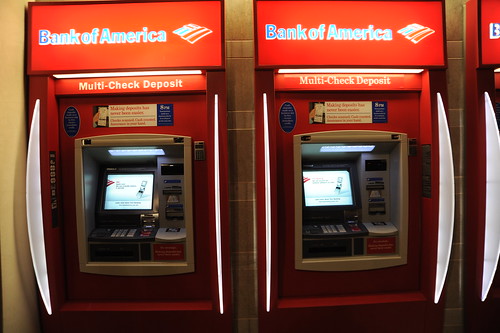
Friday Roundup: Bank of America, BOA, and Bank of America ;)

bank of america atms

Good Morning and Happy Friday DINKS.  As I was surfing the next this week looking for the best posts to add into our Weekly Roundup I noticed a huge amount of posts about the Bank of America.  It seems that BOA has rubbed many clients the wrong way over the past few months.  Bank of America has lacked so much on their customer service that clients (aka Financial Bloggers) feel the need to write blog posts about it online.

I personally do not have anything against the Bank of America, but it appears that a lot of people do.  Maybe the reason that I have nothing against the Bank of America is because I have never actually been their client.

Check out what these Personal Finance Bloggers had to say about Bank of America:

– Frugal Dad talks about the instability of banks in the post “Bank of America in Trouble – Is It Still Safe to Keep My Money In a Bank?  I totally love it when news headlines report that companies are having sustainability problems, then the company announces that they will be cutting thousands of jobs, and then they finally announce that the financial institution made billions of dollars in profits last quarter…Yes I totally love that.

– Yes I am Cheap talks about her credit score, her Mom, and her favourite financial institution in the post “F*ck You, Bank of America.” She got the run around from BOA which caused her many hours of frustration as well as a family rift between her and her Mom.  Financial Institutions do not always understand that sometimes money is a family issue, and sometimes the Financial Institutions decision affects more people than just their client.

– Wise Bread discusses bank profits and bank fees in the post “Is Bank of America’s $5 Monthly Debit Card Fee Just the Beginning?”  Banks always feel that the best way to earn more profits is to cut jobs (salaries) and increase fees.  However, in my opinion the best way to earn more profit is for CEOs to give up their extravagant lifestyle, salaries, and bonuses which are all directly paid by the Banks profits.

– Budgets Are Sexy J. Money’s brother talks about his negotiation struggles while trying to renew his mortgage in the post “How Bank of America Made Me Bald.” This post is interesting because usually banks are dying for mortgage business.  However, J. Money’s brother had a chaotic experience complete with incompetence, poor customer service, and a lot of frustration.

– New York Times talks about the financial institutions 3rd quarter results, profits, and job cuts in the post “Bank of America Corporation.” I love this post because it is not anyone’s opinion, it is just the facts.  Profits are up and jobs are being cut and that’s just the way it is at Bank of America.

Photo by Wonderlane

Our Financial Personalities: Do you love “stuff”?

financial personality, financial tips, financial discussion

coinsLast week I went to Toronto to see my Mother for a belated (Canadian) Thanksgiving celebration.  While we were shopping she was willing to spend $200 on a new handbag, and she almost did it, but thank goodness she controlled herself.

I am trying to live a less materialistic lifestyle where I save more and spend less on “stuff” but this is typical behaviour from my Mother.  She and my Step Father are Re-DINKs.  They each have two kids but none of us live at home any longer.  Her new DINK life allows my Mother the freedom to spend her money as she wants.  She now has the luxury to enjoy the finer things in life if she chooses to do so.

My Mother Spends Her Money on Enjoyable Assets

My Mother is not yet ready to retire but she has accumulated enough retirement savings that she really doesn’t need to save a lot more on a regular basis.  If we combine the lack of need for savings as well as the fact that she no longer has children to provide for she can basically spend her hard earned money on herself.

My Mother chooses to spend her money on material goods that are also a good investment.  I understand that an $85 wallet and a $200 handbag are not good investments but those are exceptional purchases.  My Mother and her husband usually spend their money on enjoyable assets and life experiences.

Enjoyable investments are assets that they can enjoy now but will appreciate in value over time.  My Mother’s enjoyable assets include Art Work, remodelling their Home and a Summer Cottage.  As a Financial Planner I encourage clients to save for their future; we have to understand that this doesn’t always mean keeping money in the bank. Saving for our future can include accumulating enjoyable assets.

My Dad Spends His Money on “Stuff”

Although I am no longer close with my Dad I couldn’t help but think about him while my Mother was contemplating the purchase of her new handbag.  I thought to myself that my Dad would never spend $200 on one single item because he would be calculating how much other “stuff” he could buy with $200.

My Dad has the exact opposite spending habits of my Mother.  My Dad loves to fill his house with “stuff”, even when my Dad upgrades or replaces his current “stuff” he doesn’t throw out or get rid of his old “stuff”,  he just keeps accumulating more “stuff.”

My Dad is proud to show off his home and his collection of “stuff” to everyone and anyone who visits.  He built a shed to store all of his “stuff” when he moved into my Step Mothers home. My Dad moved into HER house and SHE didn’t want any of his “stuff” in HER home.

My Dad’s collection of “stuff” includes everything from several irons to multiple televisions.  My Dad spends money on getting good deals and he definitely shops on a budget.  He doesn’t like to pay full price for anything, but that is mostly because he can’t afford it.  When my Dad finds a good deal on something whether it is groceries or t-shirts he always buys them in mass quantities. My Mother has a different shopping strategy.  She tries to buy the items that she needs while they are on sale, but at the end of the day if my Mother needs something she will buy it regardless of the price.

Quality is more important to my Mother than Quantity.  Unfortunately I can’t say the same for my Dad.

Photo by Portable Antiquities

You cannot copy content of this page