
Why You Might Need Life Insurance (Even if You Don’t Have Kids)

life insurance, securing the future, life insurance policy

life insuranceWhen it comes to life insurance there’s a big misconception that if you don’t have kids you don’t need coverage. This couldn’t be farther from the truth.

In fact, there are many instances when singles need insurance and even more cases where DINKS need coverage.

So today I wanted to take a look at the reason that you might need life insurance even if you don’t have kids.

You Have a Spouse Who Depends on You

DINKs are two income families. And if you have a partner who depends on your income to pay the bills, especially debt like a mortgage, then you definitely need coverage.

You don’t want to leave your partner in a pinch if something would happen to you. It’s going to be hard for your spouse to adjust to life without you without even considering finances.

The last thing you want to do is leave even more of a burden on your loved ones.

According to a recent study conducted by State Farm, the top three feelings evoked by Americans when they think about a life insurance purchase are protected (36 percent), confident (22 percent) and relieved (21 percent).

If you want to feel confident about your family’s financial situation then determine the amount of life insurance you need and contact your agent. You might be surprised at just how cheaply you can obtain coverage.

You Have a Co-Signer on Your Debt

Have you taken out a student loan, car loan, or other type of debt but needed a co-signer to be qualified? While it’s nice to think that your debt dies with you that doesn’t happen when there’s another guarantor on your loan.

Whoever cosigned for your debt is going to be on the hook if something happens to you.

If you have no one else depending on you, you should at least get life insurance for the amount of debt you have a co-signer on. You don’t want to be a financial burden to the person who was willing to help you out.

You Want to Cover the Cost of a Funeral

Funerals aren’t cheap. In fact, the most recent data from the National Association of Funeral Directors reports that the average cost of a funeral is around $6,600.

If you know your loved ones won’t be able to easily afford this cost you can cheaply obtain a life insurance policy with that amount of coverage.

Plus, you’ll find peace knowing that you’re not causing financial stress to your family.

What Are Some Other Reasons?

Life insurance is not just a financial tool for married couples with children. The fact is, we all have different needs. Some of us need a lot of coverage to feel protected while others can get by on very little.

Examine your individual situation to determine how much coverage is right for you. Then call your insurance agent or visit Good Neighbors to learn more about life insurance.

Having life insurance will round out your financial plan and give you the peace of mind you deserve.

Do you have life insurance? If so, what made you decide to get it?

Disclosure: This blog post was written as part of a sponsored program for State Farm to raise awareness about the importance of life insurance. All views expressed are entirely my own, and were not influenced or directed by State Farm. You can learn more about this blogger program and life insurance at GoodNeighbors.com, PlantingMoneySeeds.com, and by following #StartLiving on Twitter.


How B2B Marketing Differs From Consumer Marketing

graphBusiness-to-business marketing is a remarkably different beast than consumer marketing, even though their aims are quite similar. While successfully selling a product or service is the eventual goal of any marketing campaign, the machinations of how you go about that selling are vastly different when you’re selling to other businesses as opposed to individual consumers.

Every supply chain includes a large and reliable amount of business-to-business commerce. From the manufacturing of t-shirts to the manufacturing of flag decals that adorn a world-traveling vehicle, businesses couldn’t be or stay afloat without selling to and buying from other businesses. If you’re looking to do a better job of selling within the supply chain, you need to familiarize yourself with the ways in which marketing to businesses differs from marketing to consumers.

B2B Markets Are More Complicated
When it comes to selling to consumers, the decisions made around purchasing rarely involve more than one or two people. From products for the home to clothing and entertainment, marketing efforts that are targeted at consumers can aim at the individual. Business-to-business markets, on the other hand, usually involve a complex system of individuals, teams and cost-benefit analyses that must all be taken into consideration, and unlike households and individual consumers, the players in that complex B2B system may move in and out of it as people change jobs, get promoted and the like. B2B marketing must appeal to this complicated system and the differing people within it.

B2B Buyers Are Less Whimsical and Emotionally Driven
Consumers often make buying decisions that are impulsive and driven by emotion. It’s why grocery stores put magazines and candy in the checkout lanes. Business-to-business buyers rarely act on the spur of the moment, and hard facts and analyses — not emotions — drive behavior. This difference exists because consumers don’t have to make their purchases pay for themselves in the end, whereas B2B markets rely on profits to stay in business. For the B2B buyer, every purchase has to benefit the bottom line. B2B buyers respond to marketing that’s tied to well-made products and services that will increase their own sales.

B2B Products and Services Are More Complicated
Consumer products and services are usually much simpler than the products and services being purchased in a business-to-business relationship, and even when a consumer does buy a complex product — like a car or computer — very little expertise is required to make the decision or use the product. B2B products and services, on the other hand, are purchased by experts who not only have to fully understand what they’re buying, they also have to understand how it fits into their own companies operations and aims. Your marketing must reflect this complexity.

Personal Relationships Matter Moreshake
When a consumer needs a new pair of jeans or a smartphone, she doesn’t rely on a personal relationship with the one selling those items when it’s time to make a purchase. B2B markets, on the other hand, rely heavily on personal relationships that are built over time and mutual success. Not only does this make business-to-business markets more loyal, it also makes the people marketing, selling and buying within them more valuable. Especially in supply chains that involve multiple countries, being able to trust someone with whom you are on a first-name basis that their new product or service is going to work for you is the best marketing money can buy.

B2B Buyers Want to Buy
Consumer marketing is filled with products that people might like to own but that they probably don’t need. To that end, it aims at pleasure, identity, envy and the like in order to makes sales. B2B buyers, by contrast, want to buy and need to buy in order to stay in business, and competition dictates that they do so wisely and regularly. Marketing to B2B buyers then, can assume that the product or service is wanted, all you have to do is convince them that you — and not your competitor — are the one from whom they should buy.

B2B Buyers Are More Knowledgeable
It’s not unusual for B2B buyers to know as much about the product or service you’re selling as you do. In some instances, because they actually use it, they may even know more. Because of that expertise, business-to-business copy has to be research-driven in terms of the product, the markets it’s used for and its applications. Oversimplification, jingles and logos may work on consumers, but they definitely won’t work in B2B marketing situations.

Marketing is only effective when it knows its audience and tailors its efforts accordingly. B2B marketing — because the business buyer differs so widely from the individual consumer — is necessarily most effective when all the needs, knowledge and complexity of its audience is taken into consideration.

How to Invest for Short-Term Goals

soldWhen you think about investing, you probably think about putting money away for the future — 20, 30 or 40 years from now. It’s true that investing is a wise way to grow your wealth over the years and help you meet big financial goals like sending your kids to college or funding your retirement.

However, it can also help you save for short-term goals — those things you’d like to have money for within the next 10 years. Such goals could include making a down payment on a house, paying for a wedding or funding the vacation of your dreams.

When you invest for the long term, you can afford to take more risks with your money because you have more time to recover from market downturns. But when you’re investing for the short-term, you’ll want to play it safer. You don’t want to save diligently for your kids’ college or your dream wedding only to have the market tank a few months before your goal date, leaving you with nothing. More secure vehicles for short-term investment include money market funds, bank loan funds, bonds and CDs. If you’re investing for a goal that is three to 10 years in the future, you may to add some stocks to your portfolio.

Creating a Short-Term Investment Strategy
You should focus on two things when investing for a short-term goal — security and liquidity. Your money needs to be both safe and easy to get to. That means you need to invest in short-term vehicles that allow you to easily withdraw your money, and that aren’t subject to the whims of the market. That means bonds and bond funds. You’ll get a lower rate of return on these types of investments, but since you’re going to use the money fairly soon, you won’t have to worry much about inflation.

If you are going to invest in stocks to save for a short-term goal, your goal should be at least five to ten years away. Keep a close eye on your investments so you can move your money if your stock value starts to drop. Decide ahead of time how much money you can stand to lose from your stock investments — 10, 15 or 20 percent, for example — and make a commitment to sell if you reach that threshold. As your goal draws closer, you’re going to want to move your money into more secure investments or even into a savings account.

Certificates of Deposit (CDs)
You’ve probably heard of CDs — most banks sell them. They’re insured by the FDIC, just like bank accounts. Many short-term investors like them because you know exactly how much of a return you’re going to get from a CD — you’re guaranteed a specific rate of interest. However, you must also hold CDs for a specific period of time before you can redeem them, anywhere from 30 days to five years.

Money Market Accounts
A money market account is also insured by the FDIC. It’s like a savings account, but it earns a higher rate of interest. You’re also able to write a small number of checks from it each month — usually no more than six. This makes it one of the easiest investment vehicles for folks who need to be able to access their money whenever they want. Since a money market account earns interest the same way a savings account does, you don’t have to buy shares in it. If you want to buy shares, however, you can invest in a money market mutual fund instead.

booksBank Loan Funds
Bank loan funds invest in bank loans funded by corporations. They offer a relatively high rate of return, compared to some of the other options discussed in this article, but they can be risky especially if the economy slows. They may also carry relatively high costs and expense ratios. You’ll also need to plan carefully when you withdraw the money, since you may only be able to get to it once per quarter.

Bonds
There are several kinds of bonds that can help you reach your short-term investment goals. These include ultra-short bond funds, which invest in Treasury bonds, corporate bonds and mortgage-backed bonds. They mitigate risk by investing in short-term securities, and usually have a term of about six months, so they’re not as vulnerable to interest-rate changes as some bonds.

Short-term municipal bonds are another option. They’re more vulnerable to interest rate changes, and they’re exempt from federal income taxes. If you need a short-term investment with more security, you might consider U.S. Treasury bills, which carry terms of 13 to 26 weeks and are backed by the federal government. They’re as secure as savings bonds, but without the 30-year wait.

Bonds, CDs and money market accounts are all great low-risk ways to invest for short-term goals. If you’re investing in stocks for a goal that’s five or 10 years in the future, watch these investments closely. In any case, be prepared to move your money into a safe and easily-liquidated vehicle as your goal date approaches.

Is Your Company doing their Best to Retain You?

Even in the current job market, hiring employees is a challenging process from the short-listing of candidates to the training of new hires for their jobs. The organisation invests its resources, such as time, effort and money, to find the right people for the right jobs at the right time!

As such, employee retention is of crucial importance to employers considering the resources invested in the process from hiring to training, not to mention the possibility that the employee will apply his knowledge and skills for the competitors’ benefits. Of course, employees also benefit from their employers’ retention program because of the salary, bonuses and benefits, and career advancement opportunities.

But what happens when you feel undervalued as an employee? Will you continue with your employment especially with the scarcity of jobs in many sectors or will you stay in your job whilst looking for ways to feel more valued?

Both Sides to Blame
In case of employees feeling undervalued by their employers, both sides – the employee and the managers – share the blame for the experience. As an employee, you can easily lay the blame on your managers’ failure to provide the appropriate incentives, including monetary rewards and non-monetary recognition, for your greater productivity. You can blame others for your feelings of being undervalued.
As a manager, you can also easily lay the blame on your subordinates. You pay them to do what they have to do, after all, so they must work regardless of the environment. Get yourself in your managers’ shoes and you will probably be thinking along the same lines.

Signs to Look For
There’s also the consideration that you may not actually be undervalued (i.e., perception against fact). To clear up the confusion, you should pay closer attention to the following signs that increase the likelihood that you are, indeed, undervalued by your employers and managers.
• You are kept out of the loop especially when it comes to the bigger picture (i.e., the relevance of your tasks to the organisation).
• You are relegated to routine tasks below your knowledge, skills and capability for professional growth.
• Your good work remains unappreciated even when your co-workers garner praise for apparently mediocre results – or even for good results while still skipping your table, so to speak.
• Your opinions and ideas are unwelcome, much less solicited for, by your managers and employers.
• Your career advancement opportunities have apparently dried up so much so that you are being bypassed by others on the hierarchy.
You should be able to feel it in your gut when you are, indeed, undervalued.

Steps to Take
• But don’t make hasty decisions either. You must carefully consider your next moves by keeping these tips in mind:
• Give your managers the chance to discuss the issues and solve the problems since there may be ways to stay in the company.
• Weigh the pros and cons of leaving your job.
• Honour your existing commitments regardless if these are in a contract or not but avoid taking on more projects.
• Talk to your mentors in and out of your office.
• Find ways to exit your job with dignity but avoid burning bridges with your managers and colleagues.

Your final decision should, indeed, be yours to make and take.

At Morgan Hunt, their highly specialist teams maintain in-depth knowledge of their sectors. They work closely with both clients and candidates to offer a consultative approach in order to expertly match candidates across a broad range of disciplines with their ideal job.

Disputing Debt: Stop Paying What You Don’t Owe

debt graffiti

We hand the credit card to the waiter and give it nary a thought while the faceless service worker takes our card away for, what on reflection, seems like an unnecessarily long time, and charges us an unreasonable amount (was that Pepsi really $5?) that we just pay without questioning. On top of that, we feel socially obligated to tack on 10% to 15% more than the price of the meal as a gift to the waiter for the extraordinary service of not being rude while doing their job.

Why do we uncritically pay too much for things? Many restaurants do not provide itemized checks. So we do not even know what exactly we are paying for. This kind of social conditioning is costing us money in far more consequential areas of our lives. And it is past time that we stop the madness.

When a person’s credit falls into disrepair, they become susceptible  to overpaying for debt they did not incur. But that can be a hard thing to prove. And even if provable, it seems difficult to fight. They have a room full of attorneys to support their case while you have none. Even one attorney on your side can even the score. What you need is an attorney that can help you with your credit dispute letter.

It is easy to let yourself be overcharged because:

  • You know you owe a lot of people money and have lost track of the amounts
  • You stopped caring about the amount because the situation seems hopeless
  • You never knew the full amount because of intentionally confusing payment terms

Fortunately, there are ways to turn things around and stop getting overcharged:

Ask for an Explanation and Reduction of Bills that Seem Too High

It seems like some companies ought to be ashamed of themselves for what they charge for products and services. As it turns out, they often are. They charge the way they do because customers let them get away with it. You don’t have to let them get away with it. You can confront them, and often get recompense for ridiculous charges. This tragic story about a horrendous injury to a dog, and the ultimate costs, provides an example of how it is done.

After a visit to the vet and an emergency clinic, the traumatized dog owners had a bill of $9,000. $900 of which was from the family vet. When the reality of the bill hit them, they decided to look at the bill more closely. As related in the article:

“I went into the vet office and asked to speak with whomever would go over the bill. For 30 minutes, I told them I would not pay their crazy prices. They charged us $200 per dog just for shaving their wounds. They used a freaking electric razor! It took them a few minutes to do each dog. The emergency clinic even told me they had to do it again because the shave was not good. Nope, not paying full price!”

He goes on to talk about other outrageous fees for products and services. The upshot is that he got half of the $900 bill removed. The hospital refused to budge, however. Even so, just confronting companies with the absurdity of what they are doing can pay dividends.

Another example can be found in the plethora of stories about outrageous fees charged by cell service providers to travelers foolish enough to think they could use their phones overseas for similar prices as they do at home. They discovered that minor cell use while traveling could cost them thousands. Those fees were often retroactively reduced when the provider is confronted with them. It pays to confront serial overchargers.

Check Your Credit Report

This one is easy and obvious. You can’t delete your spam faster than free credit report offers can fill it up. While the methods of making you aware of this service are sleazy, the idea is good. Just because you don’t like the used car dealer does not mean you don’t need a used car. Keeping track of your credit report will allow you to see disputable charges near the time they happen. You can’t dispute it if you don’t know about it. Stay informed. Creditors make mistakes all the time.

Dispute the Unfair Debt

If you don’t dispute it, you own it. Fortunately, there is a process that enables you to dispute debt. Furthermore, disputes are very winnable. The burden of proof is on them, and they have a limited amount of time to present that proof. If you really don’t own it, the odds are in your favor of not having to pay it.

It is hard enough to keep up with the debt you rightfully owe. Never pay for debt that you don’t.


photo courtesy of edenpictures

Tips to protect your property investment

Whether you’re becoming a landlord for the first time or just looking to maximise the income from properties you already own, precautions can be taken that ensure your investment is safeguarded. There is a lot to consider when you own property and a lot more to consider if you have a database of tenants to deal with if you have more than one property. To help you out we’ve got a few tips to ensure your investment remains profitable.

Increase the energy efficiency
Maximising your property investment isn’t just about renting it out to tenants it’s also about knowing when the right time is to sell and making sure you get the best possible price. Upgrading aspects of the property are things you can do that make the property look more appealing to potential buyers, ensuring the property is as energy efficient as possible will be a big plus for a potential buyer. One of the very least things you should ensure is that insulation is installed, but really have a think about added extras which could increase the value of property, like heat pumps and solar panels.

Make sure you’re covered
Insurance for landlords covers everything from valuables to the bricks and mortar that hold the house together. You will also be protecting yourself from any seasonal occurrences that could damage the property – burst pipes or an attack of mould. Notices may have to be produced and served on bad tenants or you could lose your tenants through property damage caused by fire or an accident that results in structural damage. Protecting yourself from these potential accidents will ensure you are protecting yourself from a loss on your property investment. If your property houses tenants then insurance for landlords is the first thing to tick off.

Keep it fresh
If you’re looking to cash in on your investment by selling or keep the money coming in with new tenants it’s always advisable to keep the property clean, bright and lively in look and feel. If you keeping the property to house new tenants don’t go too overboard on fixtures and fittings, but do try to improve the look of the property with basic accessories and necessities. A professional carpet cleaning service or a quick run around the garden with a mower will create a good impression of the house. Selling the property may require a bigger investment from you, so look at what can be done in areas such as the bathrooms and kitchen.

Choose tenants wisely
When looking to maximise your income on your property investment it’s not just about getting people in who can pay the rent, you have to ensure they are going to be good tenants. Ask for references from employers, ask for a guarantor if these are not credible and run credit checks with official credit companies. Any estate agent would perform these checks so don’t think you are asking for too much, it may take a little longer to get the tenants, but this shouldn’t stop you from doing all you can to ensure your tenants can and do pay the rent on time.

We do hope you find the above helpful, for further related housing information you can read more at www.webuyanyhouse.co.uk Allan Freeman is the Comms manager who put this piece together.

Buying Auto Insurance for Teens

Parents with teenage children have a lot of expenses and may find it hard to balance the household budget. Along with food, clothing and school-related bills, there are also expenses that go with having a teen driver in the family. When it comes to teenage drivers, one of the main expenses is auto insurance. Consider some of the following ways that parents of teenagers can save on their monthly car insurance payments.

Reduced Rates for Good Grades

Some insurance providers offer reduced car insurance rates for teenage drivers who maintain good grades in school. It’s a wise move for parents to look into whether their insurance provider offers this sort of discount. If so, not only do the parents pay a reduced insurance rate, but their teenage children have even more incentive to maintain a high grade point average. The lower rate is a reward for teens who are responsible on the road as well as in school.

Thorough Driver’s Training

Teenagers who receive a program of driver’s training will be more familiar with the rules of the road and may be less inclined to get into an accident. In a thorough driver’s education program, students are taught about traffic laws and safe driving practices. Also, teenage student drivers are taught about the risks of texting and talking on the cell phone while driving. They are also told about the risks of having too many friends in the car while driving. Some parents will choose the driver’s education program at their local high school. Other parents opt to send their teenagers to a private driver’s education program. There are many programs that fully prepare teenagers for the responsibilities of driving. Teenagers who have participated in a quality driver’s education program may be less likely to have accidents that increase their car insurance rates.

A Safe Vehicle

Finally, it makes sense for parents to get their teenager a newer vehicle to drive. It doesn’t have to be brand new, but newer model vehicles have safety features such as updated seat belts, air bags and backup cameras. All of these types of features increase the safety rating of a car and can result in a lower rate for car insurance. Alternatively, a teenager who is given an older car to drive will likely pay higher insurance rates because the car may not have air bags and other important safety features.

Save with Online Discounts and Coupons – A Guide

We are living at a time when prices of consumer goods and services are ever rising. As a result everyone is looking for a way to save money when shopping for different items. One of the best ways of spending less on items is finding coupons. Whether you are buying products from online stores or physical stores you can make use of coupons when buying specific items. Thanks to the popularity of online shopping, manufacturers and sellers are nowadays making use of online printable coupons and Nordstrom promo code. There are many benefits of shopping from Nordstrom online stores using coupons. The best part is that you can buy a wide range of items such as men, women and children wear, belts, accessories, handbags and so on.

Free to apply and no need to spend on newspapers and magazines
For starters, they are easy to apply because you can do it. Unlike in the past when one had to buy newspapers and magazines to find coupons, nowadays you just have to login into websites that gather promo codes and coupons and then select coupons designed for products or items that you wish to purchase or even ones that you can use in your favorite online stores. The fact that applying for such coupons is completely free makes them an easy way to save money. What is more, you no longer have to buy magazines and newspapers for you to access coupons. This means that you get to save a huge chunk of money. In any case, even when you save a few dollars it is still worthwhile.

Buying products at discounted prices
Another way of saving using coupons is getting products at discounted prices. By visiting online stores, you get access to different types of coupons where product prices have been discounted by up to 70%. This means that you can buy items at very low prices than you would have purchased if you didn’t have a coupon. With Nordstrom online promo codes, it becomes easy for you to afford an item that you have not been able to purchase either due to its high price or because you have been experiencing money shortage in recent days. How does this happen? One of the ways through which you can get an item for free is purchasing a product that comes with a coupon attached to it. Some of these online promo codes allow you to get one product or item after buying a similar product or related item.

Free shipping
You can also benefit from free shipping when shopping using promo codes and coupons. People who shop online are always looking for free shopping because they do not want to pay for the shipping. Paying for shipping makes the overall purchase of products expensive. In this regard, with the use of promo codes and coupons when shopping online, it becomes extremely cheap and convenient for you to shop online. When it comes to coupons, there is never a rush because the seller and manufacturer intend to attract as many buyers as possible. In this regard, you can shop when you feel it’s convenient for you after applying and getting coupons. Nordstrom online promo codes take weeks and sometimes months before they expire. This means that you can take enough time to deliberate over the purchase decision.

Tips for Expats Moving Money Abroad

If you’re thinking about moving abroad you may already be in that stage where you are beginning to cost everything up. You’d be forgiven for finding it a rather more expensive proposition than you were originally expecting, especially if you are working across two different currencies. There are often large sums of money involved in an international move that need to be exchanged into foreign currency, whether you’re transferring personal or business accounts or even buying property. This is why it’s important to get the best possible exchange rate for your money, and here are some tips on how to do just that.

Assessing the Options

 Many people go straight to the high street currency exchange services. However despite their relative convenience you will find they typically offer very poor rates which lead to punitive losses if you are exchanging significant sums. It’s a good idea to always check the prevailing exchange rates using tools like those online at Currencies Direct so you can have a rough idea where the current rate stands. Banks can offer a good alternative with more favourable rates, however they often charge high administration fees, and you may have to wait longer for them to order the money into the local branch. You could instead bypass these and find a foreign exchange broker, or a financial advisor who specialises in the practice of money exchange. Expats often look to these specialists as they offer better exchange rates and take a smaller personal cut out of your money. They are also clearer about the costs involved including their own margins, offering a more personal service and specialised advice. If you’re moving to a particularly challenging country like Russia or China where the rules, not to mention the language, are very different then their expertise will come in especially useful.

Where to Find Advice 

With so many different foreign exchange brokers on the market, it’s worth speaking to a range of different specialists before opting to work with one of them. Check their credentials such as Financial Service Authority membership as well as whether they are registered with the Authorised Payment Institution, which will give your money more security if the broker suffers financially. Visiting them in person is always a good decision too. Ultimately you have to do your homework thoroughly and shop around before deciding on a currency exchange method, so that you can keep more of your hard-earned money and make the most of your move.

Understanding A Financial Aid Award Letter

Understanding A Financial Aid Award Letter, financial aid, student aid, college financial aid, college plan

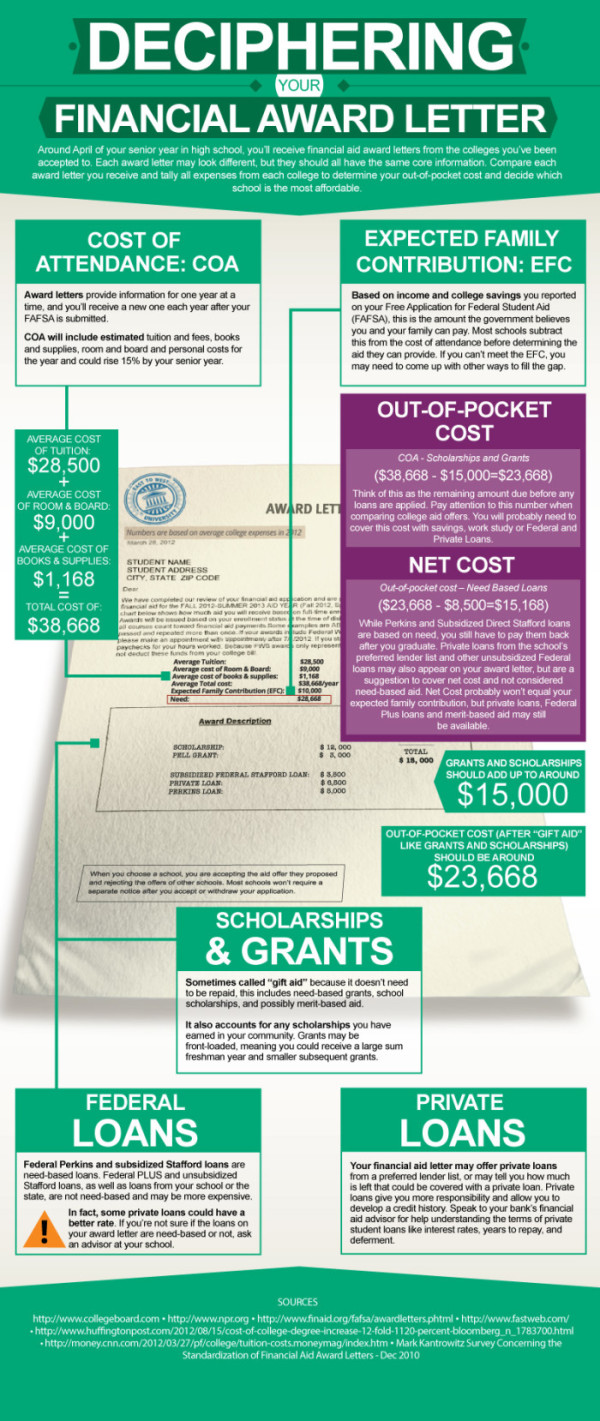
If you’re applying to college for the first time (or helping your student apply), you may be overwhelmed by the financial aid process. After you fill out the FAFSA and are accepted for enrollment at your chosen universities, schools will use the information to determine your (or your student’s) eligibility for various types of financial aid provided by the government, from your state, or from the individual school. You’ll be able to view eligibility for grants, scholarships, and even work study opportunities.

Your award letter is extremely important, as you’ll also be able to further understand if you will need additional aid to cover education costs, such as private student loans. Use the infographic below from Citizens Bank to understand what a sample financial aid award letter looks like and how to break down what each section means.

decipher-financial-aid-award-letter

You cannot copy content of this page