Everything Is Better In The US

old antique American flag
Happy Friday Everyone! This past week I was outed by a reader. Yes, I admit it…I am Canadian. I am your neighbour north of the boarder. So for this week’s weekly roundup we are discussing the relationship between America and Canada. I love America. I visit about 3 times a year. Actually, as you are all reading this I am on my way to NYC.

Originally, I was meeting my mother this weekend for a shopping trip but actually it has turned into a business trip. I have a lot of clients in Montreal (that’s where I live) who also live and do business in New York, specifically in real estate and the diamond business. So, I am driving down to NYC with a couple of clients and I will also be joining another client for dinner on Saturday night. I will let you know how it goes next week.

When I was younger we (as a family) would drive to the US almost on a monthly basis to buy things such as groceries, and clothes. American grocery stores such as Meyer’s and Farmer Jacks are amazing! We didn’t even need to show any identification back in the 1980’s, now I have to show my Canadian passport.

Today there is no need for this since our dollar values are basically the same. I bought my $1000 US Dollars for exactly $1000 Canadian Dollars this past week. The only difference is the service fee that banks charge their clients for foreign exchange transactions. Since we are just beside each other I wouldn’t technically consider the United States foreign. I know it’s weird. Do you consider Canada a foreign country?

~ Tahnya Kristina

PS: Here are some articles this week on the economic and political relationship between Canada and the United States of America:

And then here are some other great articles from around the financial sphere:

(photo by Beverly & Pack)

Book Giveaway! "The Little Book of Behavioral Investing"

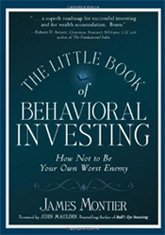
The Little Book of Behavioral InvestingLet’s give away a couple free books, shall we? Got an email about this newish one that just came out back in Feb, and from a quick glance over it seems pretty promising.

Here’s a little more about this book by James Montier, followed by the directions on how to enter today’s contest:

The Little Book of Behavioral Investing: How not to be your own worst enemy


Here’s a clip from Amazon:
“Ben Graham, the father of value investing, once said: “The investor’s chief problem-and even his worst enemy-is likely to be himself.” Sadly, Graham’s words are still true today. Bias, emotion, and overconfidence are just three of the many behavioral traits that can lead investors to lose money or achieve lower returns. Fortunately, behavioral finance, which recognizes that there is a psychological element to all investor decision making, is now firmly embedded in the mainstream of finance. Applying behavioral principles to an investment portfolio can help investors avoid some of the mental pitfalls that so often cost them, and financial institutions, billions.

In The Little Book of Behavioral Investing, behavioral finance expert James Montier takes you on a guided tour of the most common behavioral challenges and mental pitfalls that investors encounter, and provides you with strategies to eliminate these traits. Along the way, he shows how some of the world’s best investors have tackled the behavioral biases that drag down investment returns, so that you might be able to learn from their experiences.”

Look good? Tell us a time when emotions played a big part in one of your financial decisions – either for the good or bad. Or just tell us why you want the book, that’ll work too. We’ll Random.org the winner this Sunday, and we’ve got 2 to give away so your odds are good!

————–
More from Amazon: The Little Book of Behavioral Investing: How not to be your own worst enemy (Little Book, Big Profits)

————-
*GIVEAWAY NOW OVER* Winners are… Jennifer & Leilani – Congrats!

Drafting a Will and Keeping It Up to Date

stack of papersThis was not a topic that I had planned to write about this week but I felt the need to address the situation. As you know I work in a bank branch as a Personal Financial Planner. This past week I had two different clients come and see me with their children to get their estate affairs in order.

My own Dad offered to send me a copy of his latest investment statements because he wants to me to know “how my money is doing.” When I asked why he said “Well Tahnya because when I go, it’s going to be yours.” I couldn’t believe what my ears were hearing. I thought to myself “where is he going?” My Dad is only 56 years old.

The average age of my clientele is 45-65 years old. If you are a DINK then you are most likely in your late 20s to 40s. This means that just like me, your parents are baby boomers and getting ready to retire or have recently retired. My Dad retired last June and now he feels that “he’s not going to be around forever.”

It is important to draft a will and keep it up to date for many reasons such as it ensures that your final wishes are honored. It also leaves less of a headache for your loved ones that are left behind. Settling an estate without a will can be very costly and can also take many years before it is officially finalized.

A will is not only a good idea for designating beneficiaries of financial assets, it can also be used to distribute personal belongings such as jewelery and household furnishings. A will can also be used to organize funeral arrangements with the wishes of the deceased.

This is a posting for DINKS but also for your parents, and if you are lucky enough your grandparents. So please pass this on to them so that they can be well informed. I don’t assume that many baby boomers and seniors read our blog, but hey who knows, maybe this will bridge the generation gap and open some new doors for DINKS.

It is responsible to have good financial and estate planning. But at the same time we also don’t want to think of our parents passing away or living our daily lives without our Mom and Dad.

It’s good to be prepared, but don’t be paranoid.

~ Kristina

——
(photo by lotyloty)

Is Negotiating Credit a Lost Cause?

credit card numbersCredit products such as Mortgages and Credit Cards can in some cases be negotiated on the client’s behalf. But don’t be mistaken, regardless of the wonderful deal that your personal banker is promising you; in the end the bank always make a profit.

Sometimes (I admit to using this strategy) personal bankers will tell you that they have given you everything they can, and that they are actually not making money on your deal. However, they are willing to do it for you because “you are an excellent client”. This means that your personal banker is at their wits end and they want you to get out of their office…after you sign on the dotted line, of course.

The rules for bank employees to negotiate mortgage rates are very similar to the rules allowed for negotiating rates on investments. Financial Institutions have a spread which allows them to negotiate down to a certain extent from the posted mortgage rate. Never ever except the base rate on a mortgage. My bank has a calculator where we enter the posted rate, the rate offered to the client, the amount of the mortgage as well as the interest term and the amortization. This will calculate how much money, if any, the bank will make in profit on the mortgage deal.

Mortgage rates are restricted in negotiations, however all applicable fees are not. Always negotiate your home/land evaluation fees, your notary fees, as well as any closing costs. Cash back on mortgages is also a very common incentive for clients. The rates on a “cash back” mortgage are usually not negotiable. However, after you have agreed on the interest rate ask your personal banker what they can do to refund part of your closing costs and other fees such as moving expenses etc. Make sure that this refund or “cash back” is in your mortgage contract before you sign. This type of refund also considered cash back on a mortgage but usually it will be between 1% and 3% of your total mortgage value. Not the standard 5% on a regular cash back mortgage. Notary fees and evaluation fees should always be absorbed by your financial institution.

Annual Credit Card fees are usually not refunded by financial institutions because even if they don’t charge us as a client, they still owe that fee to Visa or Master Card, or American Express. However, just like in any case the bank may be willing to waive the fee for the first year. At my bank if you take a mortgage with us of over $200,000 we will waive the first year’s annual fee on our Visa Gold card. After that you can cancel the card or continue paying the $100 annual fee. We do this because the client feels they are winning since they saved $100 in 1 year, and we are making interest on their $200,000 mortgage over the next 25 years. It is definitely in our best interest to offer this promotion to clients. Interest rates charged on credit cards are never negotiable.

Since credit card fees are generally not negotiable the financial institution has to really be making money off their clients somewhere else when they do refund those fees. The bank makes the most money on direct deposits from payroll and also on money in a checking or savings account that is not invested.

The new trend this past year or so has been the introduction of “high interest online savings accounts”. These are bank accounts that offer you a higher savings interest rate in exchange of only having to do business transactions online. Now here is the secret…Banks tell clients that they can offer this special higher interest rate because there are no ATM fees, or Bank Teller fees for transactions since they are all done by the client via online banking. The truth is that banks want clients to leave money in these types of accounts because they make the most profit on cash money sitting in a bank account where the money is not invested.

At the end of the day, banks are in the business of making money.
And therefore, at the end of every deal they will make money. Always try and negotiate your rates and fees, but also know the limits. It won’t hurt to ask…the worst thing your personal banker can say is “No.”

~ Kristina

(Photo by The Consumerist)

IRAs, Home Theaters, and Sicilian Graveyards

Are you like me? Do you experience night terrors about your parents moving in with you because they have failed to set up any kind of retirement plan? Does your spouse have to wake you in the middle of the night to assure you that your father-in-law is not in the kitchen scrambling eggs in his underwear at three in the morning? That it has all just been a bad dream? While they may be nightmares now, if I don’t get my parents hooked up with an IRA soon, these nightmares could easily become reality. I cannot bear the thought of living with my old, exasperating parents. Are you like me? Are you horrible like me?

But really, my parents are idiots. Hopeless imbeciles. How they have made it this far is beyond me. They recently purchased three brand new flat screen TV’s, and yet they have no retirement plan. My parents-in-law, however, are a different story. While they have a retirement plan in place, they’re Sicilian – tiny little Sicilians. They’re kind of cute really; but beneath – beneath they’re scary. Italian scary. They have crazy ideas about family. For Sicilians, family is FOREVER. They’re not only convinced that they’re moving in, but they’re plotting an area in our backyard for their burial. I’ve come to accept that I am powerless against their eventual take-over. Yet, if I can get MY parents to start an IRA, I can at least feel comfortable when I pack my bags and head for the hills once HER parents move in. Let HER bury them in the backyard. They’re not MY responsibility. Are you like me? Are you horrible and scared like me?

So I’ve been doing a lot of reading on IRA’s lately. Initially, I included two pages worth of basic, boring information on IRAs, Roth IRAs, SEPs and Simple IRAs. As a favor to the DINK audience, I chose “select all” and “delete.” I could not bear to bore the DINK audience with all the information that everyone but my parents, and myself included, already know. It appears that no “insider” or groundbreaking IRA information exists out there. It appears that putting away for retirement is all about discipline. It appears that I need help. I feel horrible and scared; and I can’t sleep.

My parents are in their late 60’s. They run their own business. They make about $80K/year. They have NO retirement plan in place, but they do have a great home theater system. Please, I need advice. How do I convince my parents to put their money towards an IRA, and where do I start? Am I really horrible for feeling this way, or should I just embrace the arrival of a new home theater system, and a Sicilian graveyard outside of my living room window?

Weekly Recap: Scandals, Wealth, & The New $100 Bill

weekly roundup
Hello DINKs and Happy Friday!

We have survived another work week and now it’s time for some light reading to kick off the weekend. This week’s recap is full of fun and focused solely on money! So let’s get to it!

First off I would like to congratulate Aaron @ Clarifinancial who is the official winner of our First DINK contest. We chose his tagline “Live Life. DINK it up.” as my new tagline sign off. Thank you to everyone who submitted an idea. Aaron, get in touch with me so I can send you the reward money via PayPal.

OK now for a little employment/financial discussion. Making headlines this week is Ms. Ashley Dupre. If you don’t recognize her by name, you may better know her by her alias as “The call girl in the Eliot Spitzer Scandal” She made a television appearance as a guest host on the popular daytime talk show The View. The women invited Ms. Dupre to join the show as a relationship expert and offer her advice on cheating husbands. She also writes a relationship advice column for the New York Post.

This past week Ashley also conquered another personal goal… to be on the cover of Playboy Magazine. Did I miss something? Since when are hookers millionaires and prostitutes experts on relationships? I think everyone is missing the point here. That is a prostitute cannot really give advice on cheating husbands since they are usually the woman with whom the husbands are cheating… not the wife who is being cheated on.

Who knew that sleeping with a NYC Politician could be the best decision that a call girl could ever make. They say to be careful about who you sleep with. This is especially true nowadays because apparently it could become the best career move and most profitable financial decision that you ever make! It’’s just a little something to think about over the weekend.

Now here are some other blogs and articles we’ve gathered throughout the week – Enjoy!

~ Kristina
Live Life. DINK it up.

(Photo by Williac)

If You Can Make it Here, You Can Make it Anywhere

Golden Bar
Good Business Equals Good Finances. It is not a secret that you need to be successful to make money. Actually, let me rephrase that because we live in a society where people who party at nightclubs in NYC are famous, and people who are born rich become instant celebrities. In the majority of cases, being successful will also make you very rich. You could be successful in business, or successful at something such as a sport, or possess a talent but either way you are making money.

For some people making money is a problem, but for others who already have it, keeping the money is the problem. In my opinion making money is harder than keeping it. If you are broke and you become rich you should always remember what it’s like to be broke. Therefore you should preserve your wealth. However, temptation does wave that sweet apple in our faces and sometimes we just need to give in and take a bite. If you are wealthy and feel the need to flaunt what you’ve got, that’s ok. As long as you do it intelligently, and with a business mindset.

Mr. Sean Carter once said “I don’t buy the bottle. I buy the bar.” This is maybe the best piece of business advice I have ever heard. It is all about smart business. Instead of spending money on something that will bring you nothing in return; spend the money wisely on something that is sustainable and will bring you increased profits over the long term. If you buy a bottle of alcohol at a nightclub then that’s it. It’s over, and you got nothing in return to show for it (except for a hangover in the morning). You made no profit and you lost $200 in less than 4 hours. But if you buy the nightclub, you will make a profit from the clubs operations every night!

In case you don’t know him as Sean Carter, you may know him as Jay Z. He is the multimillion dollar business man who owns a successful record company called Rocafella Records, a chain of sports bars called the 40/40 Club, as well as a clothing line for both men and women called Rocawear. As if that wasn’t enough, he is also the former president of another major record label, Def Jam Records. In 2009 Jay Z made $35 million dollars. Oh did I mention he grew up with a single mother in Brooklyn NYC?

It is the American Dream… He came from nothing, and now he can have everything he wants. This is possible for anyone who has discipline and a basic sense of business…the rest you will learn along the way. He didn’t graduate from a Management School, he doesn’t have his MBA. He was a normal teenager who had ambition and grew up into a successful man. He also married Beyonce. Combined they made over $122 million in 2009 according to Forbes. Not their net worth…their combined net income.

Think twice before you spend money. If you are going to spend it make sure that you spend it wisely, and that you get something in return. Buy a house before you buy a car. Real Estate will always have an increase in value. The exact opposite is true for cars. Over time your property value increases, while the value of your car depreciates…even if you add a custom interior and spinning rims.

~ Kristina

(Photo by glennharper)

AmEx Gold Card Promo: 25,000 pts!

American Express Gold CardAmerican Express is running a special promotion right now for anyone looking. The details are below, but if you spend $1,000 in 3 months (not hard to to do if you use your credit card for everything), you’ll be handsomely rewarded 25,000 membership rewards points. You can then turn them into either $250 worth of gift cards, or a plane ticket! More info:

American Express(R) Premier Rewards Gold Card

  • For a limited time – earn 25,000 Membership Rewards bonus points when you spend $1,000 in 3 months, redeemable toward one domestic coach-class ticket. Offer expires 04/27/2010.
  • Earn Membership Rewards points up to three times as fast: You can earn 3X points on airfare, 2X points on gas and groceries, and 1X points on everything else
  • Earn 15,000 bonus points when you spend $30,000 per calendar year. (are you big ballin’?)
  • No annual fee for your first year, a savings of $175
If you’re interested, you’ve only got 6 days!
*sign up here*
[THIS PROMO IS NOW OVER — BUT YOU CAN STILL SIGN UP TO WHATEVER CURRENT PROMO IS IF YOU’D LIKE ]

American Express Disclaimer: “This content is not provided or commissioned by American Express. Opinions expressed here are author’s alone, not those of American Express, and have not been reviewed, approved or otherwise endorsed by American Express. This site may be compensated through American Express Affiliate Program.”

Changes Coming for Health Savings Accounts

Piggy Bank
If you have a Health Savings Account (HSA), you might be wondering what changes are coming down the pipe due to health care reform. But first, let’s backup and review what an HSA is in the first place.

What’s a Heath Savings Account?

An HSA is a tax-exempt account you can open to pay (or reimburse yourself) for certain medical expenses. You’re eligible to have an HSA if you meet these requirements:

  • You’re covered by a high deductible health plan (HDHP) and have no other general health care coverage
  • You’re not enrolled in Medicare
  • You can’t be claimed as someone’s dependent on their tax return

What Are the Benefits of a Health Savings Account?

Here are nine reasons why I’m always the first to tell people how much I love my HSA:

  1. You get a tax deduction for money you put in the account – even if you don’t itemize deductions on your tax return.
  2. Interest you earn on the account grows tax free.
  3. Money you withdraw to pay for qualified medical expenses is tax free.
  4. There’s no deadline to spend the money – balances rollover from year to year.
  5. You can do a tax-free rollover from an IRA (Individual Retirement Arrangement) to fund an HSA once during your lifetime.
  6. For 2010 you can contribute up to $3,050 if your HDHP covers just you. If it also covers a spouse or dependents, you can contribute up to $6,150. If you’re age 55 or older, add $1,000 to both those limits.
  7. After age 65, funds that remain in the account can be use for non-medical expenses without penalty, similar to a traditional retirement account.
  8. You own and control the account – not an employer.
  9. They usually come with a debit card and checks, which makes paying for qualified expenses very easy.

Changes Heath Care Reform Will Make to Heath Savings Accounts

I used to be able to say that my HSA money could even be used to pay for over-the-counter medications – such as cough syrup, aspirin, bandages, and Neosporin – on a tax-free basis. But according to the new health care legislation, beginning in 2011 the only medications you’ll be able to purchase with HSA funds are prescription drugs and insulin.

Another change that’s coming next year is the penalty for spending HSA money on something that isn’t allowed – that’s called a nonqualified distribution. Right now the penalty is 10% plus ordinary income tax on the amount. If you slip up and use HSA funds for a nonqualified distribution in 2011, the penalty will be doubled to 20% plus ordinary income tax.

Where to Find the Best Health Savings Accounts

So, where can you find a Health Savings Account that earns the highest rate of return? Interest rates depend on where you live and how much you have in the account (higher balances earn more). Credit unions tend to have some of the most competitive HSA rates – so if you belong to one, check there first.

Here are some of the best HSAs that I’ve found:

  • American Chartered Bank offers up to 1% APY (annual percentage yield) with no fees.
  • HSAbank.com offers up to 2% APY with monthly fees of $2.25.
  • Bank of America offers up to 1.5% APY with monthly fees of $4.50.
  • State Farm Bank offers up to 1.39% APY with annual fees of $25

Where to Find a High Deductible Health Plan

Even though health care reform will reduce the overall tax break you get from an HSA, it will still be a great benefit. If you have a high deductible health plan or are considering getting one to lower your insurance costs, don’t miss out on also having an HSA. You can shop for a high deductible health plan at sites like GoldenRule.com and eHealthInsurance.com.

—————–
Laura Adams is the author of Money Girl’s 10 Steps to a Debt Free Life. It’s available as an audiobook at Audible.com or as a short e-book in the Amazon Kindle Store, the Sony Reader Store, and the Fictionwise E-bookstore. Learn how easy it is to get out of debt and stay out of debt for good. Take control of your finances today and create a more secure future.

(Photo by Alan Cleaver)

When Your Dual Income is Cut in Half

Change?
On April 13, 2010 the US Census Bureau reported that Imports surpassed Exports in Foreign Trade. So, what does this mean for us? Well, for many it means that we have lost our job within the last 12 to 24 months. Now the question to ask is how can you adjust your current lifestyle when your dual income is suddenly cut in half?

First, re-do your Budget.

Go over your finances and see where you can make some cuts in your monthly spending. Your sudden loss of income may only be temporary but there is no way to know when you will find another job… it could be 2 weeks, or it could be 2 months. A good way to review your spending habits is to print your last month’s bank account or credit card statement. Assuming that you use your debit or credit card for all of your purchases you will be able to track your spending and see where you can make some changes.

Don’t be drastic in your changes. Small adjustments in your budget can have a huge impact on your personal finances. It just takes some time for the new budget to settle in. I am not saying that you should cut off your 250 HD channels, or stop buying your lunch every day but maybe you can live (even if its temporarily) with only 100 channels, and brown bag your lunch at least 3 days a week.

These two minor changes could free up at least $150 for you. If you buy your lunch only 2 of 5 days and your average lunch costs $10 per day then you are saving approximately $30 per week and $120 per month. That is just on eating out; we haven’t even explored the cable bill yet.

Secondly, stop saving until you find another permanent job.

Saving money is an excellent idea… but not if you are broke. There is really no point in saving money if your bills are not paid on time. I say wait until you find another permanent job because temporary work is not a stable income and the amount could also vary. Once you have found permanent employment wait a month to adjust to your new income and catch up on any bills that are behind. Then you can start saving again. Don’t pressure yourself into saving. The food in your belly and the roof over your head are the chocolate ice cream, your savings account is just the whip cream on top.

If you have recently lost your job swallow your pride and don’t be afraid to ask for help. Friends and Family members should understand about your temporary situation. I am not a big fan of mixing family and money but in the end they are family, and they should help you out. If you do borrow money from family make sure to give them an exact repayment date. Don’t say “I promise to pay you back.” Tell them “Once I find a job, I will pay you back within 2 months.” This will ease any nerves. They say that “blood is thicker than water.” Well, it’s also thicker than paper!

When we have money we “want” certain material goods and services, but when we are broke those “wants” are put into perspective with the reality of our needs such as housing and food.

~ Kristina
Love It or Hate It

“The Nation’s international trade deficit in goods and services increased to $39.7 billion in February from $37.0 billion (revised) in January, as imports increased more than exports. (April 13, 2010)” – Census.gov

(Photo by SomeDriftwood)


Here are a few good reads:

You cannot copy content of this page