Make a Balance Transfer Card Work for You

What’s a Balance Transfer Credit Card?

Balance transfer cards are a special type of credit card that offers a very low or 0% interest rate. That means you can keep a balance on a transfer card without having to pay a penny in interest, in some cases. The most common way to use them is to pay off high-interest debt, such as another credit card or loan, and save a substantial amount of interest.

That sounds fabulous, doesn’t it? Well, the catch is that the low rate on balance transfer cards is only temporary. It’s an introductory offer that runs out after a certain period of time, typically anywhere from three months to a year. The amount you can transfer is also subject to the credit limit you’re offered and you must have good credit to get the best offers. Additionally, most transfer cards charge a fee for each balance that you transfer that could range from 2% to 5% of the amount you move to the card. So for a $5,000 transfer, if the card has a 3% transfer fee you’d be charged $150, increasing your debt to $5,150.

Strategy for Using a Balance Transfer Credit Card

To use a balance transfer card wisely, you must have a solid exit strategy for paying your balance off before the promotional rate expires. You should never, ever transfer a balance without knowing for sure that you’ll be able to pay it off in full before the low rate ends. Shifting debt to a credit card with a lower interest rate obviously doesn’t make the balance go away, but it can make the debt less expensive for a limited period of time. That’s called “optimizing” your debt.

A Good Balance Transfer Scenario

Here’s a situation where doing a balance transfer makes sense: Let’s say you’re having a good year at work and are going to receive a $3,000 bonus within six months. You plan to use the bonus to wipe out your $2,000 credit card debt. Instead of waiting for the bonus, you can pay off the balance with a new transfer card that charges 0% interest for six months and a 2% transfer fee. You won’t be charged any minimum payments during the six-month promotional period. If your minimum payment on the old card was $80, now you can save that amount each month instead. Over six months you could save a total of $440 (6 months x $80 = $480 – $40 transfer fee). Once you receive your bonus you would pay off the transfer card in full, before the 0% offer expires.

There’s a great balance transfer calculator at creditcards.com. Plug in your own information to find out how much you could save by doing a balance transfer. Here’s a great guide for more information too: The Ultimate Guide to Balance Transfers.

The Dangers of Using Balance Transfer Cards

But if you’re not positive that you can pay off the full balance in time, don’t risk doing a balance transfer. When the music stops playing and the low rate ends, you might get stuck with a huge, double-digit interest rate on your debt, and few options to improve the situation. You could try to transfer the debt to another low-rate card right away. But if you’re not approved for one, all the savings you had hoped to gain from doing a balance transfer would be lost. You’d probably be worse off than if you hadn’t done a transfer in the first place.

The Best Balance Transfer Cards

Take a look at the Citi® Platinum Select® MasterCard® or even the Discover® More Credit Card. Card offers are always changing, so be sure to do current research on sites like balancetransfers.com, cardratings.com, and creditcards.com.

(Photo by BigBeaks)

Book Giveaway: “Enjoy Your Money! How to Make It, Save It, Invest It and Give It”

Enjoy Your Money! BookHey guys, got another great book to give away this week!  This one’s a bit more fun and down to Earth, and we’ve got TWO copies to give out this time.

Here’s a snapshot on the book written by educator J. Steve Miller:

Enjoy Your Money! How to Make It, Save It, Invest It and Give It (The Adventures of the Counterculture Club)

The story line: four diverse high school seniors meet in “In School Suspension” (think: The Breakfast Club) and discover they have one thing in common – their parents are hopeless at personal finance and they desperately want to do better. So they start meeting each week with an eccentric teacher for wide-open discussions of successful money management.

The book also teaches through real stories: Like how billionaire Warren Buffett accumulated $47,000 (in today’s money, accounting for inflation) by the time he graduated from high school, doing jobs that anybody could do, like finding and selling golf balls, caddying and doing paper routes. Or how Thomas Jefferson, Mark Twain and Led Zeppelin’s manager LOST tons of money.

And here’s a quote by Dr. Dwight “Ike” Reighard, former Executive Vice President, HomeBanc:

“Had I read this book in my 20’s, I’d be financially independent today. It’s a remarkable blend of fabulous research with clear and lively writing. You’d pay an expert quite a sum for this caliber of counsel. That’s why I say that the best investment you make this year just might be this book. Your second best investment will be the copies you buy for your children.”

Want a copy? Share with us a side job you once had to bring in some extra money, and you’ll be entered to win. We’ll Random.org the winners this Sunday night (June 20th) at 10pm EST. Good luck!

————-
More info on Amazon: Enjoy Your Money!: How to Make It, Save It, Invest It and Give It

Reading the Tea Leaves

A hotly debated financial reform bill has passed the US Senate and very little (except some process) remains until a unified bill is slid under President Obama’s signatory pen.

Discussion now shifts from debate on financial reform to understanding what financial reform has reformed and its impact on us, the consumer.  For good or for ill, dramatic changes in our financial sector will occur.

I’ll do my best to summarize the likely changes you can expect to see in this space:

  1. Stores will be able to set across the board minimum spending limits in order for you to be able to use your credit card.
  2. Stores can offer discounts for say, using cash, or lower fee (to them) cards.
  3. You will now find it easier to prepay your mortgage.   If you have a balloon payment or are underwater, you will be allowed to prepay.  If you have a traditional product, the prepayment penalty for early payoff can only apply in the first 3 years, otherwise you’re scott free
  4. You MUST receive a credit score if your credit score is a reason why your offer / job / application is rejected (this particularly applies to renting a home).

Of course there are many other provisions, but since the House and Senate versions differ on these (such as the Consumer Financial Protection Agency), we really don’t know what the final product of these differing provisions will look like until the bills are combined and re-conciliated.

Overall, financial institutions will find a more regulated environment with many former money-making ventures regulated away (or highly restricted).  Consumers of banking products should see lower bottom lines, but with less choice of products.

———–
(Photo by KRSPO)

Book Giveaway: Living Trusts For Everyone

Book - Living Trusts For EveryoneHey guys! Got another book to give away this week. Looks pretty good if you’re interested in trust vs wills stuff. We have 3 of these to give out, so if you’re interested check out the directions at the end of this post.

Here’s a little about the book by attorney, and author, Ronald Sharp:

Living Trusts for Everyone: Why a Will is Not the Way to Avoid Probate, Protect Heirs, and Settle Estates

“Should you have a trust or a will if you want to save money and give your loved ones the maximum benefit from your estate? Do lawyers always have their clients’ best interests in mind? Is your estate too small for a trust to be the right choice? Ronald Sharp answers these questions and more as he explains trusts in clear and easy-to-understand language, including one truth that most lawyers don’t want to admit: A trust is not only as effective but is often less costly than a will. Everyone who cares about what happens to his or her assets at death will want to read this book. From savings in legal expenses to protecting your assets for your heirs, Living Trusts for Everyone explains the many advantages of trusts and why wills are not the best way to handle an estate.”

Do you want a copy? If so, drop a comment below letting us know what one of your favorite financial books are and you’ll be entered to win! We’ve got 3 to give out, so the odds are in your favor :) We’ll use Random.org to choose the winners in a week – Good luck!

——-
More from Amazon: Living Trusts for Everyone: Why a Will is Not the Way to Avoid Probate, Protect Heirs, and Settle Estates

A Little Nudge

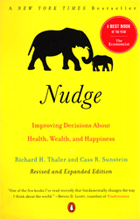
Nudge BookYou may or may not have been aware of a little book that’s made waves in the econo / political blogosphere recently.  Nudge, a work by Richard Thaler and Cass Sunstein (though, one is not an economist), discusses how very small changes to our behavior lead to great(er) improvements in our well-being.

For a personal example, there’s my morning coffee routine.  A small change that not only saves a good chunk of change each year, but because coffee brings people together, I got to know some of my co-workers as better friends, especially when discussing coffee blends.  The unintended consequences of behavior change are quite interesting.

Nudge is a book that hinges on how to consciously “engineer” our choices towards some object (goal) that we aim for. For a long time in economics, we studied people as if they were rational decision makers who decide optimally.  That’s a laugh.  “Homo Econimus” may live in the museums of an Introduction to Economics book, but today is an extinct species of thought.

Sunstein and Thaler find that we make 5 common mistakes in our thinking, and that correcting these biases would help us make better decisions.

  1. Anchoring -We base decisions on what we know, rather than on what actually is
  2. Availability -We tend to think that our city is more violent than it is because thats’ all there is on the news until the weather 20 minutes in.
  3. Representativeness -We see this in sports alot, where attribute “streaks” that encourage better streaks in the future.
  4. Status Quo -We continue to do something even though circumstances change.
  5. Herd mentality -We tend to do things that we see others doing.

Thinking of strategies that avoid these 5 problems tend to lead to better outcomes for us.  I can read these 5 problems and the problems of investing and retirement planning and cash flow maintenance come to mind immediately.  What I gather from these issues is that taking a step, or two back to reflect upon a decision to be made would be of great benefit.  One trick for my wife and I is to shop with a list, and if we spot something we want but isn’t on the list, that item gets on the list for the next trip…if we still want it then.  Normally, we don’t.

Economics and Modern Philosophy

Ah…my day to shine. Good news ahead. The federal government has planned the creation of a consumer financial protection agency. Ralph Nader himself is turning over in his grave with interest. Or wait… Ralph Nader is still alive—I think. Anyway, he’s turning over somewhere—probably in a cozy sofa chair at Starbucks in DuPont Circle.

Here are just a few of my favorite proposed amendments included under this regulatory reform:

  1. Free credit scores: In this proposed amendment, my friends from the three credit reporting agencies would be required to provide not only a free annual credit report, but a free credit score once a year. Now you can shout the number out loud, or hide it under the sofa—at least once a year.
  2. Get this: Ban the use of credit checks for employment: I did not want to bring it up, but hey…there it is. Not to worry, this amendment has exceptions including certain jobs related to national security, working with specified state or local government agencies, or handling customer funds or company financial accounts. Well…it’s a start.
  3. Set Rules for Payday Loans: I saw a commercial the other night for one of these “don’t worry, we’ll let you borrow it until you get your paycheck” bottom feeders. The commercial was blatantly targeted at single mothers. Anyway… this amendment would put these crooks under federal regulation. That aside, this amendment actually imposes more regulations for the consumer than the lender. It limits the consumer to 6 pay day loans a year. Other than the federal regulation clause (that should win over well), the only regulation imposed on the lender is the requirement to offer an extended payment plan. Nothing at all about interest rates.
  4. ATM Fee cap: Can you even imagine this? Capped at 50 cents per transaction! I got $2.50 saying that one doesn’t pass. Banks always win.
  5. Credit Card interest rate caps: As we all know, banks have a way around capped interest rates—impose additional fees. Under this amendment, any additional fees can not exceed the capped interest rate. I have a feeling this one will see some opposition.

Again, these are just some of my favorites.

Excuse the cliché, but we are certainly living in some interesting times. Economy is the new modern philosophy. We have conquered the mysteries of the universe (with the exception of time travel); however, Steven Hawking has just reported that his time machine is up and running—powered entirely by his new iPad. It is evident that we have not yet conquered the mysteries of the economy. Protestors are lining the streets throughout the world with one thing on their mind—their money.

I relate this to the above amendments with this thought: When no one questioned, nor understood the dealings of Wall Street, our economy remained solid for a good period of time. Now Wall Street has let us down and we all demand change and accountability. The philosophical question of the day is: to regulate, or not to regulate?

Personally, I am not one to defend Wall Street, but they did a pretty good job up until now. And sure, there were some shady dealings going on to make it happen, but no one questioned the ethics of Wall Street until their bank accounts went sour; except for Mr. Nader, of course. He’ll ride you to his grave. Keep it up Ralph.

(photo by americans4financialreform)

How Does Marital Status Affect Your Taxes?

It’s the time of year when couples like to tie the knot. The beautiful weather and flowers in spring and early summer make having an outdoor wedding an occasion to remember. But in all the excitement, it’s easy to forget about tax issues that need to be addressed when you get hitched.

What to Do if You Plan to Change Your Name

One of the first things to remember once you get back from the honeymoon is to notify the Social Security Administration (SSA), if you plan to change your name. Your tax return must match the name you’ve registered with the SSA in order to avoid problems. You’ll also need to get an updated Social Security card with your new name. Simply submit Form SS-5, the Application for a Social Security Card, and allow yourself at least two weeks for the change to go into effect. You can find more information at socialsecurity.gov.

How to Change Your Address

If you have a new address, notify the U.S. Postal Service as soon as possible so your mail delivery won’t be interrupted. The post office sends your new information to the IRS. However, I also recommend that you notify the IRS directly about your address change using Form 8822, especially if you’re expecting a tax refund.

How to Decide You Tax Filing Status

It’s important to decide which tax filing status you’re going to use for the year in which your marital status changes. Your filing status is vital because it determines the amount of tax you have to pay. It affects the amount of your standard tax deduction, whether you’re eligible to claim certain tax deductions and credits, and your income tax withholding. So be sure to complete a new Form W-4, the Employee’s Withholding Allowance Certificate, for your employer.

Your marital status on December 31st determines whether you can consider yourself married for that entire tax year.

There are five different filing statuses for taxpayers:

  1. Single status applies if on the last day of the year you were unmarried or were legally separated or divorced from your spouse.
  2. Married Filing Jointly status applies if on the last day of the year you were legally married and is one of two options for married people. Filing a joint return allows spouses to combine income, exemptions, and allowable deductions on one tax return. It gives you more tax benefits and usually results in lower taxes than filing separately.
  3. Married Filing Separately status applies if on the last day of the year you were legally married and is your second option if you’re married. It generally offers the least beneficial tax treatment, but may be necessary if one spouse doesn’t agree with the other about taxes. For instance, one wants to file taxes but the other wants to skirt the law, or one spouse doesn’t want to take joint responsibility for the other’s tax messes.
  4. Head of Household status applies if you’re considered unmarried on the last day of the year, paid more than half the cost of keeping up your home, and had a qualifying dependent live with you for more than half the year. This status gives you more tax benefit than filing as a single taxpayer or as a married person filing separately.
  5. Qualifying Widow or Widower with Dependent Child status applies if you’re unmarried, due to the death of your spouse within the last two years, and you’ve cared for a dependent all year. After two years, if you remain unmarried, your filing status must change to either single or head of household.

You must choose one status for each tax year, so always choose the one that results in the least amount of tax. Whether you’re getting married, or are a guest or chronic wedding crasher, have a great time!

(Photo by Gatis Orlickis)

Numerophobia

Numbers? Ahh!

Recent work highlighted in this week’s Economist showed that, after accounting for a whole host of differences between people who took out “sub-prime” mortgage during the run up to the housing finance crisis, the defining variable that predicted whether or not these people would miss payments, default, or be foreclosed upon came down to their degree of innumeracy (numerical literacy).

I recall from my schooling days, and I imagine it is true today as well, that math isn’t most people’s favorite subject, so once you learn the basics (add, subtract, multiply, divide), there isn’t much of an interest to go further (say, into ratios or calculus or trending).  Math just isn’t taught in a fun way, and I bet this contributes to innumeracy (Check out Dan Flockhart’s attempt to merge fantasy sports and mathematics in high schools).

Innumeracy is not limited to high school dropouts, I see this innumeracy amongst friends and colleagues who hold advanced degrees. The ability to understand a slight bit more about numbers may be a difference between successful homeownership or foreclosure, between a strongly performing savings and investment portfolio, and one where the rabbit is chased but never caught.

The economists doing this research came to a strong conclusion supporting the development of a “small pot of savings” for families starting out with homeownership.  Many DINKs readers probably think  “We know the value of having an emergency fund!”, but economists are now fleshing out just how important a small fund has on a household.  It’s a shame it took a housing crisis to understand the importance of the emergency fund, or the importance of strengthing our comfort with numbers.

Our government maintains a personal finance clearing house  website, mymoney.gov .  I attended a meeting 2 years ago on the development of this website and its nice to see our suggestions were incorporated into the previously bare-bones website which is now user friendly.  This website is huge and filled with personal finance research  done by many federal agencies.  If there’s a question you have, odds are consulting the research here is an excellent, and free, start. If you want to begin improving your financial numeracy, I’d start here.

If you want to test your numeracy, take the quiz!
(Your resident DINKs economist scored 5 for 5.  Whew)

Should Couples Combine Their Finances?

swan heart couple

In a recent interview, a journalist asked me if I thought couples should combine their finances or not. Since arguments about money are one of the leading causes of divorce and stress in relationships, it’s an important topic that I wanted to share with my fellow DINKS—and get your comments on.

I told the journalist that my husband and I have always had joint accounts for everything—our bills, banking, and loans. Having joint accounts works really well for us, so that’s what I prefer. She told me that in her house, she and her husband have one main joint banking account for paying the bills, but that they also keep their own separate checking accounts for play money. She said that the secondary account gives both of them a feeling of financial independence.

My advice is to do what works for you, but to be open to making changes if your financial house gets out of order. For couples who aren’t married or who divide like oil and water when it comes to how they handle money, keeping separate accounts may be best.

Here are 3 tips to follow when you combine finances with your sweetheart:

1.  Share your net worth.

If you don’t each have a net worth statement, create one and share the information before you combine your finances in any way. How do you do that? Simply make a list all of your assets and their values, such as cash, investments, vehicles, homes, jewelry, and so on. Then list out your liabilities, or what you owe. That might include a mortgage, car loan, student loan, credit card balance, or retail store card balance. Once you add up the value of everything you own and subtract out the balances of what you owe, you’re left with your net worth.

The purpose of calculating your net worth is not to make you feel superior if you’re worth more than your partner, or inferior if you’re worth less. The point is to share a full financial disclosure on paper so that there are no surprises down the road. You need to know your partner’s level of debt—especially if you plan to co-sign for new accounts. If you’re not comfortable sharing the details of your finances, then it’s possible that you’re not with the right person or that you need counseling to understand your reluctance.

2.  Discuss your credit scores.

If one half of a couple has poor credit, it may be a good strategy to keep your finances completely separate until they raise their credit score. To do that, they’ll need to settle up on any overdue bills, pay bills on time, and try to pay down debts as much as possible.

3.  Reveal your financial goals.

If you’ve always wanted to buy a house on 10 acres, but your partner dreams about renting an apartment in the city and living on a sailboat part-time, then I don’t have to be a fortune-teller to know that you may have some problems. If your big financial dreams concerning homeownership and retirement, for instance, are way out of line, you need to work out those differences as soon as possible.

Remember that untwisting the personal finances of a couple can be very difficult if the relationship ends. If you’re simply not committed or don’t agree on money matters, it’s best to keep the majority of your personal finances, well, personal. That financial separation may help keep you from losing that lovin’ feeling.

(Photo by Keith Marshall)

You cannot copy content of this page