
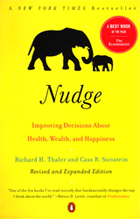
 You may or may not have been aware of a little book that’s made waves in the econo / political blogosphere recently. Nudge
 , a work by Richard Thaler and Cass Sunstein (though, one is not an economist), discusses how very small changes to our behavior lead to great(er) improvements in our well-being.
For a personal example, there’s my morning coffee routine. A small change that not only saves a good chunk of change each year, but because coffee brings people together, I got to know some of my co-workers as better friends, especially when discussing coffee blends. The unintended consequences of behavior change are quite interesting.
Nudge is a book that hinges on how to consciously “engineer” our choices towards some object (goal) that we aim for. For a long time in economics, we studied people as if they were rational decision makers who decide optimally. That’s a laugh. “Homo Econimus” may live in the museums of an Introduction to Economics book, but today is an extinct species of thought.
Sunstein and Thaler find that we make 5 common mistakes in our thinking, and that correcting these biases would help us make better decisions.
- Anchoring -We base decisions on what we know, rather than on what actually is
- Availability -We tend to think that our city is more violent than it is because thats’ all there is on the news until the weather 20 minutes in.
- Representativeness -We see this in sports alot, where attribute “streaks” that encourage better streaks in the future.
- Status Quo -We continue to do something even though circumstances change.
- Herd mentality -We tend to do things that we see others doing.
Thinking of strategies that avoid these 5 problems tend to lead to better outcomes for us. I can read these 5 problems and the problems of investing and retirement planning and cash flow maintenance come to mind immediately. What I gather from these issues is that taking a step, or two back to reflect upon a decision to be made would be of great benefit. One trick for my wife and I is to shop with a list, and if we spot something we want but isn’t on the list, that item gets on the list for the next trip…if we still want it then. Normally, we don’t.
The Nudge blog (http://nudges.wordpress.com/) is pretty stellar if you loved the book. They talk a lot about Nudges in the news. It’s really interesting stuff.