This attorney in Tennessee wrote a little ditty about Timothy Geithner. The song points out some inconsistencies between Geithner’s failure to pay his own income taxes and the IRS’s more recent aggressive stance towards individual filings. Its got over a million you tube hits, so she’s evidently struck a nerve.
It’s important to keep in mind the hit to your wealth when you filed your taxes incorrectly. You likely will need an attorney and could be facing fines or at the very least some steep litigation fees.
So, my wife Miel and I were at our local BB&T branch a couple of weeks ago. We were adding her to the safety deposit box I had opened. While we were going through the paperwork, the banking rep took the opportunity to pitch us on overdraft protection for our checking accounts.
I waffled. While I didn’t want to criticize BB&Ts products directly in front of a BB&T rep, I generally think that overdraft protection – in particular overdraft loans – are nonsense. Here is why:
1) It’s not protection for you, its revenue for the bank. Often, overdraft protection arrangements are loan agreements whereby they cover any expenditures made in excess of account deposit balances. Typically these sorts of loan arrangements carry annual fees and interest rates of 12 to 18%.
Something like 46% of people overdraw their accounts due to excessively liberal use of ATM cards (1). That is, they just make too many withdrawals. Typically, it’s a bunch of small transactions, 5 buck lattes, $40 at the ATM, 10 dollars for Chinese food, stuff like that. What this means is, for a bunch of small transaction, the consumer gets slapped with 18%.
Think about it, is it in your best interest to pay a percentage on money you don’t have? On the other hand, banks can make 12 to 18 percent with the overdraft product. When considered this way, it becomes clear that overdraft loans aren’t really protection for you, they’re money for the bank. Bank revenue numbers support this. In 2007 the banking industry made 17.5 billion on overdraft fees (1). Use the cash to build your wealth instead and you will be much better off.
2) There are better alternatives. The high cost of overdraft protection loans means you probably should think about alternatives. These include:
A) Linking checking to a savings account. Usually there is a modest transfer fee, something like $5 dollars. But, this is certainly better than an annual fee and 12-18% interest.
B) Better account management. If you are using overdraft protection more than once in a while, it probably means that something is wrong with your cash flow management. Instead, it might make sense to think about ways to improve your cash arrangements. These could include a paper register for your transactions or increasing your use of paper money.
For more on this topic check out Wisebread’s posting – it’s got Ralph Nader (WB).
Some things in life are a necessity, food, water, shelter. Some things are a luxury. One controversial luxury is pet insurance. While it might seem ridiculous, a lot of people own pet insurance. Expenditures on medicine and medical services for pets was 9.3 billion in 2007 (1).
At any rate, if you’re in the market for a policy for your pet, here is another informative video from Stacy Johnson’s Money Talks News. It gives you some pointers on what to look for if you’re buying a policy. If you are looking to buy one, please keep in mind the wealth-building alternatives you could be plowing that cash into.
Oh yeah, by the way…here are our fat cats! We don’t have insurance for them!
Regardless of your current economic situation, cutting expenses and saving additional money is always welcome. You may be surprised to realize how much of your monthly expenses go to insurance companies. While some of this coverage is prudent, most people can examine, change, or eliminate insurance policies for huge savings without losing security.
1. Save and Invest Health Insurance Premiums. If you must pay health insurance premiums, consider a tax advantaged Health Savings Account and high deductible health insurance policy. You can invest the premium savings into your account, earn interest, and deduct those savings (within IRS limits) from your income tax. The higher deductible health insurance policy should also be much cheaper than a lower deductible plan.
In addition, you can use the account to pay for a variety of medical services, like dental or vision care, that are not covered by major medical insurance. Since you can deduct the account savings from your income taxes, you can think of that deduction as a discount on medical services!
You can roll over your savings from year to year, and keep earning more interest. At retirement age, you can withdraw the savings with no tax penalty. So if you were lucky, and did not have to spend all of your savings on medical services, you can add it to your retirement savings.
2. Auto Insurance Premiums. Did you know that the difference between a $500 deductible and a $1500 deductible can be hundreds of premium dollars every year? If you could take part of that premium difference and save it in an interest bearing emergency fund, you would be far ahead if you can avoid making an auto insurance claim for several months.
Sure, you need to consider how much you can afford to pay if you do have an accident. But the higher premium for the lower deductible puts you in a situation where your expenses are much higher, and you will be less likely to have savings.
3. Save Hundreds on Disability or Long Term Care Insurance Premiums. Most Long Term Care (LTC) policies have one thing in common with disability policies. They both include waiting periods before coverage will start paying, and they also have a set time limit that they will provide coverage.
The waiting period may vary between a few weeks to a number of months. Likewise the coverage time could vary from months to years to lifetime coverage. Insurers have flexible types of plans to vary from short term to long term coverage, and also to keep premiums more affordable by excluding very short term needs for their products. For instance, a disability policy with a 60 day waiting period was not meant to cover a minor illness that only caused a covered person to miss a few days of work.
If you can adjust your waiting period, before coverage kicks in, to 3 months instead of 3 weeks, your premium will drop dramatically. Likewise, an adjustment over the coverage period will also drop your premiums. It can certainly benefit you to set aside some, or all, of this premium difference in case of a shorter term emergency.
4. Do you need all of your insurance? One type of insurance that costs a lot for the value is credit insurance, such as the type sold by credit card companies to their customers. You usually pay a percentage of the outstanding balance so that your minimum payments will be made if you lose your job, or so that the balance can be paid off if you become disabled or pass away.
But the premium is usually charged back to that same credit card. You may not just be paying a premium, but also paying interest on that premium! The very coverage that should protect your credit may actually be making the situation worse.
Most people would be better served by eliminating that monthly charge and using that amount of money to try and eliminate debt.
5. Shop Around. Do not assume that all insurers set rates the same way, or that your old insurer is giving you the lowest rates out of loyalty. Many people compare insurance companies every year to make sure they have top qualify coverage at the best rates. Online insurance quote forms make this task much simpler.
This article was written by Barbara Waltz, an industry expert and one of the founders of a well known insurance blog.
You’ve probably seen the headlines by now. General Motors is planning a reverse stock split.
A reverse stock split is essentially a procedure to reduce the number of shares a company has outstanding. For example, assume a company has 10 million shares outstanding and each share is valued at 10 dollars. If the company engineers a reverse split of 10 for 1, the ending number of shares outstanding will be 1 million and each share will be worth $100. Reverse splits are usually done by companies who wish to raise the price of their shares. Unfortunately, the are often done by firms who have weak financial positions.
Now, back to GM. GM filed a Schedule 14C to notify the SEC of their action. The 14C announced the companies intention to do the following. As taken directly from the SEC filing:
1) “effect a 1-for-100 reverse stock split of GM common stock”.
2) “increase the number of authorized shares of GM common stock to 62 billion shares”
3) “the U.S. Treasury (or its designee) would own at least 50% of the aggregate amount of pro forma outstanding GM common stock”
4)”If the restructuring as currently contemplated occurs, there will be very substantial dilution to existing holders of GM common stock. After the restructuring, as currently contemplated…existing holders of GM common stock would hold approximately 1% of the outstanding GM common stock.”
So, what does all this mean? It means that if you own shares in General Motors, your equity stake in the company is going to obliterated. Assuming the shares are worth 1.85, after the split, they’ll be worth .0185, about two cents.
The story is getting a lot of coverage, but frankly, I’m impressed at the sheer loss of value. The company was trading at 87 dollars in 1999, thats a loss of over 53 billion in equity alone on the companies current 610 million outstanding shares. Even with the huge numbers being batted around in the headlines these days, its still an impressive destruction of wealth.
At this point you are probably well justified in selling your GM shares. They won’t build your wealth, and at best you will “only” lose some of the wealth you invested into the shares.
Its Wednesday morning. The latest unemployment figures are out. Evidently, April saw declines of 491,000 total jobs lost (1). While just shy of half a million, this was still better than last months total of 709,000.
Despite this improvement there is still a LOT of uncertainty in the economy. For example, recent headlines show that nearly 20% of US homeowners owe more on their mortgages then their homes are worth (1) and even some wealthy people are defaulting on their mortgages (1).
So, what should you be doing? Well, sticking to the basics could keep you on track.
1) Spend less than you earn. This is a “no brainer”. If you consistently run a budget surplus, you’ll be in much better shape then if you run a budget deficit. Learn how to live frugally, and implement frugality into your every day life. Again, spend less than you earn.
2) Educate yourself. We have a mini-library of personal finance books, reference works and textbooks so we can understand corporate balance sheets, accounting terminology, macro economics, etc. etc. A little education never hurts.
3) Build up an emergency fund. Personal finance thinking is shifting. Current advice is to be in cash or bonds and maintain a large emergency reserve due to tightened borrowing conditions.
4) Invest in ownership. Stocks are the pits, but the evidence is conclusive. Owning a business is still a good way to achieve serious substantial wealth. It is much easier to create wealth when you are owning something, anything really.
5) Pay off high interest debt. Credit cards, rent to own schemes and payday loan arrangements all can charge upwards of 100% effective interest. Avoid these like the plague. If you’ve got them, consider allocating your extra funds to paying them off.
We’ve blogged about this at length before, here, here and here. In fact, we’ve said this so many times, we’re getting the digital equivalent of blue in the face. But all of these, when prudently managed, should help improve your bottom line.
It’s Tuesday, that means its time for the link round up.
1) Suze Orman is changing her advice. Instead of arguing that people should pay off their credit card debt, she is now saying that you should build up your emergency fund. The reason being is its much harder to borrow against your credit cards or home equity these days if you fall onto hard times (SuzeScoop).
2) On a similar note, personal finance stalwart Jane Bryant Quinn advocates moving out of stocks and into cash and bonds (Bloomberg).
3) Helaine Olen at Slate says most personal finance advice over the past 30 years has been trash. Who’s to say she’s wrong? (Slate).
4) CNN says frugal is now hip. Amen. Check it out for living frugal tips and how to add the “live frugal” mindset into your own life. (CNN).
5) Evidently, garage sale proceeds are taxable, but only if you have capital gains (DMWT).
6) Official statistics say housing is looking better, Zero hedge says its a false indicator. You decide (Bloomberg, ZH).
7) If you’re interested in something a bit more thrilling, Master Your Card has the story of Christy the bank teller. Christy’s bank got robbed – twice (MYC).
8) Malcom Gladwell is at it again. It’s a bit off topic, but Gladwell has an interesting mind. This time he explains how underdogs can win in contests against opponents vastly superior in strength and talent. In it, he advocates that that the Federal Reserve should make its monetary adjustments in real time, via a computer. (NewYorker)
9) Yes Virginia, there are millionaires next door. Check out JD’s blog posting on his millionaire neighbor (GRS).
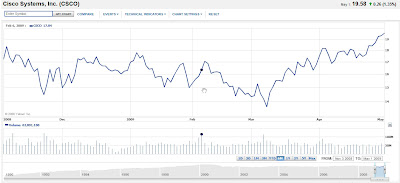
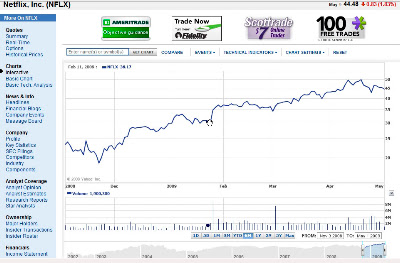
So I finally got around to figuring out what I wanted to buy with my recent ROTH IRA contributions. After looking around at a couple of mutual funds, that are obviously unimpressive these days, I opted for tech stocks. This reflects what our stock buying plan is for 2009. We selected tech stocks, since it seems that people are still using more technology than ever, even in a down market.
Specifically, I split my ROTH IRA contributions in half between Cisco and Netflix.
For Cisco they seem to be holding strong and manage a great deal of the back end of technology. I also read an article back in the fall from Forbes that was talking about their business model and the quality of their management. The details are fuzzy to me now, but they seem to be a solid company that will continue to be in demand. They are also hanging on in this market, so I figure that say something. I think this will be a buy and hold stock, since I’m not expecting this to take off like gang busters.
As for Netflix, it seems they have won the battle of the video market. Going to the video store is just so eighties. Now that the streaming videos have been available, and can go direct to one’s TV, I think that Netflix is only more likely to gain a larger market share. Given how quick technologies change, I’ll keep an eye open to see if their is viable competition that seems likely to boot Netflix out of the running.
I know I could have done more research overall, but I found a couple of good stocks and went for it. Had this purchase been for larger sums of money I would have done more due diligence, but as it was I’m happy to have maxed out my contributions for another year and hope to see my wealth increase from these investments. Wish me luck!
James & I have splurged and decided to treat ourselves to a gym membership. We had been considering it for awhile but finally took the plunge last weekend.
While $110 a month, for each of us, is arguable a steep price to pay, but we think it is worth it.
Motivation: For James he used to play rugby and run regularly, but since going back to grad school the motivation to exercise has been lacking. For myself I have already been consistently working out four days a week for several years, so I figured that I could step up my routine.
Convenience: The gym is only a couple of blocks away and is a nice tranquil place that draws you to it. They also have great schedules of classes – thus far I’ve tried out inspired yoga, spinning, boot camp, and power abs this week. James has also made it three times.
Short and Long Term Health: Though I was working out often before, I’ve basically doubled my workout time from switching to an hour class in the morning rather than a half hour video. I can feel the benefits already.
Long-term Value: I figure that if I were in my grandmother’s shoes, at 93, I’d probably think it was money well spent. I was also paying the same for medical insurance before, which is now covered by my work. I haven’t seen a general doctor in the last five years so clearly I’m getting more from my money at the gym, and improving my health!
Relative Value: While considering the debate of signing up for the membership I ended up at a dinner party where people were talking about the price of their cable and flat screen TVs. It occurred to me that I’d much rather have a gym membership to pay for than cable or a car. Investing in yourself, whether mentally or physically, is usually money well spent.
While it might be more money out of our pocket, we are very happy to be hitting the gym.