Avatar photo About James Hendrickson

James Hendrickson is an internet entrepreneur, blogging junky, hunter and personal finance geek. When he’s not lurking in coffee shops in Portland, Oregon, you’ll find him in the Pacific Northwest’s great outdoors. James has a masters degree in Sociology from the University of Maryland at College Park and a Bachelors degree on Sociology from Earlham College. He loves individual stocks, bonds and precious metals.

Six Considerations When Investing In Stocks

considerations when investing in stocks

considerations when investing in stocks

You have a lot of choices when it comes to your money. You could buy something fun like a flat-screen TV or a boat, you could remodel your house or you could even take that dream vacation. On the other hand, if you wanted to be a little more practical, you could put your money to work for you and invest it in the stock market.  However, getting the most of out of the market is sometimes easier said than done.  Here are some general considerations.

1. Stock Picking Gurus Often Have Poor Long Term Performance

The history of U.S. stock markets is littered with hot stock pickers who ended up failing. For example, famous market pundit Jim Kramer’s investing skill has been unfavorable compared to a monkey.  Taking a broader approach CXO Advisory ranked the performance of investment managers between 2005 and 2012 (1).  They found that most of them don’t manage to consistently beat market indexes.  Other studies have found similar results. Take the advice of “gurus” with a grain of salt.

2. Market Timing Can be More Challenging Than it Looks

Market timing is basically the strategy of making buy or sell decisions of financial assets (usually stocks) by attempting to predict future market price movements. It’s controversial, but some people argue appropriately timing markets can significantly boost your returns. Timing is often more challenging than it might seem. A few things get in the way of effectively timing markets, including the need to fully evaluate things like consumer confidence levels, industry specific metrics and corporate profitability, along with economic indicators like interest rates and retail spending. Also you’d need to get good at technical analysis, which is the process of reading charts containing  information about trading volume and price). So basically, its hard to identify when markets turn and in order to so effectively you need specialized knowledge.

Feel free to use this image just link to www.rentvine.com3. Stock Market Risk Diminishes over Time

Your 401(k) investing experience or just reading the newspaper – has probably convinced you the stock market is a risky place to put your money. However, U.S. equity markets tend to have a strong upward historical trend. Since at least 1926, and adjusting for inflation there has never been a 20 year period when you would have lost money in a diversified portfolio of large company stocks.  So even when you account for the impact of inflation and market downturns, if you have a very long time frame you’ll eventually make money.

When considering your entry into the stock market, it’s important to not only think about which stocks to buy but also to understand the broader context of your investments. For example, CSL Limited, a leading biotechnology company listed on the Australian Securities Exchange, represents a sector that could diversify your investment portfolio. By keeping an eye on the CSL ASX stock price, investors can make informed decisions about when to buy or sell, based on comprehensive market analysis and an understanding of how different sectors contribute to their overall investment strategy.

4. Your Time Horizon Determines Your Risk Perception

With equities, time horizon is the length of time over which an investment is made or held before it is liquidated. Time horizons can range from seconds, in the case of a day traders, all the way up to decades for a buy-and-hold investor.  There is no “right” time frame – it depends on the investor’s individual objectives. That said, you should have a longer time horizon (such as 5 to 10 years) if you have lower tolerance for risk. This is because stock market values can fluctuate wildly in the short term and you’d need time to make good on any potential losses.

5. The More You Have In The Market, the Greater The Mental Wear and Tear

As your net worth grows you’ll likely have more money in the stock market. This is because many people tend to invest through their 401(k), through mutual funds or via direct ownership of stocks. While the trend isn’t perfect, statistically speaking richer people tend to have more money in equities (stocks & mutual funds).

wealthy people own stock
Source: IRS Statistics of Income.


However, what this means is the more you have in the market the more you need to be aware of fear and greed. The better you understand your ability to handle fear and greed, the better you’ll be able to stick to sound investment decisions based on knowledge and historical patterns. This becomes even more important the more you have invested.

6. You Need To Be In the Market To Profit

It goes without saying that you’ll never profit from the stock market if you don’t own stocks. But not only is being in the market important, what kind of assets you buy is also important. This is because asset allocation is a big part of investing returns.  The profitability of stocks in U.S. equity markets has historically been consistently 3% or 4% higher than alternatives like bonds and cash. Some research also suggests that asset allocation, not picking individual stocks or trying to time the market, is the most important aspect of successful investing. In any event you won’t profit if you don’t bother to invest. So having market exposure and understanding asset allocation are required before you can bring in the serious bucks.

So what does all this mean for the individual investor?  It means three things:

1. Given the challenges of timing the market, a realistic strategy for the majority of investors would be to invest in stocks immediately. Don’t try to call the market, just go ahead and buy.
2. Long term, it’s almost always better to invest in stocks—even at the worst time each year—than not to invest at all.
3. Dollar cost averaging is a good plan if you’re prone to regret after a large investment has a short-term drop, or if you like the discipline of investing small amounts as you earn them.

You may also check these:

Image source: 123rf, AI generated.

The Buy and Hold Strategy and Its Alternatives


Hi All,

For this posting, I wanted to pose a question. For most of the last forty years, the conventional wisdom has been that buying and holding financial investments has been an optimal long term way to build wealth. However, last years meltdown has given a lot of people reason to reconsider this. The question therefore becomes: What are the viable alternatives to buy and hold?

The “buy and hold” strategy has a couple of components. One is compounding, the second is time. The thinking is that overall increases in corporate profitability reflected in higher share prices will be augmented by increasing stock or bond payments. Increases in equity prices and elevated payments over time will allow compounding to take effect. The end result is a high degree of wealth at retirement. The curve looks something like this:

The idea is that where there is moderate growth, then by retirement the amount of wealth starts to increase substantially due to effects of compounding. The end result should be, at least theoretically, enough money for ones golden years.

However, there are a number of problems associated with the “buy and hold” strategy. The problems are conceptual and practical.

First, conceptually buy and hold suffers from historical bias.

Most advocates of a buy and hold strategy draw on the experience of US stock and bonds markets since the great depression to show that overall financial prices and payments have a long term upward bias. However, the long run performance of some stock indexes in other industrialized countries have shown no such positive bias. For example, the Japanese Nikkei average has actually declined over the past 20 years. Other indexes like the German DAX have been essentially flat since the 1980s. So, the assumption of upward bias is highly US specific and is based on performance in the post war era.

Second, the buy and hold strategy is practically challenged.

In this regard there are two problems. First, life sometimes gets in the way of holding on to ones investments. People get divorced, illness can strike, circumstances oblige one to sell investments, wars happen, family members can fall on hard times, etc etc. Second, stock market unpredictability can torpedo your investment plan.  Anyone who has been a

So, if buy and hold is out, what can you do?

This a 64,000 dollar question. Buy and hold has been extremely successful for many people. But, one should not rule out the possibility that the strategy may not work in the future. Accordingly it might make sense to consider some alternatives for securing your financial well being. As I see it, you have at least three options:

1) Modify the buy and hold strategy
2) Takeover a small company
3) Extreme savings

Some people feel that trading stocks while cleverly avoiding downturns is the best way to build wealth, however most of these people lose their money. You are probably safe rejecting market timing out of hand. On the other hand, these options are viable. They also assume you’ll keep your day job and that you have a good amount of time before retiring.


First, try a modified “buy and hold” approach.

It is possible to modify a “buy and hold” strategy with the following considerations.

1) Relative emphasis on index funds. Index fund are weighted by market capitalization. This means they will drop any companies whose share prices decline precipitously or bonds that become worthless. In other words, they automatically reject the worse losers, so your downside it limited. Index funds are also preferable for a number of other reasons that have been well addressed elsewhere.

2) Supplemental business activity. One way to mitigate the chances of buy and hold failure is to start a side business. Even if you bring in 5k to 10k a year, the difference in income can help in a number of ways. The extra money can keep you out of debt, reduce your borrowing costs or increase your passive income.

Second, buy majority shares in a small company.

If you chose the small company correctly it is possible to buy a majority interest in the firm, thereby allowing you to take control and divert profits accordingly. This is very rare, but it can be done. For example, the family that now owns Tootsie Roll Inc. did something similar in the 1920. They and their extended relatives pooled their funds and bought shares over a long period of time. After owning 51% of the available equity, they installed a new president and executive officer. It can be done. It is difficult and concentrates your wealth in a single business, but some people prefer that level of challenge.

Third, ignore investing entirely.

If buying and holding stocks won’t get you the financial security you want, its possible to switch to an extreme saving strategy. The idea here is pay off ALL your debts then switch to saving via ultra safe CDs or government bonds. This would entail something like the following progression:

1) Payoff non-deductible debt (car loans, credit cards, etc)
2) Eliminate smaller deductible debts (student loans, etc.)
3) Payoff your larger deductible debts (typically your mortgage)

Once you get started the debt payoff will take less time than you think and will result in a good amount of disposable income. This income can be saved safely via CDs or other low risk products, possibly government bonds. Ten or 15 years of saving can then secure your retirement future. Of course, you may still need to draw on your savings, but at least you will have less direct exposure to the financial markets.

If you have any other ideas for wealth building, please do leave us a comment below.

Read More

Want to Build Some Passive Income? Consider Ark7.

For our European Readers, Consider BankingGeek

Want Real Money?  Consider Buying An Oil Well

Don’t Forget the Basics

basic finances, personal finance, going back to basics

If you’re reading this post it means you care about building your wealth.   The road to wealth accumulation can be a long and hard one, so when you’re out hunting down your next deal or shaving some bucks off your budget with coupons, don’t forget the basics:

1. Live Below Your Means

Often when people get a raise or otherwise come into money they tend in increase their lifestyle related expenses.  For example, people who get a new house often feel the need to buy new furniture or get new clothing.  The money you don’t spend on ‘stuff’ or waste on expensive travel or meals could better serve most people by being saved and invested for the future.

2. Buy High-Quality Durable Items

When I was in graduate school, I had a friend who always bought cheap sneakers.  My friend reasoned that the sneakers were great because they only cost 20 dollars – however, they always fell apart after a few months – meaning that there really wasn’t any value to the sneakers at all.  Instead if you want to get real economy, consider investing a little more upfront in to get a long term better value.  For example, consider getting 80 dollar sneakers that won’t fall apart in a few months instead of 20 dollar shoes that are guaranteed to be junk.

3. Save

Its impossible to get wealthy without investment capital.  Anything you want to do – buy a house, pay off debt, invest in stocks, start a business – requires some degree of investment capital.  The best way to get capital is through savings.   It doesn’t matter where you are in your wealth development, a beginner, working on more intermediate projects or already comfortable, etc – you need savings to move forward.  There really isn’t any way around it, you have to come up with capital and the best way to do that is through savings.

4. Have an Emergency Fund

Life in the U.S. over the past five years has proven to be very unpredictable.   Huge numbers of people have lost their jobs and many have seen their income cut and the value of their homes and stock portfolios eroded.  So, prudence dictates that you should consider having a stash of cash.  Without enough liquid funds when unexpected financial situations come about, you could be stuck with higher borrowing costs or in a worst case scenario – inability to take care of yourself or your family for lack of resources.

5. Invest Smart

Investing can really supercharge your wealth accumulation efforts.   But you have to be smart about it.  This means investing in high quality opportunities, such as good quality common stock and mutual funds.   It also means educating yourself about investing and doing common sense things to improve your bottom line, such as avoiding fees and diversifying where it makes sense.

6. Re-Invest Your Profits Wisely

At some point, some of your investments are going to pay off for you.  You’ll likely have either capital gains or dividends to decide what to do with.  A smart idea is to reinvest the proceeds of your risk and labor into your investments or businesses.  This will allow you to take advantage of the time value of money.  The time value of money indicates that in general, the more and the longer you invest, the more wealth you should have at the end of your investing process.  While it doesn’t always work, generally speaking reinvesting can help build your wealth.

7. Take Advantage of What Uncle Sam Gives You

Many employers offer a 401k plan and very often your employer matches every dollar you invest with some percentage.  That is basically free money that makes sense to pick up.  If  you are self employed, there are SEP-IRA and ROTH IRA options available also.   The bottom line here is that you should stuff as much money into tax deferred accounts or other tax reduction mechanisms offered by the internal revenue code.  Do it, it works.

All of these have been shown to work effectively in building wealth over time, so don’t forget to stick to the basics.

Is Ark7 Safe?

Amidst declining real wages and decade-high interest rates, you might be contemplating entry into real estate. One avenue worth exploring is through crowdfunded real estate platforms, with Ark7 being a notable example. If you are considering investing in real estate through Ark7, you need to know whether it is a trustworthy investment opportunity.

In this article, we will take a look at Ark7, evaluate its safety, and give you an overview of what you need to know to make a good decision.

What is Ark7?

Ark7 is a real estate investment platform that allows investors to invest in commercial and residential properties from as low as $20.

The process involves investors acquiring shares in the properties available on the platform. Subsequently, Ark7 handles property management and other administrative responsibilities. By pooling investment dollars from various investors, the platform acquires properties and distributes shares to its investors.

Is Ark7 Safe?

The short answer is: Yes, Ark7 is mostly safe.

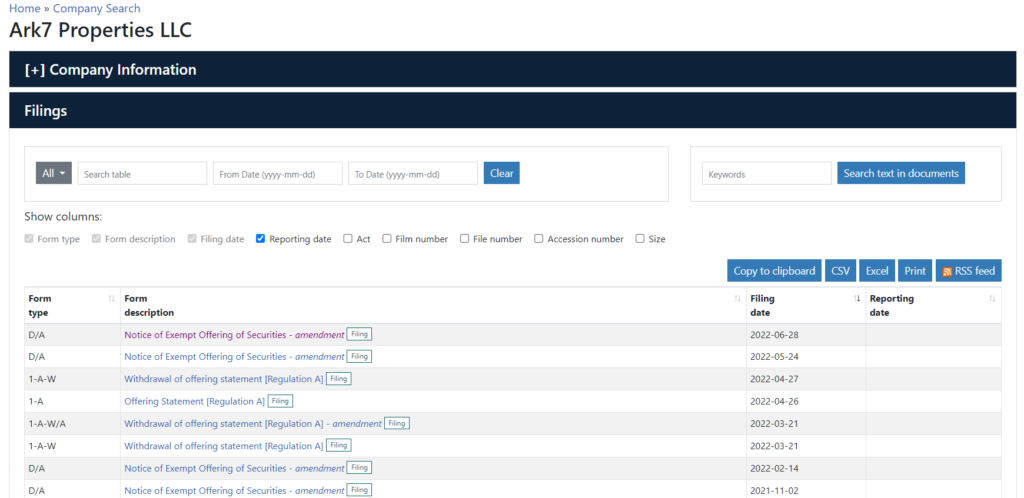
Ark7 is SEC-regulated and follows all legal requirements. The company provides investors with a high degree of transparency on their investment, including their percentage ownership of the underlying property, rental income, financial reports, and maintenance costs. Investors can also track their investment progress through the platform’s dashboard. Here is Ark7 SEC’s filing:

Ark7 SEC filings
Ark7 SEC Filings, Accessed 11/27/2023.

Ark7 also does a good job screening which opportunities to include in their platform. For example, the platform only invests in properties with strong cash flow potential and avoids those with high risk or low return. In addition, the platform uses an experienced property manager that can help mitigate risks.

Ark7 is relatively safe, but it is also subject to all sorts of risks. These include interest rate changes, risk of regulatory change, market fluctuations, or other changes.

What Are the Benefits of Investing in Ark7?

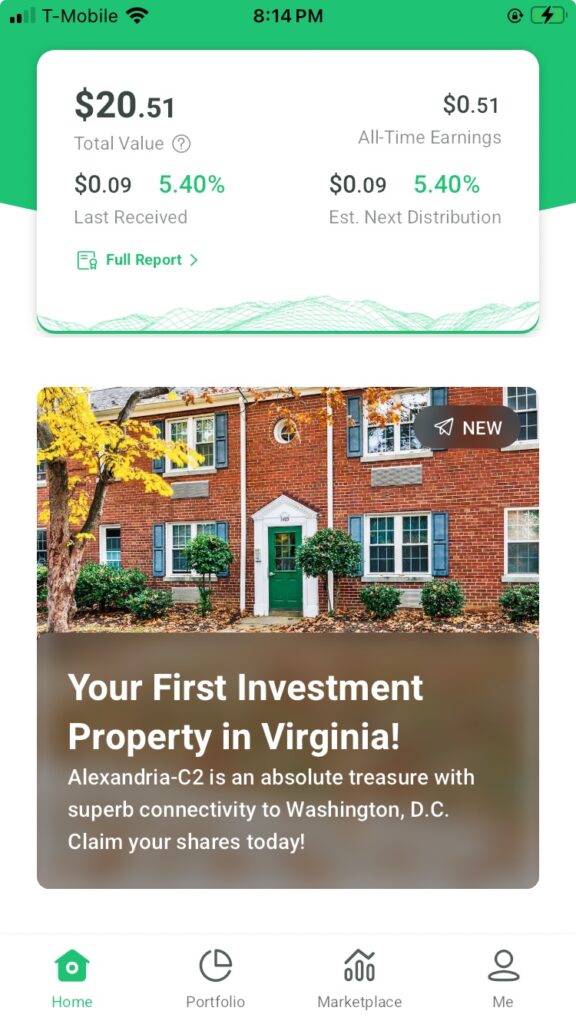
Author’s Ark7 account.

One of the benefits of using Ark7 is its low minimum investment requirement. Investors can start investing for as low as $20, which makes it an accessible investment opportunity for those who are cash-constrained. Another advantage is that investors don’t have to worry about management tasks; Ark7 takes care of everything. Investors receive monthly rental income and have the opportunity to make a profit when the property is sold.

But, the real advantage of Ark7 is its ability for investors to implement a geographically targeted investment approach.

Unlike competitors such as Fundrise, Ark7’s offerings are highly specific — you invest in specific properties in specific cities. If you believe that a specific geographic area may appreciate in value more quickly than others, Ark7 will allow you to make targeted investments to capture that appreciation.


Ark7 has offerings in many, but not all U.S. cities.

Investors can also opt to invest in commercial properties like shopping centers, office buildings, and even industrial properties. Residential assets such as single-family homes, duplexes, and multi-family buildings are also available.

Lastly, if you are thinking about signing up – you can do it here.

Wrapping This Up

In conclusion, is Ark7 safe? Yes, it is. It is a trustworthy platform that allows investors to invest in real estate with reasonable risk. With its SEC-regulated status, transparency, low investment minimums, and geographic focus, it is a good investment opportunity for cash-constrained real estate investors. As with any investment, there are risks involved that investors need to be aware of, but with proper due diligence and research, Ark7 can provide a solid investment opportunity.

Read More Great Dinks Articles

Everything You Always Wanted To Know About Ark7 But Were Afraid To Ask

Is Ark7 Legit?

Here Is The Reality Of Building Streams Of Income

Grow Your Wealth Fast — Learn To Pick Stocks For Maximum Profit

pick stocks for maximum profit

pick stocks for maximum profit

There are thousands of stocks to choose from, and investors can pick any company they want.  Are you looking to increase your wealth through investing, but not sure how to pick stocks that will bring in the biggest profits? With stock markets nowadays offering so many options, it can be difficult trying to make smart investment decisions. It’s important that investors have a clear understanding of what factors should influence their decision-making process when picking stocks for maximum profit. If you are looking to execute sales directly, visiting Share Sales Direct can provide you with valuable insights and tools. This platform facilitates the direct sale of shares, allowing you to bypass traditional brokerage firms and reduce transaction costs. In this blog post, we’ll go over some key points on how to evaluate potential investments.

Here are some considerations that may help you select stocks that are going to perform well.

1) Name Recognition & Personal Experience:

One way to get an edge is to buy stock in companies with brand recognized for quality and which you have personal knowledge of. For example, if you enjoy traveling and you stay at the well known hotel chain Marriott International Inc., and you feel their service and customer experience is good, you might consider buying their share.

The advantage of personal experience is you have an on the ground sense of whether a business is growing or not. In the case of Marriott, you can tell if there are people in the lobbies and cars in the parking lot. Leveraging your personal experience is an idea utilized by professional money managers. For example, Peter Lynch made the idea popular in his famous book One Up On Wall Street: How To Use What You Already Know To Make Money In The Stock Market. Famed stock picker Jim Kramer has also historically done on the ground research on the stocks he’s bought.

2) Profitability and Price-performance:

If you want to pick stocks for maximum profit, buy companies that have a three-year history of growth in both profitability and price.

Regarding the first point, the company really needs to be profitable. How can you tell? Well, this means it should be 1) pre-tax cash flow positive and 2) needs to have grown both its earnings per share and its post-tax profits in the past three years beyond what could be expected due to inflation. About this second point, we like to see that the price of the stock will move in tandem with its growth in profitability.

If the company is profitable, but its share price hasn’t gone anywhere in years, like Microsoft under Steve Ballmer, then it makes sense to consider other alternatives. The main idea here is that price follows earnings. The more profit a company makes the more valuable it should be, all things being equal.

3) Balance Sheet Health:

The total debt to assets ratio should be less than .5, meaning there should be 50 cents of debt, or less, for every dollar of assets. This is a must. Companies are like people, debt slows their ability to be competitive and to react to changing market conditions. Debt also reduces a company’s ability to be profitable by increasing interest expenses it needs to pay.

4) Dividends:

Your investment should make at least a small dividend payment.  All things being equal, the bigger the dividend the better, provided the payments are sustainable.

Dividends do several things:

  1. They force company management to make good decisions. If managers know they’ll need to make a dividend payment, they’ll allocate their resources in the most efficient manner.
  2. Dividends are a signal of good corporate governance. Company managers can always fiddle with accounting tricks to create nominal improvements in margins, but its a lot harder to fake dividend payments. Either the money is there or it’s not.
  3. Dividends provide you a source of income, so you’ll get cash payments in addition to any appreciation of the stock you own.
  4. Dividends mean share price increases. All things being equal, dividend-paying stocks tend to outperform non-dividend paying stocks by a small margin. This is largely because their earnings are better than non-dividend stocks.

5) Smart Money Buys The Stock:

Commercially available free services such as Yahoo Finance will tell you what percentage of a company is owned by institutional investors. When selecting stocks for maximum profit, look for institutional ownership from organizations you think are smart. A note of caution here – if a company is part of an index such as the S&P 500 or the Russell 2000, then index funds will buy the stock regardless of what they think of the company. So what’s important here is which institutional investors are buying the fund. If a well regarded management company such as Dodge and Cox is buying the shares, that’s a favorable indicator.

6) Other Factors:

Of course, a ton of other factors are important; price, analysts ratings, capitalization size, industry, etc.

When its all said and done, examine the total picture and make a subjective judgment based on these criteria.

Here are more great articles on the topic of wealth building:

Nine Ways To Make Extra Money
The Pros And Cons Of Mutual Funds
What Building Seven Streams Of Passive Income Really Looks Like
Yes, You Can Buy An Oil Well
Near Future Report Review 2025: Is Jeff Brown’s Manifested AI Prediction Legit?

If you liked this article, please share it on social media!

Image source: Free Thinkers.

The Five Signs of Financial Fraud

5 signs of financial fraud

If you are concerned that your financial advisor might be a thief, you should check out this.


With 11 books under his belt, Fisher is a prolific author and as chairman of Fisher Investments, he’s on the Forbes list of America’s richest 400 people.  The video was filmed when Fisher was a guest speaker at Humboldt State University in California. It outlines his thinking on how you can identify scammers in the money management industry.  According to Fisher, these are the five signs of financial fraud.


The Five Signs of Financial Fraud

1. They combine decision making and custody of assets. That is, the same person who holds the money makes the decisions. All criminals do this, but its not necessary proof positive of crime. Many legitimate hedge funds do this too.

2. Returns are always too good to be true. All great investors have bad years.  In contrast, scammers offer high and smooth returns.

3.  Scammers use complicated or confusing concepts to explain investing results. Ponzi schemer Bernie Madoff talked about “split strike conversions”, and NFL scammer Kurt Wright used the terms “capitalizing volume metrically”.  The use of these complex mysterious terms discourages questions.

4. They market unimportant symbols related to exclusivity/prestige. Thieves often have photographs with politicians and celebrities. They also build impressive false biographies or personas. In some cases, scammers will own expensive jewelry or high profile assets like cars or sports teams. These are used to manage the scammer’s image and lure victims into giving them money.

5. They discourage due diligence. Fraudsters often deflect questions and avoid transparency. Legitimate people will answer questions and provide good service.

Fisher also argues it is harder to spot a fraudster today as society has become more mobile. This means that most people don’t have good background information on potential investment professionals.  Flashy lifestyles and photographs with movie stars are not a good basis for investing. Instead, you need to ask the right questions and exercise due diligence.


That’s nice, so what?

Here is the takeaway. If your broker shows the five signs of financial fraud, you can check up on him or her.   Go to the Financial Industry Regulatory Authority (FINRA) website or you can visit the Securities and Exchange Division’s Investment Advisor Public Disclosure webpage.  Both of these will let you examine the track record of your advisor – and hopefully prevent you from getting ripped off.

For more, you might enjoy our articles on:

Are the Madoff Family Members Innocent Victims of Willing Accomplices?
More Fallout from the Madoff Disaster
The 20 Most Famous Pyramid Schemes
There Are The Signs Of A Fake Rich Person

Away Days Brewing: Beer, Bonds and Community Investing For The Win

Away Days Home Brewing

I don’t usually recommend individual passive income investments here on dinksfinance, but there is one I wanted to share with dinks readers.

Here is some context: I’ve been investing in small business bonds through a marketplace called SMBX (SMall Business eXchange), which screens small businesses and helps them issue bonds.  We’ve covered them pretty extensively here, and here.

Away Days Brewing

Well, last week I was reviewing the site and I saw a small business here in Portland, Oregon, that I thought looked promising. Its a brewery called Away Days Brewing.  So, I saw the place was local.  Then I called a friend and went to visit. I was pretty impressed.  The brewery was clean, full of customers, the beer tasted good, and the staff seemed happy.  I chatted with the bartender who basically corroborated the information that was in Away Days bond prospectus.

In any case, they are issuing about $350,000 worth of bonds, at 10.5%.  Here is the image from their bond offering on SMBX.

Away Days Home Brewing

You can find the actual bond paperwork on SMBX’s website, here.
I put something like $560 dollars into the offering.  This should give about $12 in terms of monthly principle and interest payments, so its a nice little addition to my passive income streams.  Once the offering closes, payments should start in about 30 days.

What’s Great About This?

One thing I like about SMBX is that it makes investing more concrete. Most of the time when I invest in stocks, the returns are basically numbers on digital screen.  With an investment like Away Days Brewing, its nice to see the business actually working – that is watching the beer get poured and people paying the brewery.  So, I can see their financial activity is actually backed up by real economic activity.  This is something that has been missing from the stock and crypto markets.

If you get a chance, you should have a look at Away Days Brewing’s offering. You can find it on SMBX here.

SMBX and Communities

While I’m on the topic…
I’m not a huge fan of the concept of system racism – it often gets used a political and sociological cudgel by special interest groups. However, its abundantly clear that the bigger banks systematically disfavor African American owned businesses. This tends to starve these communities of capital and helps keep them poor.  I like SMBX because its crowdfunded model means that capital is provided by local communities, not by huge institutions.  Crowdfunding also means that bond payments are made to local people, not to the big banks, whose executives hog the returns.
So, the SMBX model is much better at distributing capital to local communities and in particular communities of color.

For more great money making ideas, read these:

Our List Of Top Ways To Make Extra Money
Want A Lucrative Side Gig – Buy An Oil Well
Stacking Cash, Some Free And Low Cost Ways To Make Extra Money

Eight Ways To Eat For Less And Save Like A Champion

eat for less, frugal eating, frugal grocery

eat for less, frugal eating, frugal grocery

Everyone needs to eat, but eating doesn’t have to break the bank.  One of the easiest expenses to reduce is the amount you spend on food.  Reducing your grocery bill may mean eating more homemade food, but it generally means that you have more money in your pocket and better control of your diet and your finances.  Here are eight sure-fire ways to cut down on the amount you spend on food.

1. Buy the house brands. 

The last time we went shopping we picked up a 1 lb of Safeway brand peanut butter – it was like a buck cheaper than the Smuckers brand on the shelf above it.  Always check the unit price to compare sales as well.

2. Make bulk meals.

If you double the recipe and store the extra half, you’ll be less tempted to buy prepared food or get take out.  After all, you’ll just need to pop your leftovers in the microwave to get fed.   This can be great especially for lunches – for example check out this posting over at Cleverdude.com.  This guy managed to make a months worth of sandwiches for something like $6.99. Brilliant.  There are also lots of brilliant recipes to turn one meal into another from the left overs.

3. Buy in bulk.

You can shave a few bucks off your budget if you buy in bulk.  This is especially true for staples like toilet paper, toothbrushes & toothpaste, liquor (if you want to go full alcoholic), rice, batteries, light bulbs, bread, meat (you gotta freeze it) and batteriesave-money-foods.  It doesn’t make sense to purchase perishables like fresh vegetables, berries or flour that can go bad, but it does make sense to freeze these items at the peak of their season or to buy frozen fruit/veg.

Buy apples, oranges, or other bagged fruit while in season and on sale.  If you eat it regularly, salsa is a great one to buy in bulk, the price is about a third in a large container versus a medium one.  Also buy in bulk when items you frequently buy are on sale.  This can help a lot with cereals, breads, soups, and the like.

4. Pack a lunch instead of eating out.

If you are still working outside of your home, pack a lunch.  Eating out is hugely expensive over time.  For example, if you spend 10 bucks a day eating out, after a month you’ll have spent $200 bucks.  After three months, you’ll have spent $600 dollars, or $2,400 a year.  Even if you make lunches twice a week you’ll save an estimated $960 a year!  Need some lunch ideas?  Soups, either homemade or healthy canned versions are very cost-effective.  Do it yourself salads save a lot also.  I have a friend who brings a bag of spinach to the office and then adds in berries, nuts, and protein.  Hummus with veggies to dip can make a great healthy and filling meal as well.  The options are endless and you’ll probably be happier not forking over cash everyday for lunch.

5. Minimize prepared foods.

Fried chicken, frozen meals and deli macaroni and cheese all taste great, but they also carry a price premium.  According to a study in Family Medicine Magazine, the cost per calorie for a convenience diet was 24% higher than for a healthy diet (1).  Salad dressings are another great one to skip on. Making your own is easy and much, much cheaper.  One good secret ingredient hack is to add red chili pepper flakes (the kind you use on pizza) with oil and vinegar.  Adding a bit of onion dip mix to oil and vinegar is also very tasty and easy.  Once you make your own dressing you’ll never want to go back.

6. Clip coupons.

Although coupon clipping is falling a bit of out of favor as the economy goes electronic (here), some people really good at saving money by using coupons.  I typically use a few key coupons on each shopping trip, only on items I buy in any case, and likely shaves about $5 a month off my grocery bill.  Its not a lot, but the savings add up over time.

Pro-tip: if you forget to bring your paper coupons to the grocery store, all is not lost.  Come back the next day and bring your receipt and your coupon.  Usually the customer service people will give you a credit or cash for the coupon.

7. Save money on alcohol.

If you enjoy an occasional libation, consider drinking less or buying less expensive beer, wine, or liquor.  For example, some good craft beers go for pretty cheap (clicky) and you can always find good values on wine for under $15 dollars.  You are better off sipping on your happy hour beverage than having several and then splurging to eat whatever.  It is best to use a budget mentality when consuming, considering whether it is worth the value.  Often times you are better off without the next drink.

8. Buy only what you need.

We all know it is easy to waste money on unused foods.  Be honest with yourself about what you will and won’t eat.  Consider what your plans are for the week, whether you will be going out of town soon, etc.  Use what you have, eat your way through your freezer and dry goods.  If you are looking at a full pantry and simply can’t find anything to eat, challenge yourself to come up with something.  Shop with a list and don’t fall for unnecessary items.  Coordinate menu items to reduce the need for excess specialty items.  Shop the perimeter of the store and avoid isles you don’t need things on.

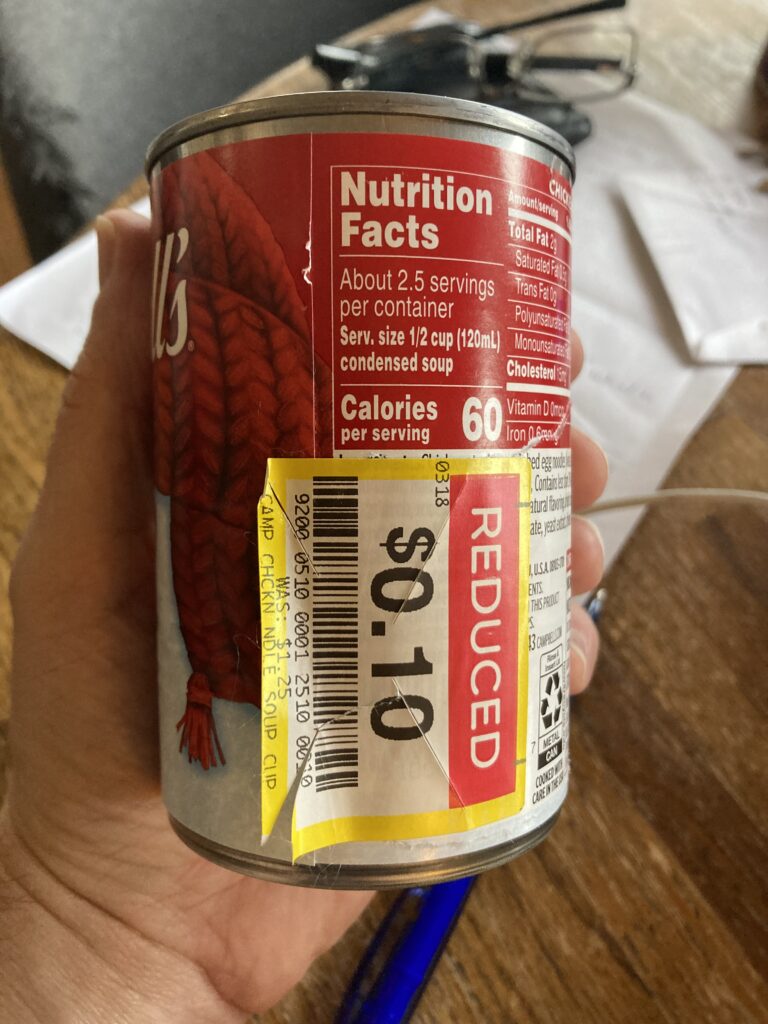
Case in point – I bought about 128 of these cans of Campbells soup at my local Kroger a year ago.  The cans were on sale for 10 cents each.  That was an unbeatable deal that I couldn’t pass up.

ambells soup for 10 cents

The only thing is I bought way more than I needed, so I ended up giving away most of the cans to a soup kitchen.

Saving money on groceries is actually easier than it seems.  It takes mindful and a bit of discipline, but your bank account (and likely waist line) will thank you for it.

Happy shopping!

For more on this read:

Nine Sustainable Frugality Tactics To Make Your Budget Sing

Frugal Tip Of The Day – Don’t Order Drinks

Yes, You Can Eat Peanut Butter and Jelly Every Day

Why Guns Are Not a Good Investment

why guns are not a good investment
“The Knotted Gun” by Fredrik Reutersward.

As you probably know, Americans love guns. Since the dawn of our country firearms have played prominent roles in politics and society. Currently half of American households own a gun and many others advocate the rights of the individual to bear arms*. While firearms are a hugely controversial political and social issue, the focus of this posting is purely on the impact of firearms ownership for personal finance. From a strictly monetary standpoint, firearms are NOT a good pecuniary investment.

Guns are financial liabilities. By this, I mean two things. First, guns often depreciate in value after they are bought. Second, owning a gun often obligates one to purchase a number of other things as well. For example, if you own a firearm, you might need to pay for:

1) Higher insurance premiums
2) Costs for ammunition and accessories
3) Costs for security, safes, trigger guards and the like
4) Fees or expenditures for target shooting

Some of these expenditures can be quite hefty. For example, a large gun safe can cost several hundred dollars. The cost of even a modest amount of ammunition can easily run upwards of $50 or more – especially considering current prices.

Generally speaking, if you are interested in building wealth, you should be putting your money into investments that will improve your financial bottom line, NOT buying guns or other depreciating assets.

*Click here for more from wikipedia.

And incidentally if you are reading this because you actually want to find a firearm that will appreciate in value, Dinks isn’t the best site for that.  Instead you should check out Sharp Shooter Society.  They have plenty of firearms reviews, including which 380 Pistol is best, and others.

You cannot copy content of this page