You may think perhaps that a little tea, or a little punch now and then, diet a little more costly, clothes a little finer, and a little entertainment now and then, can be no great matter; but remember what Poor Richard says, many a little makes a mickle, and farther, beware of little expenses; a small leak will sink a great ship.
The premise of Nickel and Dimedwas that Barbara went under cover in the working class; you can check our my review of this book here.
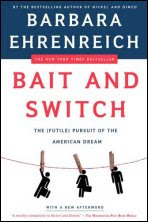
Bait & Switch – The (Futile) Pursuit of the American Dream takes another look at employment in America; this time from the middle class. I’ll admit that I actually bought the book in a bit of a rush while I was shopping to come to Kabul and thought after reading Nickel and Dimed that it was work the $6.98 on sale at Powell’s. I mistakenly thought it was about the myth of being better off with both parent’s working.
In fact, Bait & Switch is about trying to get a job in corporate America. After an entire career as a writer, Ehrenreich changes her identity and tries to get a job in corporate America. While there are some points of the book that I would identify with, I think there are a number of areas where she misses the mark:
1st – She sets up this experiment with an allotment of $5,000 for expenses related to job searching. I don’t know about you, but I don’t know many people who have just lost their job and have $5k to dedicate to coaching and travel expenses in getting a job. From my experience, it’d be more likely that the person was $5k in debt and they’d be lucky to have planned ahead and have $5k for living expenses until they got a job. 2nd – She sets her expectations way too high. For some reason, she claims it was the coaching but I think it was her, Ehrenreich expects to land at an executive level. I just think that she was in over her head and overly confident about her place in the corporate ladder.
3rd – The book reeks of an experiment with her life, and not the real deal. She clearly sees herself as different from all of the other job seekers she meets. Her attitude just doesn’t feel genuine. When someone has lost their job it is more than an experiment for fun. For instance, she upgrades or downgrades her resume as she goes along. Real people don’t have that liberty.
4th – Bait & Switch also is permeated with self justification. You can easily tell that Ehrenreich is proving what she has set to prove rather than seeing how it all plays out. It reminds me of shadiness of tweaking the stats to prove your point.
5th – She makes lots of assumptions and generalizations about job seeking and the corporate world. I don’t think she has what it takes to back these up.
I honestly started the book really wanting, thinking, that I would like to book. In the end I probably only finished it so I could report here what the outcome was. In the end, after nine months of searching, she basically doesn’t get a job and just gives up. She’s missing the whole point, that most people don’t have that option. She just acts like such a pompous know-it-all that it was hard to take some of the book.
The odd thing is, you would think that this would have been more of the case with her review of the working class in Nickel and Dimed. In the end I think she is too close to the middle class and thinks she is superior. I had much more respect for Ehrenreich before reading this book though.
To sum things up, I guess I would recommend the book if you want to have someone to argue with. If you like books that make you want to curse at the author, this one might be for you.
I guess I’ve also had some experience in this area, so that might be why I saw through her experiment. Near to the same time Ehrenreich was doing her little experiment, 2003, I was also looking for a job. Luckily it took me two months rather than her failed attempt in ten months, but my two months was far more real than her ten. I remember sitting around a room with five folks in their twenties with prestigious undergrad degrees and not one of us had a job. That was real, her experiment was far from it.
To truly illustrate my point, her last paragraph reads: I do not follow my fellow job seekers into the world of survival jobs. My great advantage in this project is that I can simply say “game over” and return to my normal work as a writer. My fellow job seekers still hang out there, suspended above the abyss.
I find it ironic that I’m actually having to deal with topics closely related to this subject. Tomorrow I’m doing a training on how to write a good CV and today I had to fire my assistant. So the realities of the importance of employment feel pretty close to me at the moment. Unfortunately, I still don’t think Ehrenreich gets it.
Best wishes in the job market. If our readers have any comments on their experiences with job searches I’d love to hear them.
Lately I’ve been thinking more and more about retiring to a ranch in Texas. I think I like the fact that its wide and open. I also like the fact that one can have a thousand acre ranch there for the price of an expensive house here in DC.
To take a departure from last weeks theme on travel, I wanted to return to a more bread and butter topic – savings. There’s lots of good information available regarding tips for economizing your budget, but relatively less information about how saving fits into your overall strategy for your personal finance.
1) Saving is a Means to an End:
The first point is savings should be a core part of your strategy. Saving should be a core part of you achieve something greater such as building up a nest egg or obtaining capital to start a business. Its not about gathering money for the sake of having money – that’s hoarding. Even a basic savings plan will help you better answer question such as how much money you need and when you’ll need it. Saving will also help you to able cope with finance challenges like overspending or changing priorities that can derail your good intentions.
2) Your Savings have to Beat Inflation: Inflation is defined as a sustained increase in prices over time. This is important because high inflation can erode the amount of stuff or services your money will buy. Since you’re reading this blog, you probably already know what inflation means, so I won’t try to further define it here. The main idea here is that anything you put away needs to beat inflation to keep your savings from falling behind. How much do you need to beat inflation? – Good question. The table above will tell you the return your saving need to do better than inflation.
3) You can Save 10 Percent:
Absent a goal, lots of people ask how much they should be saving. The truth is most people can manage ten percent of their income. Whenever I have this conversation with my friends, they inevitably start to say that they can’t save 10%. They complain that rent is too high, car payments are too much…etc etc. The way around this initial reservation is to start with a small amount, like 5%. Once you find that it doesn’t impact you that much, you can then gradually ramp up to 10%. Your expenses and lifestyle probably won’t be all that affected if you take a gradual approach.
Finally, the main point to consider is that savings can fit into your overall personal finance strategy. For example, you might be interested in putting a house downpayment together, or you might want to build up a cash reserve in case you have major medical problems. A savings plan that beats inflation can be an integral part of this.
In American society trading things is mostly for kids. Here in the USA we mostly use cash to pay for goods and services. But – its not always the case that you need currency to get things when you’re traveling.
If you’ve got the magic touch negotiating touch, you might consider going back to basics. That’s right – good old fashioned barter. For those adventurous individuals, there are a number of things you might consider trading to supplement your travel experience and improve your bottom line.
Some of the skills you might consider trading are:
English Lessons – English is still a dominate language for trade and culture. Yoga Lessons – Helps to be more advanced or certified as well. Exercise – General fitness trainer, cardio, volleyball, etc. Cooking Lessons – For example, think of teaching how to make comfort foods or the like. Labor – we have a good friend Levi who planted trees and picked fruit in exchange for free accommodations in Australia. Transporting Drugs – On second thought – don’t do this. It’s a good way to end up jail.
For longer term travel you can also try things that are related to your field of work. For instance, one of James’ moms is a doctor and traveled the world for a year tapping into work with local clinics. Once you’ve been an area longer, it might also be feasible to give tours of things you know folks would be interested in. For example, some anthropologists have given tours of indigenous persons villages in exchange for free travel.
We admit his option won’t be for those folks who aren’t willing to step out on a limb and go for it. If you want a vacation without a lot of fuss, go spend the money and work when you are back home. However, if you want some adventure, bartering to supplement your costs might be right for you. Also if you’re looking for an unconventional way to meet people while traveling, this is a terrific idea.
Good luck with all and we’d love to hear if folks have had success with trades in the past.
Couch Surfing is a great way to both meet folks and possibly crash on somebody’s couch. The way it works is that you don’t ever have to commit to hosting someone, unless the timing and the person both fit your style. This might save you a bit of money (though gifts for hosts are always appreciated) and make you some new friends!
Check out the map of all the surfers they have registered!
I’ve always been a firm believer that the best way to travel is to do so through friends. Whether it be a friend, or a friend of a friend, or someone you met randomly, it’s always better to travel with some local knowledge.
They also have a great option for those of us with only love seats, or no couch, as in my current living situation. You can say that you are just interested in coffee. I’ve just made my profile as a way to meet folks in Kabul and while we are on R&Rs. You can check out my profile if you decide to create a login, just search for Miel in Kabul.
Even if things don’t work to meet up, you might be able to give/get some good tips on where to check out.
I first heard of couch surfing from a friend who lives in Costa Rica and has used this service a ton and loved it. One day she instant messaged and said she had a surprise. She put on her webcam and it was my friend from my Peace Corps days in Ghana who was surfing on her couch in Costa Rica. It is a small world indeed!
My best couch surfing (with out the benefit of the site) were: Sweden – Staying at a friend of a friend who new me when I was a baby. Portugal – Staying with a nice guy and his son that we met at the ATM when we discovered the last bus had left and the hotel was booked. Finland – More times than I can count – crashing with fellow exchange students! Australia – Stay with Aborigines that we met at their place in Nimbin. Leaving their place they couldn’t possibly let us stay at a hotel for the Byron Bay Blues festival with Ben Harper. We crashed at their friends house in a great place on the beach. Fiji – Stayed with villagers on a small island for a month. Denmark – Crashed with my sister’s host families. Spain – Surfed on my German college roommate’s couch and a friend’s former host family. Ghana – Surfed on a many a couch as a Peace Corps Volunteer. Colombia – Family of my friend’s host family – four adults in one twin bed (if you wonder how that is possible, just thing Charlie and the Chocolate Factory!) Canada – Multiple trips to BC to visit a dear friend!
Once you are of a certain age it can be a bit tougher to couch it, but there are always beds! For me, meeting new folks is always a treat.
To follow up on our last post, once you’ve booked your hotel you can still get more out of rewards. One way is to sign up for rewards programs for the hotels you frequent.
Marriott has tended to be our choice hotel after a couple of longer stays. They have several different tiers of hotels so you can stay in a decent place all the way up to the nice resort we stayed in for our honeymoon. One of the places we stayed is pictured here on the banks of the ChaoPhraya River.
Originally I had intended to do a full run down of all the best rewards programs, Starwood, Priority Club, Marriott, Hilton HHonors, and the Hyatt.
As it turns out I found a fabulous site that shows all of the rewards programs lined up side by side. Of course it all depends on where hotels are located and what their prices are, but it looks pretty clear that Starwood comes out ahead on the line-up. I know that a close friend of mine loves the Starwood rewards and now gets free breakfast and dinner every time she stays.
Another tip for hotels: Ask about the concierge’s breakfast. When we stayed in NYC on at a priceline rate my friend hit up the front desk for the free concierge’s breakfast. We went into the inter sanctum through a special set of elevators and came upon a fabulous breakfast.
Keep in mind that it points with hotel programs often go farther dollar-for-dollar than what you get from frequent flyer miles. It’s also not worth your while to transfer miles from hotels to mileage. So far I’ve kept with credit cards going for mileage because I use more flights per year than hotels. For us it is saving money towards flights we would already have to buy, whereas with hotels we’d just be getting extra freebies. Now that we are going on frequent R&R trips that will be different, but there aren’t any reward chains in Iceland. Guess we’ll have to do it Scandinavian style!
Remember: There are always perks! You’ve just got to ask for them!
Unless you’ve got a friend, or a friend-of-a-friend, to crash with, many of us will eventually succumb to forking over the cash for a hotel from time to time.
As we’ve mention previously, while we’ve done our fair share of backpacking, James and I tend to fall a bit closer to the hotel snob side these days. If you are going to suck it up and take a real vacation, here are some of the tips to make the most of it.
Seek out Deals. You’d be amazed where you can find deals. Back in my pre-James days, an ex of my was clever enough to find 2-for-1 nights at Holiday Inns across the UK from the back cereal boxes. (Luckily he claimed to like the cereal as well!) Newspapers are also great for this. Entertainment Card. For those who haven’t caught on to this secret, it’s good for much more than hotels alone. They used to have a flat 50% off all rooms, but now it tends to not be quite that good at all times. It still is a great deal. The book costs $30 a year, so if you use it once on a hotel you’ve saved money. If you haven’t heard of it, the card gets you 2-for-1 on tons of restaurants, entertainment, movies, card rental, etc. Priceline. Frequent readers will know that I’m a fan of Priceline for hotels. For the full story you can check out an earlier post. The short story is that we got a suite at the best hotel in Portland, Oregon for $100 on the second night of our honeymoon. Vacation Packages. It can also pay to look at full packages. It really can save you money to book everything at once. Early Bird Specials. Pay attention to specials that may be offered by hotels. When I was checking hotels for our trip to Iceland in February they have a special for 50% off rooms if you purchase 60 days in advance. Travel Off-Season. You might get better deals for traveling at non-peak times. Also look out for festivals, conferences, holidays, etc, where the price and availability will be unbearable.
Miles work the same as any other part of your budget: Do what you can to earn more and spend less!
EARN MORE: Frequent Flyer Miles can add up quickly. These days you don’t even have to fly, to earn or redeem, but spending money is generally involved. Many mileage programs have some or all of the following ways to earn miles:
Mileage Credit Cards. The best way to rack up your mileage is by putting as many of your monthly expenses as you can on your mileage card. Whatever the item, check to see if you can pay for it on your mileage card. Pay off your balance in full, every month, preferably with auto pay.
Household Expenses. Mortgage (many won’t let you, but you’ll rake in the miles if they do), rent, utilities, phone bills, internet, classes, car payments, you name it!
Earn Double for Flights. Book your flights through the mileage program and many airlines will double your miles.
Hotels, Car rentals, Vacation Packages. Book through your mileage program and you’ll often get at least double the miles.
Mileage Mall. Many mileage programs have agreements with lots of vendors to give you double, triple, or more miles per dollar you spend. My philosophy here is that when shopping online it is best to start here, because generally it just redirects you to the site and gives you the bonus miles. If you are going to shop, you might as well get more miles. Check out United’s as an example.
Dining Out. Many programs allow you to earn extra points for eating at certain restaurants. Even if you aren’t paying attention to where you eat you’ll still get extra miles. For example, I hit the jackpot when the place that I happened to host my DC farewell party had double miles. I treated for food and drinks for my friends, so the extra miles were a nice treat for me.
Gas. We don’t have this expense, so that saves money, but you might as well get the miles if you drive.
Groceries. You’ve got to eat, so you might as well get miles if you can.
Tuition. United offers double miles for paying student bills at Universities. At UMD my financial aid loans were deposited into my checking account, I paid my bill with my visa, and then paid off my bill with the loan money. Not a bad way for double the miles.
Go Gold! The best way to earn miles is once you’ve reached gold status (some programs allow you to do so by just paying more for the credit card). Earning double the miles on everything generally makes it worth the annual fee. I just reached Premiere Executive status with United on my trip to Kabul!
SPEND LESS: Once you’ve earned all of those fabulous miles, make sure you get the most for your miles!
It is estimated that ever mile you have is worth at 1.2 to 2 cents. This means that if you are going to spend 25,000 miles on a frequent flyer ticket, that it is only worth your miles if can’t find the ticket for less than $375. Here is a simple guide to help you:
On the flip side, if you can find your ticket to Disneyland for $200 and your mileage program wants 25,000 miles, it’s not worth it. Take the cash and then buy the ticket.
These days you can also redeem miles for tons of things, we’d advise buying something that would normally be in your budget so it is a net gain. Miles are also great for gifts.
Here a few links to some helpful sites: Head 2 Head allows you to compare different mileage programs. Flyer Talk is an online community where you can learn more about programs from other flyers. I’ll definitely check this out and report back to our readers with any good tips. WebFlyer seems to have a fair amount of info on various programs all in one place. FrequentFlier.com also seems to be loaded with great info.
I also suggest that while it is good to be member for lots of frequent flyer programs (all those you fly on), you’ll get the most bang for your buck if you focus your miles on one provider. With bonuses like you get in gold status it is worth it.
DINKs would also like to give credit where credit is due. GoGlobal is the company whose class I originally went to on How to Travel for Free! You can also buy the complete booklet at Gina’s site.
In keeping with our theme of frugal travel week, I’m doing a quick posting on a topic many people don’t think about: airline miles. Have you ever had a ton of airlines miles, but haven’t been sure about what to do with them?
Well, – it turns out that airline miles are a commodity like any other. This means you can sell them! If you’re interested in paying for your next vacation by converting miles to cash, there are a couple of things you can do:
1) Sell Your Miles Personally. A great way to do this would be go through something like craigslist or ebay. Usually the price for a 25,000 domestic voucher is $300-500. You’ll need to be sure about the transfer regulations and its important to be certain that the airline who is honoring your miles won’t hassle you for making the transfer. United has the worst reputation in this regard.
2) Go To a Broker. The main idea is that a broker can tell you how much your miles are worth and whats the best price for them. A good site seems to be awardtraveler.com. To note here, certain types of miles are worth more than others. For example, larger blocks of miles and miles applicable to first class upgrades and international flights seem to be more valuable. If you’re considering this option, you might want to take a word to the wise, some people heavily criticize coupon brokers as being dishonest and others note that this industry has declined in recent years. That said, its not a violation of criminal law to sell your miles, so its basically up to you.