Picking pennies and change off the sidewalk might not be sexy, it can even be a bit unsavory, it certainly won’t make you rich, but it is symbolic.
To me it means being open to prosperity in all of its forms. Passing by money on the street is like telling the universe that you aren’t open to having more prosperity in your life. Wealthy individuals rarely pass up opportunities to make “easy money” and neither should you, even if it is picking up a dime off a sidewalk.
You can also tell a lot by a neighborhood where change goes passed by on the street. As if those passing by are above picking up a stray dime.
You might say that it is small chump change, as they say, but think about this. If you did an experiment with putting a dollar on the street, I bet that most people would go out of their way to snatch up a dollar bill. Equally as dirty as a penny, still not significant in terms of financial gain, but perceptually very different.
Arial, one the most commonly used fonts, actually uses the most. I think it is a conspiracy myself!
Consider other ways to save on your office expenses by reducing your font size to use less for paper, when printing larger documents it makes sense as well to bring out the margins, print on both sides when possible, and reuse scratch paper before recycling. You can save money just by making a few changes with how and what you print!
First, thanks to all of our fabulous readers who have left comments for our freebie give aways. Remember that we love comments just as much when we aren’t giving stuff away!
On my to do list this morning is to deal with United Frequent Flyer miles that are expiring for my husband James at the end of September. I know, some of you might be wondering why I am dealing with James’ miles. Frankly, I’m the travel junkie and know what the miles are worth. Since setting up James’ account before our honeymoon we’ve gotten several free tickets out of the deal, so it has definitely paid off.
Anyway, United used to have a great deal where you could just transfer miles to friends or family – no questions asked. I was going online to do just that, when low and behold, they are now charging 1.5 cents for ever mile, plus a $35 fee.
On the surface this might not seem like much, but the reality is, if you do the math on what frequent flyer miles are worth – they average between 1 cent and 1.5 cents. That means, you are paying the full value of the miles, plus the penalty fee. This means you are paying to keep your miles and get nothing value added in return.
The same goes for some of those new programs out there, which United has as well, where you can buy extra miles, or pay to double the miles you are earning on a trip. The thing is, you are paying outright for those miles, with no extra deal out of it. Some people just love miles and it feels like you are getting a deal, even when you aren’t.
Reinstating your miles is equally as bad of a deal.
In the end, the only option was to use the miles towards restaurant.com gift certificates. Luckily one of James’ favorite places down the street is on their list, so it looks like we’ll be having a few dinners there in the next year or so. Could be worse I suppose.
Good luck getting the most out of your frequent flyer miles!
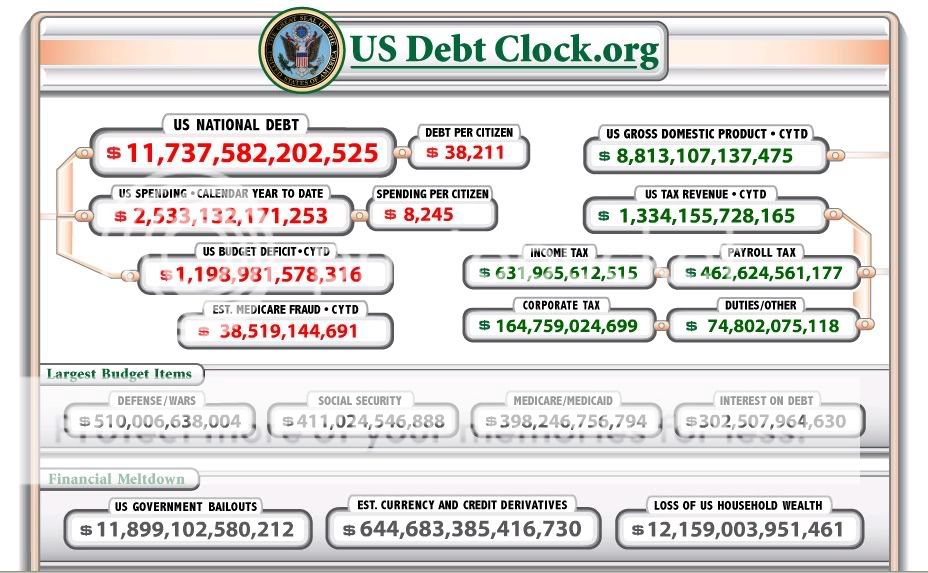
This debt clock is pretty amazing, click on the picture to see it in action. It’s remarkable the hole that we have dug ourselves in, and we can only hope that those in D.C. realize the danger of a nation in debt.
Just wanted to send you all a quick reminder. Our giveaway week is wrapping up at 12:00pm tonight. So, if you want a chance to win any of the following free stuff, please feel free to go ahead and do it now.
For any of these, its free for you to enter and win. All you need to do is leave a comment on the posting. We’ll randomly select a winner. Then we’ll send you the goods via snail mail!
In part one of my three part series on John Maynard Keynes I talked about the man and gave some background on how he became such an influential figure in the world of economics. In part two, I gave a high-level view of the most important principles of Keynesian Economics. Today, in my third and final piece in the series, I will talk about the influence of Keynesian Economics in our current market.
The Decline of Keynesian Economics
Keynesian Economics became the en vogue economic standard following World War II and maintained its position at the head of the economic table until the late 1970s/early 1980s. During the 70s, the United States experienced a period of stagflation (stagflation refers to a period of time that is simultaneously experiencing stagnant economic growth and rising inflation). The United States also went through Nixon’s infamous wage and price controls, as well as the oil crisis of 1973. Eventually, this all came to a head with a deep recession, which resulted in backlash against the Keynesian school of thought. Keynesian theories were abandoned for stricter monetary policies, which were employed with the hope of slowing the rapidly rising rate of inflation. As the 80s moved forward, U.S. presidents such as Ronald Reagan moved closer to an “open market” system, emphasizing less government spending and deregulation.
Despite a rocky start to the 80s that saw unemployment creep above 10% and the recession of 1982, the economy began to right itself, eventually expanding at an unprecendented rate in the 90s.
The Bubble Bursts
Despite a few periods of financial difficulties (the tech bubble bursting in the early 2000s, for example), the U.S. economy continued to grow, followed by much of the Western world. However, massive deregulation leading to the creation of hazardous financial loopholes (especially in the housing market) as well as unprecedented levels of over-leveraging on the part of both businesses and individuals lead to an over-inflated economic situation that was bound to burst. And burst it did.
Crisis
The current economic crisis became the best opportunity since World War II to demonstrate the correctness of Keynes’ theories. This period of time saw a rapid application of Keynesian thinking to the world’s economies. Banks were either bailed out or nationalized, and stimulus (sometimes multiple stimulus) packages were enacted throughout the world. This sharp turn-around corresponded with a rapidly growing disillusionment with free-market capitalism. Many economists saw the financial sector collapse as a direct result of deregulation, a shift towards monetarism, and a general laissez-fair approach to new methods in financial engineering. By 2008, it was generally accepted that the idea of a self-healing market was dead, or at least put aside for the time being. This allowed governments to take a more Keynesian approach to the market, resulting in huge deficit spending (both in public projects such as Obama’s last stimulus package and in institutional takeovers, such as GM’s situation that came to a head earlier this year) in the hopes that it would right the economy and pull it out of the recession.
Criticisms
It remains to be seen what the final effect will be of the various stimulus packages and takeover projects will be; however, the most recent approach to fixing the economy has not been met without criticism. While there was almost universal agreement in the beginning among economists that the government should step in and take some action, many people have expressed dissatisfaction with what has happened so far. Pure Keynesians have expressed concerned that the economic reforms haven’t gone far enough to be effective; others have been concerned that the changes went too far, and the massive deficit spending that occurred will ultimately cripple every economy that adopted those policies. In addition, the traditional arguments against Keynesian Economics has also held, with the most prevalent opinion being that this stimulus spending could actually do more harm than good, with people actually holding on to their money more as they fear higher taxes in the future to pay for all this spending.
Outlook
Despite these concerns, there are some indications that things may be turning around, albeit slowly. Capital is a bit looser, people are showing signs of spending more, the stock market has lost some of its violent volatility and unemployment is holding steady (or at least not rising at the same massive rate as before). However, things are far from being fixed. It’s hard to tell what exactly will lead us out of the recession, and what the long term effects (both positive and negative) will be of employing these Keynesian-inspired techniques. Regardless, I thought it’d be interesting to track the development of the philosophy that lead us to where we are today with the economy.
In my last post I reviewed John Maynard Keynes the man. Today I will be talking about his economic theory, commonly referred to as “Keynesian Economics”. Later this week I will be wrapping it up with a discussion on how his economic theories have impacted our modern economic policies. Keynesian Economics is a huge area, and I certainly can’t give a detailed description of the entire school of thought in a single blog post, but I’ve tried to hit the points most relevant to our current situation.
The Main Idea
As its name suggests, Keynesian Economics is the set of macroeconomic theories attributed to John Maynard Keynes. Essentially, Keynesian Economics states that it is the government’s responsibility to manage its economy’s market cycles, in both good times and in bad. In bad times, the government is responsible for stimulating the economy by spending money and issuing tax breaks, and in good times, the government is responsible for controlling inflation by cutting its spending and increasing taxes. This, Keynes argued, would help ensure economic stability throughout all economic cycles.
A Break from the Past
Prior to Keynes, the prevailing economic theory was referred to as “laissez-fair capitalism”. A hands-off approach; this set of principles forbade the government from getting involved, arguing instead that a free and completely open market would regulate itself, producing the best possible economic situation. This idea of a self-regulating market took a huge hit at the onset of the Great Depression, at which time economists around the world scrambled to devise complicated theories to explain this horrible economic situation.
Impact on History
Keynes however, rebuffed the assumption that the explanation for what was happening to the world’s market must be complicated, instead arguing on behalf of an explanation so simple that U.S. President Franklin Roosevelt would later dismiss it outright, calling it “Too easy”. Keynes’ explanation stated that during a time of economic prosperity, the unemployment rate is low, and the normal rates of earning and spending money hold. Those two factors establish a cyclical relationship. I work a job to earn money, which I then spend at your company, which pays your salary, which allows you to spend money at my company, which pays my salary, etc… This works fine until something breaks the chain. That something could be anything: a run on banks, a natural disaster, the threat of war, political unrest, a gluttony of goods being produced, or an unnecessarily tight hold on the money supply by the Federal Reserve. The last possible scenario is the most popular one used when attempting to explain the primary reason for the start of the Great Depression. Regardless of the reason, this event affects consumer confidence in a big way, causing people to lower their spending rate and increase their savings rate. Because of the inter-dependent relation between spending and earning described above, that decision sets off a chain reaction, where more people hold on to their money and the flow of money through the economy screeches to a halt, leading to economic stagnation and skyrocketing unemployment. The end result is a recession, in which case Keynesian economic theory dictates that the government should step in and increase the flow of money. A depression however, is much more severe, and is the case where consumers (and businesses) either refuse to spend their money or are so capital-starved that they are completely unable to, regardless of how much the government is willing to increase the money supply. When that is the case, Keynes argued that it is now the government’s role to step in and act like a consumer, spending money to loosen the tightened liquidity. This is commonly referred to as “priming the pump”. Initially rejected by world leaders, Keynes’ theory was eventually adopted and was met with rousing success. After World War II, Keynes’ theories about the relationship between unemployment and inflation, as well as his theories on the government’s influence over the economy, grew to be more formalized as nations adopted his theory into policy.
Keynes Today
Although much of his theories are highly contentious, many of his ideas have been shown to be accurate predictors of economic realities. For example, Keynes argued that wages, and prices as a whole, do not have the capacity to quickly respond to changes in the supply and demand dynamic of a given market sector. That limited flexibility, a fact even acknowledged by some of Keynes’ harshest critics, inevitably result in period of labor (and goods) shortages and surpluses. These periods of shortages and surpluses cause the economic instability that we’re all familiar with. Most relevant to our current economic situation, Keynesian Economics supports an interventionist policy when the economy demands it. As discussed above, this is done to smooth out the ups and downs of the economy, and make it more stable long term. Keynes did not support fine-tuning an economy, rather, he believed that the government should intervene in the hopes of changing the general direction that the economy is heading. Keynesians believe fine-tuning the economy is an impossible endeavor, and attempting to do so would only cause more harm than good. However, he argued that the government knew enough about the state of a given economy and was powerful enough to enact real positive, large-scale change as necessary.
Keynesian Economics became the dominant economic policy after World War II, a reign that persisted, nearly unopposed until the neo-classical movement of the late 1970s and 1980s. Lately, Keynesian Economics has seen a new energy, as the world’s markets struggle to address the issues brought about by the global recession we’re experiencing now.
In my next post I’ll discuss how Keynesian theories are being apply present day. Stay tuned!
Today is Thursday. That means its time for the final giveaway for this week. For today we are offering a $25.00 dollar giftcard from Marshalls. If you are looking for some inexpensive clothing or want to pick up some kitchen ware, this card is for you.
Since the folks at Marshalls have been kind enough to hook us up with the giftcards, here some PR fluff.
Marshalls is the largest off price retailer of apparel and home fashions in the United States. Marshalls differentiates itself from other stores with a full line of footwear as well as a broader men’s selection. In 2008, Marshalls launched a new concept called Shoe MegaShop by Marshalls, which is a standalone store featuring shoes and accessories. At Marshalls Customers can find incredible savings on men’s, women’s and children’s apparel, footwear, accessories and home merchandise every day.
So, to win the card, the rules are simple. Just drop a comment on this posting. We will select the winner on Friday – that’s tomorrow – when one person will be randomly picked. It doesn’t matter if you’ve already entered one of this weeks other giveaways, you can still win. Once the winner is selected we will contact you via email so we can get you the card.
Don’t forget folks, just drop a comment for a chance to win.

 Picking pennies and change off the sidewalk might not be sexy, it can even be a bit unsavory, it certainly won’t make you rich, but it is symbolic.