Friday Roundup: Bank of America, BOA, and Bank of America ;)

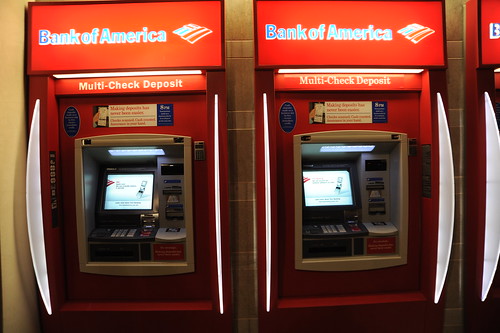
bank of america atms

Good Morning and Happy Friday DINKS.  As I was surfing the next this week looking for the best posts to add into our Weekly Roundup I noticed a huge amount of posts about the Bank of America.  It seems that BOA has rubbed many clients the wrong way over the past few months.  Bank of America has lacked so much on their customer service that clients (aka Financial Bloggers) feel the need to write blog posts about it online.

I personally do not have anything against the Bank of America, but it appears that a lot of people do.  Maybe the reason that I have nothing against the Bank of America is because I have never actually been their client.

Check out what these Personal Finance Bloggers had to say about Bank of America:

– Frugal Dad talks about the instability of banks in the post “Bank of America in Trouble – Is It Still Safe to Keep My Money In a Bank?  I totally love it when news headlines report that companies are having sustainability problems, then the company announces that they will be cutting thousands of jobs, and then they finally announce that the financial institution made billions of dollars in profits last quarter…Yes I totally love that.

– Yes I am Cheap talks about her credit score, her Mom, and her favourite financial institution in the post “F*ck You, Bank of America.” She got the run around from BOA which caused her many hours of frustration as well as a family rift between her and her Mom.  Financial Institutions do not always understand that sometimes money is a family issue, and sometimes the Financial Institutions decision affects more people than just their client.

– Wise Bread discusses bank profits and bank fees in the post “Is Bank of America’s $5 Monthly Debit Card Fee Just the Beginning?”  Banks always feel that the best way to earn more profits is to cut jobs (salaries) and increase fees.  However, in my opinion the best way to earn more profit is for CEOs to give up their extravagant lifestyle, salaries, and bonuses which are all directly paid by the Banks profits.

– Budgets Are Sexy J. Money’s brother talks about his negotiation struggles while trying to renew his mortgage in the post “How Bank of America Made Me Bald.” This post is interesting because usually banks are dying for mortgage business.  However, J. Money’s brother had a chaotic experience complete with incompetence, poor customer service, and a lot of frustration.

– New York Times talks about the financial institutions 3rd quarter results, profits, and job cuts in the post “Bank of America Corporation.” I love this post because it is not anyone’s opinion, it is just the facts.  Profits are up and jobs are being cut and that’s just the way it is at Bank of America.

Photo by Wonderlane
Our Financial Personalities: Do you love “stuff”?

financial personality, financial tips, financial discussion

coinsLast week I went to Toronto to see my Mother for a belated (Canadian) Thanksgiving celebration.  While we were shopping she was willing to spend $200 on a new handbag, and she almost did it, but thank goodness she controlled herself.

I am trying to live a less materialistic lifestyle where I save more and spend less on “stuff” but this is typical behaviour from my Mother.  She and my Step Father are Re-DINKs.  They each have two kids but none of us live at home any longer.  Her new DINK life allows my Mother the freedom to spend her money as she wants.  She now has the luxury to enjoy the finer things in life if she chooses to do so.

My Mother Spends Her Money on Enjoyable Assets

My Mother is not yet ready to retire but she has accumulated enough retirement savings that she really doesn’t need to save a lot more on a regular basis.  If we combine the lack of need for savings as well as the fact that she no longer has children to provide for she can basically spend her hard earned money on herself.

My Mother chooses to spend her money on material goods that are also a good investment.  I understand that an $85 wallet and a $200 handbag are not good investments but those are exceptional purchases.  My Mother and her husband usually spend their money on enjoyable assets and life experiences.

Enjoyable investments are assets that they can enjoy now but will appreciate in value over time.  My Mother’s enjoyable assets include Art Work, remodelling their Home and a Summer Cottage.  As a Financial Planner I encourage clients to save for their future; we have to understand that this doesn’t always mean keeping money in the bank. Saving for our future can include accumulating enjoyable assets.

My Dad Spends His Money on “Stuff”

Although I am no longer close with my Dad I couldn’t help but think about him while my Mother was contemplating the purchase of her new handbag.  I thought to myself that my Dad would never spend $200 on one single item because he would be calculating how much other “stuff” he could buy with $200.

My Dad has the exact opposite spending habits of my Mother.  My Dad loves to fill his house with “stuff”, even when my Dad upgrades or replaces his current “stuff” he doesn’t throw out or get rid of his old “stuff”,  he just keeps accumulating more “stuff.”

My Dad is proud to show off his home and his collection of “stuff” to everyone and anyone who visits.  He built a shed to store all of his “stuff” when he moved into my Step Mothers home. My Dad moved into HER house and SHE didn’t want any of his “stuff” in HER home.

My Dad’s collection of “stuff” includes everything from several irons to multiple televisions.  My Dad spends money on getting good deals and he definitely shops on a budget.  He doesn’t like to pay full price for anything, but that is mostly because he can’t afford it.  When my Dad finds a good deal on something whether it is groceries or t-shirts he always buys them in mass quantities. My Mother has a different shopping strategy.  She tries to buy the items that she needs while they are on sale, but at the end of the day if my Mother needs something she will buy it regardless of the price.

Quality is more important to my Mother than Quantity.  Unfortunately I can’t say the same for my Dad.

Photo by Portable Antiquities

DINKS Discrimination!

discrimination, DINKs, ethical problems

couple walking on beachGood Morning DINKS.  Today we are discussing our DINK lifestyle.  Over this past summer I was interviewed by an NYU student named Lorena who was researching the DINK lifestyle.  She wrote an interesting article from the DINK point of view that included interviews with yours truly from DINKS Finance, as well as a couple from DINK Life.  The main view of the article was about how the DINK lifestyle differs from the lifestyle of families with kids.
In my opinion DINK couples are still a family, just because we don’t have kids doesn’t mean that my boyfriend and I aren’t a family unit.  I definitely also think that DINKS are discriminated against at work, in life, and by other couples with kids because DINKS live (what is perceived to be) a carefree lifestyle.  I don’t know about other DINKS couples but my lifestyle is definitely not carefree, it may be flexible, but it is not carefree.

If you are a DINK do you feel that you are treated differently because you don’t have kids? If you are a couple with kids and you are reading this blog, do you ever see childless couples in the grocery store or in a restaurant and wish that you were us?

I don’t feel that I am missing anything in my life by not having kids.  That is not to say that I may regret it later, but as for right now in my life…I am good without kids.  I would like to thank Lorena for reaching out to us here at DINKS for her research.  I would also like to thank DINK Life for collaborating with us on this project.

Here are some of my favourite parts of the DINK article.  It will be published in full on DINK Life in the weeks to come. We will keep you posted.  Have a great day DINKS!

Corey Jones and fiancé Katelyn Watson launched DINKlife.com on May 17, 2011 as a tool to help DINKs meet other DINKs. As of today the sites members are mainly from the United States and they have several visitors from the United Kingdom, Germany and Switzerland. The sites Facebook page has hit 447 likes.

There were no lifestyle products to support our lifestyle and no one was paying attention to this growing life stage” said Jones.  Jones explained that married or not married, heterosexual or homosexual, if you are living together, cohabitating and sharing expenses, then you are living the DINK lifestyle.

According to Jones the 80’s term Yuppies gave way to the DINK term today. Yuppies meant young upscale urban people living in the city, earning good money, wearing nice clothing and focused on career. Business marketers asked themselves what two Yuppies became when they married each other and they coined the term DINKs.

According to a USA Today analysis of the 2010 Census, the share of households with children dropped from 36 percent in 2000 to 33.5 percent in 2010. The 2008 study made by The National Marriage Project, Life Without Children: The Social Retreat from Children and How it is Changing America, established that from 1970 to 1990 the number of married couples who had children within the first three years of marriage dropped from 71 percent to 37 percent.

Katarina Simon is a Brazilian Photographer living in New Jersey.  She was bullied by a co-worker after having a 4-year relationship with her husband and choosing not to have children. “She would bully me daily trying to convince me to have kids and reprimanding my choices. People have to stop that because I am not trying to convince anyone not to, it’s my choice. People want to drag you into their misery” said Simon.

(Photo by Gareth1953)

Do You Support the Occupy Wall Street Protests?

occupy wall street protests, wall street issues, protests

If you have been watching the news over the last few weeks then you have seen that protestors have taken to the streets in many (North) American cities to protest Wall Street and the CEOs of major Corporations.  What started as a protest in New York City has now been mobilized globally.  Last weekend while I was in Toronto I saw the Occupy Wall Street protests of Bay Street, which is the financial district in Toronto.  Occupy Wall Street Movements have been organized and protestors have taken to the streets in many major North American cities including both Chicago and Los Angeles. The Occupy Wall Street movements are also present in many cities throughout the world such as Taipei Taiwan, Rome Italy and Hong Kong.

The Occupy Wall Street protests have attracted a lot of media attention around the world, but I am not sure that this is the right kind of attention.  I am not convinced that global protests will bring change to our global financial structure.  Protestors are hoping to attract the attention of corporate CEOs, but honestly I am not sure that the CEOs of major Corporations care about the Occupy Wall Street protests.  If CEOs do not feel accountable to their shareholders (which they should) then why should/would they feel accountable to thousands of people in the streets who are not (necessarily) shareholders?

Although it is nice to see people come together in support of the Occupy Wall Street protest movements I am not sure that it will bring about global change.  I am a strong believer in standing up for what we believe in, regardless of the cause.  I personally like to see people of all races, religions, ethnicities, and backgrounds come together in support of a mutual cause.  There are so many different things in the world that tear people apart and create war amongst us that the thought of unifying over a mutual topic is very comforting.  At the end of the day regardless of our religious beliefs or our cultural background people can come together as human beings because money unites us all.

I would personally never ever want to be the CEO of a major corporation because I would personally never want to be accountable to millions of shareholders; however some people are definitely up for the job.  CEOs of major corporations have to always (or maybe I should say usually) think about what is in the best interest of their shareholders, and that is a lot of pressure.  The decisions that CEOs make regarding their corporation directly affect thousands of employers and their families as well as hundreds of thousands or millions of shareholders.  That is definitely a responsibility that I do not want to have!

Being a CEO also takes a lot of time.  This is time that could otherwise be spent with our families and friends.  I don’t know about you but I would definitely not want to work 13 hour days just to have a seven figure salary and bonus.  I am sure that having boat loads of money is nice, but having a private jet comes at the cost of having our own personal life.  This is a cost that I am not willing to expense.

Are you CEO material? Let’s Take the CEO Test!

  1. Would you ever want to be a CEO? If so then why?
  2. If you could be the CEO of any company which one would it be?
  3. Would you take a three million dollar bonus if your share prices were down and you just cut thousands of employee jobs?
  4. How would you increase profits and cut costs for your corporation?
  5. Would the Occupy Wall Street Protests affect your financial decisions?

————–
Photo by David Shankbone

Savings Rules Explained: How Much Money Should You Be Saving?

saving, saving tips, saving advice

silver coins
Everywhere we turn it seems that people are telling us to be Debt Free and to Save All of Our Money, but why? Being debt free gives us the freedom to spend that money on other things instead of making debt payments.  Saving Money allows us to have a Plan B in case of an emergency or take that trip that we have always wanted to.  However, having debt doesn’t mean that we are broke and spending money doesn’t mean that we aren’t saving money too.

The saving rules are different for everyone. Not everyone who makes $80,000 per year has the same expenses and therefore the savings ability among people can be different.  Everyone who is classified as Middle Class has different priorities and different reasons for saving or spending their money.  I am a big believer in spending money to live and love our lives.  I am also a big believer in saving money for a reason, not just to accumulate wealth.  The truth is that if my bank account has more money than your bank account it doesn’t really matter because our money won’t keep us warm at night, and money has no value if it is not spent.

With all that being said as a Financial Planner people/clients often as me “How Much Money Should I Be Saving?”  The truth is that there is not a universal answer to the savings question.  However, there are guidelines that can be followed.  Ideally if we have less expenses we can save more money, and as we are trying to experience new things we may spend more money than we save.

When we are young and we are first starting to earn our own money our priority may be to spend.  But the truth is that if we start working at 15 years old and we attend college at 19 years old we could save a lot of money in those 4 years.  At this age we don’t really need to save for the long term aka retirement.  We could split our money 60/40; we could save 60% for college and spend 40% on our monthly cell phone bill and other personal expenses.

During college we have a lot of expenses such as tuition, books, school supplies, and living costs but the problem is that we don’t really have a lot of income.  However, we still need to save some money during college because after graduation we may have debts to pay off and we definitely have a new life to start.  If we can afford to split our money 70/30 and try to save 30% while we spend 70% of our income (loans, bursaries, part time job etc.) on our expenses, we would be in a really good position after graduation.  As an example lets say that the average annual student income is $10,000.  If we save 30% of that over 4 years we will save $3000 per year and we will save $12,000 by Graduation.

As we get married, start a family, and buy a home our expenses can definitely add up quickly.  However, now is the time that we need to start saving for our retirement and start saving for emergencies.  When we are single emergencies may be easier to deal with, but as a family with a monthly mortgage payment unplanned emergencies can be devastating.  The reason it is important to try and save as much as possible during this stage of our life is because our previous savings were probably spent on the purchase of our new home.  It is important to start rebuilding our savings and start saving for retirement.  As a general guideline our income at this stage of our life should be split 80/20.  80% of our income will be used for monthly expenses and paying off our accumulated debts while the other 20% of our income should be saved.  10% (of the 20%) should be short term savings for emergencies and 10% should be saved for retirement.

The closer we get to our retirement our mortgages get paid off and we become more responsible with our debts.  This is where the savings guidelines start to turn around.  As our expenses get lower our savings percentage gets higher.  Our income can be split 35/65 with 35% of our income being saved for retirement and 65% of our income being used for expenses.  By this time our emergency savings should be built up enough that our focus should be retirement as we approach that golden age.

During retirement is play time.  Expenses are low, income can be moderate (if we planned correctly) and savings for life experiences are high.  Nothing in retirement is long term.  Planning and saving for the long term is over. Our whole life we have planned for retirement and now we are finally there.  It’s time to enjoy our money.  We should split our income 25/75 and save 25% while spending 75%.  In retirement we don’t really need to save a lot of money because our wealth has already accumulated. Saving a small portion for everyday emergencies and personal indulgences is a good idea.  But with all the free time we have on our hands we should definitely spend our income during retirement and enjoy our lives.  If we don’t want to spend our accumulated savings that is ok, but our income should be spent on hobbies, travelling, and good times. Remember…even if you save every dime, you cant take it with you.

(Photo by Mait Jüriado)

#1 Rule of Investing: Don’t Take Advice From Your Neighbor!

investing rules, investment tips, investment advice


This week I had a client come into my office and say something very ignorant about his investments and I feel the need to share.  First of all let me start by saying that my job as a Financial Planner is to give clients personal financial advice and help them plan for their short and long term goals.  My specialty is investment, retirement, and estate planning; but I also assist clients with personal budgets and money management.  I had a young client book an appointment with me because he wanted to buy Gold.  Believe it or not there is a branch location of my Financial Institution that actually buys and sells Silver and Gold Bars; but that is besides the point.

This client came in to my office with his friend who advised him that Gold is the place to be, and it is definitely the commodity to buy in his investment portfolio.  The client is a Graduate Student who has a total accumulated life savings of $10,000.  The entire amount is currently invested in a Balanced Fund, but the client is not happy with the performance of the Mutual Fund.  My job is to make sure that our clients are happy with the services offered from our Financial Institution and to make sure that our clients have the best Products for their personal needs.  All I can do to help clients is give them all of the relevant information and  make my professional recommendations, but ultimately  the client makes the final decision.  I am not an Investment Broker and I can not transact on my clients behalf.  When I asked the client why he was unhappy with the Balanced Fund performance and why he wanted to buy Gold he responded “Because I have lost money in the Balanced Fund and because my friend told me to buy Gold.” (the friend who was with him in my office)

If there is one thing in the entire world that I hate it is people who make uneducated decisions about their money and their investments because their friend, neighbour, co-worker, or husbands sisters cousin told them to do it.  Unless your husbands sisters cousin is a Certified Financial Planner or another type of Investment Professional no one should be taking advice from them.  I proceeded to ask the friend why he told his friend to buy Gold, not because I am a jerk but just because I am trying to determine the clients ultimate needs.  The friend (who was also a student but for some reason was dressed in a suit and tie) said that, and I quote, “Global speculation over the last six months says that Gold has consistently increased in value.” Without trying to laugh in his face I explained that Gold is a commodity and that it is a lot higher risk than his Balanced Mutual Fund, if he was uneasy with the 50% equity holdings in his Balanced Fund, he will probably be very uncomfortable with the daily and long term fluctuations in the price of Gold.

I also explained that it is never a good idea to buy into a commodity after you have been reading about its success for half a year.  The goal of investing is to buy low and sell high; but if the entire world is talking about the great track record of Gold over the last 6 months the odds are that you will be buying in when the price is very high. It is also never a good idea to have our entire life savings in the same investment.

When people hear that other people are making money it may be human instinct to be jealous; we want to make money too.  Investing (and money in general) is a business decision, and investing can become a bad decision if we let our emotions get involved.  Emotions run high with adreneline when we hear about stocks or commodities making profits.  We may make a quick decision to try and earn a quick buck or two by buying an investment without all of the pertinent information and without knowing the associated risks.  Just because an investment made money in the past doesn’t mean that it will make money in the future.

(Photo by Design by Zoury)


Credit Card Users Anonymous

credit card, misuse of credit cards, credit card advice

Hello my name is
My name is Kristina, and I used to be an out of control Credit Card User. This is where you all say “Hello Kristina.”  I am proud to say that I have been credit card sober for 2.5 years.

Many of us have credit cards and the truth is that each of us feels very differently about our VISA, MasterCard, American Express, or our Discovery Card. My credit cards used to be my worst enemy but over the recent years my sole remaining credit card has become my best friend.  When I was in my early twenties I had several credit cards because companies just keep sending them to me in the mail, and I just keep activating them.  Eventually I found myself tens of thousands of dollars in debt.  I had the income to pay it off, but not the will power.  The thought of spending my hard earned money to pay off debt was unsettling and I couldn’t do it, so I continued to make only the minimum monthly payments for several years.

When my pre 30 crisis hit at 28.5 I decided that I hit my financial rock bottom and I was going to turn my financial life around. For years I was spending money carelessly because I thought that made me happy and because I had the disposable income to do so.  At the same time seeing the high balances on my three credit cards and one line of credit every month made me very unhappy.  I hated my debt and blamed it on everything (and everyone) under the sun, but the truth is that I had no one to blame but myself.   I was tired of making excuses and I was about to turn my financial life around.

I made a debt repayment plan for myself.  I set a goal date to become debt free, I made a personal budget to allocate a (large) portion of my salary towards debt repayments, and I prioritized which credit cards I would pay off first based on the interest rate and remaining balances.  I definitely had to make sacrifices in my life, but I didn’t give up anything that I couldn’t live without or any of my favourite things.  I gave up all the things in life that didn’t really matter, all of the materialistic things such as multiple  vacations, eating out too much, and shopping.  I really miss shopping but I have learned to live happily without it.

Spending money is like any other drug, it is an addiciton that only we can change.  Interventions may help us see the light and see that we need to make a change.  But the truth is that I turned my financial life around because I wanted to; I couldn’t have done it before I was honestly and truly ready to make a change.  Now I only have one credit card (with a limit of only $2500) that I use a few times a month.  Honestly I would love to live without a credit card at all but that isn’t possible.  I need a credit card to book travel accommodations and also to keep (re)building a good credit score.  It is safe to say that I have definitely learned from my past financial mistakes.

Now that I am financially responsible I always (try to) pay off the entire balance on my one credit card each month so that I am not charged any interest and so that I don’t fall back into bad habits.  Sometimes I get the urge to pull out my credit card and spend hundreds of dollars on myself, but before I reach into my wallet I think twice.  I think about how unhappy I used to be when I was drowning in debt; and I think about how happy I am now in both my personal and financial lives.  Now when I get the urge to spend I think twice about my purchase, I smile, I let go of my wallet, I take my hand out of my purse, and I walk away purchase free.

My name is Kristina and I am credit card sober.

(Photo by maybeemily)

Weekly Roundup: Steve Jobs and Apple

Happy Friday DINKS!  Actually today’s Weekly Roundup topic is not so happy; it is bittersweet.  Today we are paying tribute to Mr. Steve Jobs the former CEO of Apple Corporation. Steve Jobs was (and will forever be remembered as) a pioneer in technology and in business.  The Apple Corp front man recently lost his battle with cancer, and I don’t know if the world of technology will ever be the same.  We are thankful for the impact that Steve Jobs had on the world of technology, and we are definitely sad that we had to lose him at such a young age.

We recently featured Apple Corporation in one of our Stock Market Showdown posts where we compared the stock of Apple Corp with Research in Motion. My boyfriend Nick is a huge fan of Apple Corp.  There are no words that I can say that will do justice to Steve Jobs, his career, and his impact on the world.  So I will leave it up to the online community to share their thoughts on Steve Jobs and his impact on our lives.

Here are some other posts from around the web about Steve Jobs and his dedication to technology and Apple Corporation:

  • Adam @ Man vs Debt  discusses the impact that Steve Jobs had on the world of business and technology in the post “The people who are crazy enough to think they can change the world…”
  • Trent @ The Simple Dollar talks about his admiration for the Apple CEO in the post “Some Thoughts on Steve Jobs”
  • Dave @ 50 Plus Finance tells us about the impact that Steve Jobs had on the world in the post “Apple Founder Steve Jobs Dead At 56-Modern Day Edison”
  • Catherine @ Daily Finance shows how Steve Jobs not only influenced our technology lives but also our personal finance lives in the post “How Steve Jobs Change the Way We Spend Money”

Photo by Like The Grand Canyon

5 Great Reasons To Use Your Credit Card

credit card tips, credit card uses, credit card advice

Morning DINKS.  Today we are discussing helpful ways to use our Credit Card.  If misused our Credit Cards can be very harmful to our Financial Lives. If we accumulate hundreds or thousands of dollars in debt and we are unable to make the minimum monthly payments our credit score can be ruined.  If we spend more on our credit cards than we can afford to repay we could find our self making debt repayments for several years.

Having debt doesn’t make us financially irresponsible.  In some cases having debt can be a good thing, such as when it is attached to an asset which consistently increases in value.  Using our credit cards and paying them off can definitely help build and maintain a great credit score as we show that we are financially responsible.  Using our credit card responsibly can also help us get to the next pay check if some months we find our cash flow a little bit short.

According to MSN Money there are certain situations when we should always use our credit card for purchases.

Here are 5 Great Reasons To Use Our Credit Card:

  1. Purchase Protection.  Our credit cards offer protection on all of our purchases.  If our product is defective we can withhold payments on our credit card until we work out the replacement details with the merchant.
  2. Extended Warranties. Buying big ticket items on our credit card such as a television or a computer can be very helpful because many credit cards offer an extended warranty on top of the manufacturer’s warranty.  If we buy a Sony TV and Sony offers us a one year warranty, our credit card may offer another year warranty on top of that.
  3. Categorized Spending.  Some credit card companies break down our spending for us into categories such as entertainment, food, groceries, and pharmacy.  If we see on our statement that we spent over $400 at restaurants in one month, maybe the next month we will think twice about eating out.  This can help us save money on our monthly spending.
  4. Building Our Credit Score.  Having a good credit score can help us get approved for a mortgage or car loan; it can also help us get a better premium on home, auto, and life insurance.
  5. Cash Back and Rewards Points.  Earning Cash Back and Rewards points should be a bonus feature when we use our credit cards for other reasons.  Earning Cash Back and Rewards Points should not be an incentive to or a reason why we use our credit cards and choose to get into debt.

Why do you use your credit card?

(Photo by Jnissa)

October Love Drop: The Nevins & Their 7 Kids!

This month Love Drop is helping out Jeff and Becca Nevin from Indianapolis.  Jeff and Becca currently have 4 children and they are getting ready to bring home 3 more.  Becca Nevin recently gave birth to triplets.  Unfortunately they were born very underweight, and the newborn triplets have lived the beginning of their lives in a hospital room.

I know that we are all (or at least most of us are) DINKS and we don’t have Kids, but I hope that we can find it in our hearts to help out his ever growing family in need.  Jeff and Becca Nevin are currently experiencing some financial hardships.  They are currently living in a small mobile home, and it’s about to seem a lot smaller when the 3 new babies come home.  Love Drop would love to help the Nevin Family move into a single family home.

As DINKS we may not have kids, but we definitely may have experienced financial hardships ourselves.  I know that over the last 3-4 years my personal financial situation has changed, and I know that some of you have also lived through financial hardship.  So even though we may not have kids, we can understand what it’s like for the Nevin Family to experience financial hardships.

This month’s Love Drop hits extra close to home for me because I myself lived the first few months of my life in a hospital.  I was born 6 weeks premature and although I don’t remember that time of my life, I will never forget it.

Jeff and Becca Nevin need our help so they can help their (ever growing) family have a better life. If you are not yet a Love Drop member you can sign up online to make regular monthly contributions; even $1 per month can help out a family in need.

Here are some other ways that you can help the Nevin Family:

  1. Send Some Baby Stuff – Anything baby-related that costs money on a recurring basis – specifically diapers, formula and clothes. Gift cards for all things baby to stores like Wal-Mart or Target would also be helpful.
  2. Give a Gift or Service – Services are extra helpful.  We love giving services that you can offer yourselves or from your company.
  3. Share this Site with Others – Tweet about Love Drop, Like Us on Facebook, and share it with any friends or family you think would be interested. The more we get the word out, the more we can help the triplets!

You cannot copy content of this page