Couples Money Mistakes

couples advice, couples money mistakes, couples money tips

When we get married we may choose to merge our finances or we may choose to keep them separate.  Whether we have a joint account with our spouse or not, our individual money is still part of a couple’s budget.  Whether we keep our money in the same account as our spouse or not is totally irrelevant, because we still use our individual money to pay for joint expenses.

US News recently published an article called The Biggest Money Mistakes That Couples Make.  Of course couples are bound to make money mistakes at the beginning of our relationships until we work out all of the kinks.  I started dating my boyfriend Nick when I was 19. As we all know 19 year olds are just learning about their own money, not to mention having to manage our money together with someone else. We made our share of money mistakes as a couple, but we lived to learn from our mistakes.

Here are The Biggest Money Mistakes That Couples Make according to US News:

Not Talking About Finances. In my opinion, this is the number one biggest couple’s money mistake. Communication and Honesty are the two most important components that make a relationship last, after being in love of course.  If we are not comfortable enough to talk to our spouse about money then what are we doing in a couple?

Putting One Person in Charge of the Money.  This, in my opinion, is the second biggest couple’s money mistake.  Maybe it’s because I am a control freak, maybe it is because I work in personal finance, but I just couldn’t imagine having someone else take care of, manage, and tell me about my finances.  I also couldn’t imagine making a big purchase without talking with my boyfriend Nick.  I have been with him for more than one third of my entire life, and I couldn’t imagine making a decision without him.

Combining Accounts Too Early.  Or if ever, in my opinion.  Having a joint account does not make our money joint.  If you are in a couple and you share expenses, your money is already joint; regardless of how you both access the money or where the money is kept.

Sharing Credit Cards, Real Estate, and other Debts.  I would recommend sharing debt as long as it is joint and you are both equally responsible to repay it.  Couples debt should be acquired to gain a joint asset such as a car, a home, a cottage or a boat.  Couples debt can also be acquired for joint purchases such as furniture or a vacation.  I wouldn’t recommend sharing debt as a couple for individual spending and expenses.

Ignoring the Fact that You Might Break Up.  Anytime a couple is together whether it is by marriage or not, we have to consider what will happen to our assets and debts if we break up.  Anything acquired as a couple should be split equally down the middle.  Anything that we have acquired (whether it is debt or an asset) on our own is our individual responsibility.  Since I come from a divorced family and I’m a total commitment phobic, I feel that breakups are inevitable…it’s just a matter of time. We always have to be prepared.

(Photo By Mike Baird)

Weekly Roundup: The NBA All Star Weekend, Sports, Money, and Financial Decisions

Happy Friday DINKS! Last weekend was the NBA All Star Weekend and because I am in a couple with a sports fanatic I have learned to grin and bare it during major sporting events.  I honestly do not like sports, but I watch sporting events with my boyfriend Nick. 

More recently I have taken an interest in sports news because there is actually a thin line between personal finance and the finance of sports management.  After all of the glitz and glamour being a professional athlete is a job just like any other.  Being an NBA superstar consists of good days, bad days, financial decisions, investments, and money management.

The news surrounding the NBA All Star Weekend was the impending contract renewal/trade of NBA superstar Carmelo Anthony .  If you are unfamiliar with this story, Carmelo Anthony is a 26 year old superstar who has his own shoe line, clothing line, and several other business ventures.  He invests in real estate and cars.  He is happily married (to a former MTV VJ) with 2 young children. 

Carmelo Anthony has played his entire NBA career with the same team in Denver Colorado.  His contract is now up for renewal and he is considering leaving the town that made him an All Star.  Carmelo Anthony must make a financial decision whether to sign a contract extension with his current team, or relocate to a new city and transfer to a new team.

Does this story sound familiar? It is because we witnessed a similar story with Lebron James not too long ago.  When his contract was up in his hometown of Cleveland, Lebron James chose to relocate to Miami.  This was a multimillion dollar deal that has turned out to be a not so profitable investment for the Miami NBA Franchise.

Here are some posts from around the web about Personal Finance as it relates to the NBA:


Budgets Are Sexy discusses teamwork and personal finance in the post Finance Lessons We Can Learn from the Miami Heat.

Here on DINKS Finance we have discussed the personal decision to move for a better paying job in the post Moving for Money.

Financial Samurai  says that bigger cities offer greater wealth in the post The NBA Finals Proves Location Matters For Success.

Airline Fees That Suck

airline fees, airline additional expenses, airplane fees

It’s been a brutal winter up in the cold northeast and many people are escaping to warmer weather for a little winter break.  Before we book our airline tickets this winter we need to make sure to read the fine print about airline fees.

Airlines have increased fees and created new fees for travellers that make taking a road trip a better vacation idea.  MSN Money recently published an article titled The World’s Most Frustrating Airline Fees that discusses some expensive and ridiculous fees that are now being charged by airlines.  I am not sure if it’s more frustrating that airlines are charging these fees, or it is more frustrating that airlines are actually trying to defend these new expensive fees.

Here is a list of fees that airlines are charging to their travellers:

The Airline Fee for Checked Bags: Airlines can charge anywhere from $20 to $100 per checked bag.  As a traveller I don’t want the plane to be too heavy, but I don’t think that charging travellers is the way to ensure that the plane is not overweight.  If travellers are willing to pay the fee then they can bring as many bags as they want. Airlines should enforce a strict rule about the number of bags that travellers can bring no exceptions.

An additional Airline Fee for Paying the Checked Bag Fee at the Airport: Can anyone else say ridiculous? I would never pay my checked bag fee online because until I leave for the airport on the day of my trip I don’t know how many bags I will have.  I would also never pay an additional fee for another fee; I would just book my ticket with another airline.

The Airline Fee for Using our Frequent Flyer Miles: Isn’t the whole point of using frequent flyer miles the fact that the flight is free? We already have to pay the taxes on a ticket that is booked using our frequent flyer miles; now we also have to pay a booking fee for those tickets.  The fee increases if we call a customer service agent instead of booking the flight ourselves online.

The Airline Fee to Reserve Your Favourite Seat: That’s right, if you want to guarantee that first seat at the front of the plane, you are going to have to pay for it.

The Airline Fee for Checking In: This is a fee charged by the European airline Ryanair.  A fee to check in? Seriously? If there should be such a fee shouldn’t it be included in the price of our ticket? The most frustrating thing about this airline fee is that we can’t avoid it. Checking in is only the logical next step after booking our ticket. We must check in to take the flight and therefore we have to pay this fee.

The Airline Fee to Change our Ticket: This is normal, and I don’t mind paying a fee to rebook my flight, as long as the fee is reasonable.  In my opinion it is not reasonable to charge $75 to $250 plus the price difference in tickets to change a flight. A standard $25 fee should apply plus the price difference in tickets.  $25 is still a huge profit for airlines because changing a ticket takes less than 15 minutes with a customer service agent. This is a lot less than the hourly wage that they are paid by the airline.

The Airline Fee for Carryon Bags: YIKES! This is ridiculous.  Aren’t those overhead bins there for our convenience? Some airlines are charging up to $45 per bag that travellers want to carry on the plane and place in the overhead bin.

The Airline Fee to Use the Bathroom. I have to admit that since I saw the movie Snakes on a Plane I have not used the bathroom on a plane.  In general, I don’t like to use bathrooms that aren’t stationary such as Port a Potty.  I also don’t like to use the bathrooms on anything that moves like a bus, airplane, or train.

Airlines have repeatedly justified their actions by saying that adding fees are cutting costs.  However what they are really cutting are jobs.  If we book our ticket online, the airline doesn’t have to pay a customer service agent.  If we don’t bring any bags on our flight, the airline doesn’t have to pay a baggage handler.  Airline fees are not to cut costs, they are to increase profit…bottom line.

(Photo by Ma1974)

Tips to Preserve Our Wealth

preserving wealth, tips about wealth, saving advice


MSN recently published an article titled “Athletes Gone Broke”.  I can tell you that it reads as a cautionary tale of what not to do when we have money in order to make sure that we don’t lose all of our accumulated wealth.

It is important for us to learn how to accumulate wealth, but it is also important for us to learn how to preserve our wealth.  We can learn what to do from other people’s victories, but we can also learn what not to do from other people’s mistakes.

What is your biggest financial mistake?

Being wealthy can be a great asset. We have to always remember that we can lose our wealth just as quickly as we made it.  I made my share of financial mistakes when I was younger. I regret accumulating debt because I thought that having credit cards made me more mature.  I also regret buying a $30,000 Honda Civic on an impulse purchase during my lunch hour.

I now live on a very strict cash budget, and I only use my credit cards to maintain a good credit score.  I use my credit card to pay for purchases such as trips and travel accommodations where a credit card is the only payment option.  Financial responsibility makes us mature, having platinum visa card does not.  It is ok to make mistakes as long as we learn from them, and we don’t make the same mistakes again.  We should share our stories, and learn from the financial mistakes of others.

Tips to Help You Preserve Your Wealth

Don’t Take Money for Granted. We shouldn’t assume that our money will always be there.  Antoine Walker was a professional athlete in the NBA, who accumulated over $110 million dollars from his NBA career.  Only two years after his NBA career ended, Antoine Walker had spent over $100 million dollars on bad habits which included gambling in Las Vegas.  It is ok to spend $50 million dollars a year if we are making more than that per year.  However, we can’t always assume that money will be constantly flowing into our wallets.

Mange Our Money Wisely. Some say that the number one rule of being wealthy is to spend less than we earn, and we must always live within our means.  Spending money we don’t have leads directly to bankruptcy.  This was exactly the case for Mike Tyson.  If the story of Mike Tyson losing $400 million dollars and filing for bankruptcy is not a cautionary tale of poor money management, then I don’t know what is.  We have to trust our financial managers to effectively manage our money, our wealth, and our budgets.  We also have to trust them to tell us when we are making mistakes.  Set a budget and stick to it. We should also always give ourselves a financial buffer to make sure that we have an emergency fund in case something unexpected pops up.

Be Cautious of the Good Life. Young people who come into a lot of money have the tendency to let their finances get out of control.  I know I did.  The first year that I made a 6 figure salary I went on 3 vacations, refurnished my apartment with luxury electronics and furniture, and soon after bought an overpriced car just because I could afford it. Major League Baseball Star Lenny Dykstra loved spending his money on expensive cars and expensive real estate.  This unhealthy spending habit eventually created $50,000 of assets and $50 million dollars of liabilities.

“While millions sound like they’ll last a lifetime, purchase like that will wipe them all away in a hurry.” To view the full article please click here.

(Photo by Ndrwfgg)

DINKS Reality: Who Wears the Financial Pants in Your Couple?

financial advice, financial tips, couple finances

As you know I am not married, so I don’t have any personal stories to share about my wedding. However, I am 30 years old, this is around the age when people start to get married and settle down both personally and financially. Rich Bride, Poor Bride is a show that details the wedding process on any budget, from very small to extremely big.


I have been to a few weddings over the last few years and although I haven’t seen the planning process, I have been to the final product. I can definitely tell the difference between a $5000 wedding and a $40,000 wedding.  I have heard that the bride takes the front seat during the wedding planning, but I would also hope that the groom gets to have his say. Once again, since I am not married I don’t speak from experience.

There was a recent episode of the television show Rich Bride, Poor Bride that discussed a couple named Amy and Jon. Amy is a controlling wife who micromanaged their wedding, and Jon is an adoring husband who is afraid to say no.  Afraid. Is that even a word that should be used in a relationship?

A couples wedding may be their first major expense together, if they haven’t already bought a house.  In my opinion the wedding process will set the tone for the rest of their financial lives together.  If both people financially contribute equally into a relationship, then shouldn’t they both have an equal say in how the money is spent?

Most relationships whether they are a marriage, a friendship, or within a family, have one member with an A Type Personality.  There is a difference between taking the lead and being a relationship dictator.  The last time I checked it takes two people to get married, so why should only one person have the right to make all of the financial decisions?

I am not sure why someone would want to be married to a control freak.  I also don’t understand why weddings are such a big deal!  Isn’t the point of a wedding to get married to the man or woman of your dreams?

We don’t need to spend $40,000 on a wedding to prove our love to our husband or wife.  We also don’t need to spend $40,000 on a one day ceremony to prove our love in front of our family and friends. Why are weddings such a spectacle? I can think of at least 5 other things that I would rather do with $40,000 other than spend it on a wedding.

If you spent a lot of money on your wedding, would you have rather spent it on something else?

(Photo By Ben Sutherland)

Weekly Roundup: Budget Spreadsheet Blowout

Happy Friday Dinks! This week we are reviewing the number one financial rule of all time…Live within Your Means.  How can we live within our financial means? We have to create a budget and stick to it.  It is that simple.  We must effectively manage our money in order to save and preserve our wealth.

What is a budget?

According to Investopedia a Budget is “an estimation of the revenue and expenses over a specified future period of time.  A budget is a microeconomic concept that shows the trade-off made when one good is exchanged for another.”

An estimation of our expenses means that we will need to project our future expenses. Of course we can’t predict our future expenses, but we can hypothesize based on past spending habits.  A great way to keep financial records of our past spending is by using a budget tracking spreadsheet.

A budget tracking spreadsheet will not tell us where to spend our money, but it will show us where our money is being spent.  This will allow us to make adjustments in our spending habits, and make cuts in our expenses where necessary. DINKS offers a Free Budget Template on the right hand side of our page.

Here are two great budget tracking spreadsheets that I found around the web:

Mint.com offers a free online money management tool to help you live a richer life.  The Mint.com page is fun, friendly, and helpful.  It allows us to link our bank accounts, investment accounts, credit cards, and other debts to allow us to keep track of our spending.  Mint.com is interactive.  It will remind us of upcoming goals and alert us if we are going over our planned budget. Mint.com analyzes, categories, and tracks our entire financial life. It is a great free tool whether we want to save for retirement, pay off debt, or just keep track of where our money goes.

J. Money @ Budgets Are Sexy offers a colourful and fun budget spreadsheet. Would you expect anything less from our friend J. Money? We have to actively track our own spending and manually enter our own financial information on this budget spreadsheet. I think this is a great alternative to interactive spreadsheets because it requires us to actively manage our own budget. It gets us involved in our finances.

Most financial institutions offer budget tools and most personal finance blogs offer budget tracking spreadsheets.  How do you manage our budget?

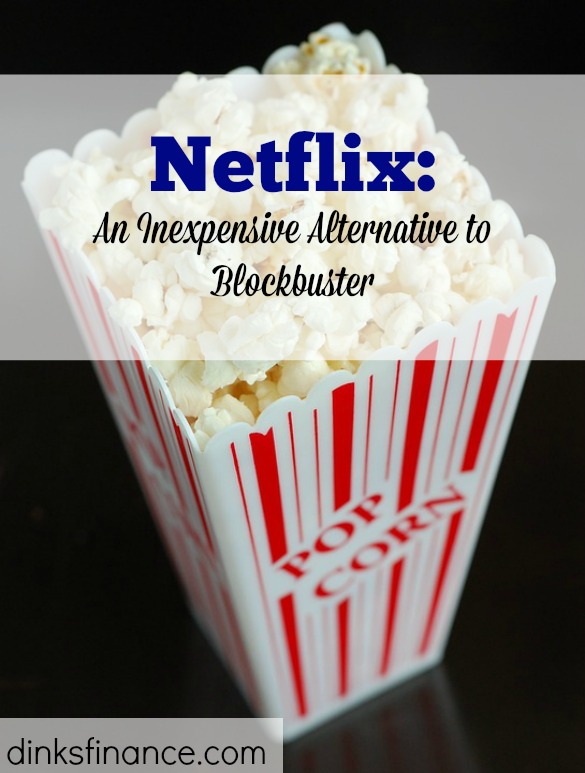
Netflix: An inexpensive alternative to Blockbuster

netflix, alternative to Blockbuster, cheap entertainment

Staying in and renting movies to make it a Blockbuster night can be expensive; even renting movies at our local independent video store can be expensive if we rent multiple movies.  The expense of renting movies combined with the general laziness of human beings has people searching for alternative methods to watch our favourite movies and television shows.


Netflix is a great alternative to our local Blockbuster. Netflix is an online video store that allows us to access unlimited Television Episodes and Movies from the comfort of our own home, without ever having to go outside in the cold, deal with crowds, or encounter rude sales people.

Netflix is currently offering a free one month trial; after it expires Netflix costs only $7.99 per month to receive unlimited TV Episodes and Movies.  This is all available for the price of one movie rental from Blockbuster.  No contract is required with Netflix, and we can cancel anytime.

We do receive unlimited Movies and Television shows with Netflix for one low monthly fee. However, we have to keep in mind that it does use our monthly bandwidth from our Internet Provider.  Therefore the monthly Netflix membership can cost $7.99, but the additional internet fees can add up to much more.

I am personally not a Netflix subscriber but I am thinking about signing up.  I don’t currently rent movies from Blockbuster because it is so expensive. I also think it’s a hassle to go back to Blockbuster in 24 hours to return the movies.

I usually watch my favourite Television Shows online because I rarely get the chance to watch them during regularly scheduled programming. The problem with watching television shows online is the advertisements. I hate having my show interrupted by companies trying to sell me something. There are no advertisements on Netflix, which is another added bonus.

I absolutely love going to the movies, I know this is not the most cost efficient movie method but I don’t really care. I see anywhere from 1-3 movies a month at the Cineplex.  This can be costly and I know that it doesn’t make financial sense to pay $12.50 for a movie ticket plus the cost of food, when I am not even willing to pay $7.99 to rent a movie for 24 hours from Blockbuster.  But it’s just something that I like to do.

I am about getting the most bang for my buck. The experience of going to the movies is not at all the same as watching a movie in my apartment. If we are comparing apples and apples, it is a better financial idea to get a Netflix membership for $7.99 per month and watch unlimited movies, than it is to pay $7.99 to rent one movie for 24 hours from Blockbuster.

(Photo by ThrowHerInTheWater)

Wall Street 2: Money Never Sleeps

wall street, stock market, money talk

I was born in 1980 and I have not seen the original Wall Street Movie. However, I can say that I enjoyed the modern day sequel Wall Street 2: Money Never Sleeps.  This movie stars Michael Douglas (who I heard was also in the original Wall Street movie) as well as Shia Labeouf.

I have to admit that this is really not my type of movie; I am more into thrillers and police/organized crime dramas.  However, I did enjoy this move. Besides the fact that Shia Labeouf looks amazing in a suit, and Michael Douglas is an amazing actor, there were many money lessons to be learned from the movie Wall Street 2: Money Never Sleeps.

After seeing the movie Wall Street 2: Money Never Sleeps the connection between corporate finance and personal finance is clearer than ever.  I am not sure if this is due to a great Hollywood director, or a really good story line; but the fact is that we can learn many money lessons about personal finance from corporate finance.  Honestly, at the end of the day we all want the same thing…to make money.

Here are some Money Lessons Learned about Personal Finance from Wall Street 2: Money Never Sleeps:

Don’t put all of your eggs in one basket. Within the first 15 minutes of the movie the market crashes, someone looses a million dollars on one investment, and the owner of a corporation commits suicide because he doesn’t want to declare bankruptcy.  The lesson learned from this is to diversify our investment portfolio.

Do your own research on investments. We should have a financial planner who manages our investment portfolio and who makes suggestions/recommendations for our portfolio. However, we should never trust anyone 100%. We should always do our own research before signing on the dotted line.

Ask for Help when You Need it. I think that this rule applies for everything in life, not only personal finance.

Greed is never good. Get out before it’s too late.

Learn from Our Parents Mistakes. Many of our money habits may have been learned from watching our parents. Hopefully we learned from their mistakes and inherited their good habits.

You have to work hard. Nothing in life is free.  If we want to have a huge pay check, we have to put in the effort. Hard work is the key to success.  It can’t be more plain and simple than that.

Speculation is an Assumption. It makes an ass out of you (and me). We shouldn’t speculate, guess, or assume when it comes to our personal finances.  We need to be educated and aware of what we own in our investment portfolio and what changes we need to make.

The number one money lesson learned from the movie Wall Street 2 is that Money Never Sleeps. Even when the markets are closed and our banks are not open, our money is always moving. It is always awake and we always need to be watching it.

Photo By Epicharmus

My Friends Make Me Spend Money

spending money, friends making me spend money, expenses

This past week I was going over my weekly spending and I noticed a very specific spending pattern.  I always spend money with the same people.  Other than the regular spending for my daily living such as groceries, and other amenities that keep my household running, I noticed a very specific spending pattern. I always spend my personal disposable income with the same three individual people.

Who Makes You Spend Money?

My Movie Friend Bonnie. Bonnie and I have been friends for almost 4 years, and one thing that we share in common is our love for watching movies.  Bonnie and I see a movie together about twice a month. Each time we go to the movies we spend $12.75 each on a movie ticket.  We buy movie food which usually includes soft drinks, popcorn, and some type of chocolate.  The combo we usually buy is $22.50. This means that if we don’t go out for dinner or go shopping before or after the movie we each spend $24.

This could include up to another $15 to $20 if we do decide to go out and eat before or after the movie.  Of course it would be cheaper if we waited for the DVD to be released, but we both love going to the movies.

Sometimes going to the movies with Bonnie is an all day event that can also include shopping.  Bonnie and I also share a love for books. Sometimes before our movie or after dinner we spend hours browsing around book stores.  We share a love for books, but we don’t share a preference for our favourite bookstore.  Therefore in one day we can shop at two or three different bookstores.

My Food Colleague Anthony. Anthony and I became instant friends over our mutual love for food and everything edible.  Anthony is an Account Manager at the bank branch where I work.  Anthony and I eat out for lunch once or twice a week.  Each time we order food to our office it costs us at least $10 each, twice a week.  This is another $20 that I spend each week that I should save. However, I like to eat. I like it even more that I don’t have to carry my lunch to work two out of five days.

My Travel Friend Gabriella. Gabriella is my friend who makes me spend money on the finer things in life. She and I are also friends from work, but she works in a different bank branch than I do.  We are both financial planners but we work in different bank branches.  Gabriella is my friend with whom I share all things girly including shopping, music and travelling to beautiful places.

Gabriella and I share a love for music.  We especially love the ambiance of live music.  We have been to several concerts together, and we have two others already scheduled for this year. We are planning to travel to Portugal together in late August.  Gabriella travels about 4 times a year and we have made a New Year’s Resolution that one of those times will be together. We have the same taste for luxury travelling, and we share common interests; so it only makes sense that we travel together.

If you had a different group of friends or if you worked in a different office would you spend less money?

(Photo By Antwerpen)

Wylie Coyote is a Financial Genius

financial genius, financial lessons, lessons from cartoons

Last week I spent an entire day watching cartoons.  If you are in your 30’s and 40’s you may remember Saturday morning cartoons.  When I was young, I used to wake up on Saturday mornings and watch Saturday morning cartoons while eating chocolate chip pancakes.

Sometimes when I need a reality check, or I need to clear my head, I watch cartoons. My life was much simpler when I was a child.  I am sure that we all have our routines that allow us to escape our everyday lives and visit a much happier time in our life.  Watching cartoons allows me to clear my head.  It is just an added bonus I realized The Bugs Bunny and Tweety Show actually has many valuable life and financial lessons.

While watching Wylie Coyote I learned that there are several financial lessons to be Learned from cartoons.

Here are some Financial Lessons that I learned from Wylie Coyote:

Focus on the Long Term. His lifetime goal is to catch the Road Runner. I am not sure why he is chasing the Road Runner, or what he would do if he ever caught the Road Runner. The point is, Wylie Coyote continues to chase the Runner because this is his long term goal.  Having short term goals gets us by from day to day, but our focus always has to be on the long term. Of course long term is relative to each person.  For a total commitment phobic such as myself, the long term is 5 years.  However for others long term could be 25 to 30 years.

Don’t Look Down.  Keep focused and keep your head up.  As soon as we look down or start to doubt ourselves everything will fall apart. Our brilliant plans may collapse if we lose focus, and we definitely don’t want our finances to hit rock bottom.

Don’t Be Afraid to Take Risks. Of course I am not suggesting that we run off of cliffs or rocket ourselves into the sky, but we need to take risks with our finances.  Without risk there is no reward.  Don’t be afraid to put up to 5% of your portfolio into an extremely high risk investment.  If it works out your 5% high risk investment return could gain more than the entire other 95% of your low risk portfolio.  And if it doesn’t work out, it was only 5% of your total investment portfolio.

Don’t Spend Money on Gimmicks.  In every single episode of this cartoon Wylie Coyote buys some gimmick from the Acme Corporation to help him catch the Road Runner.  Sometimes it is a rocket, sometimes it is a large trap, sometimes it is roller skates.  Whatever the Gimmick is, it is always a waste of money because it never works, and he never catches the Road Runner.  Gimmicks are always a waste of money. Whether it is a free toaster when we open a bank account, or guaranteed cash back on our investment, we should never give in to gimmicks.

Photo by Crawfish Head

You cannot copy content of this page