For Better or Worse, Until Debt Do Us Part.

couples finances, financial advice for couples, money management for couples

As of today we are going to start a new DINKS series called DINKS Reality, this will accompany our existing DINKS Choice series.

DINKS Reality will profile and discuss reality TV stars on shows that discuss everything about money. Reality TV shows that broadcast everything from how to make money to how to manage it and how to spend it wisely.

We will learn from the money mistakes of others, and we will also embrace their financial wisdom.  The financial mistakes of reality TV stars will become our financial windfall.  Sometimes it’s not only about what to do; it’s about what not to do.

I know that some people think that reality shows are totally fake.  But I think that we as young professionals with disposable income have a lot to learn from reality financial gurus, money managers, debt counsellors, real estate moguls, and excessive spenders. Although these may be reality shows, the reality is that they are real people with real life experiences.

There is a show called Till Debt Do Us Part that features a self made financial professional, who believes that if we want to be wealthy, “we have to do it for ourselves.” Gail Vaz-Oxlade started her career writing financial product manuals for major financial institutions.  One day she decided to do it for herself. She took her knowledge of investments, retirement, and insurance and she wrote her own book about financial basics and the do’s and don’ts of money management.

Now she offers debt counselling and money management assistance to couples in need who are drowning in debt or mismanaging their finances.  She has some very unorthodox methods, but they appear to be very effective. Vaz-Oxlade recalls a time when it was illegal to pay off credit with other credit; and therefore she doesn’t believe in credit card balance transfers.

She also discusses budget mistakes.  Gail Vaz-Oxlade lives by the financial golden rule that we can’t spend more than we make. We can’t have everything that we want. She believes that money management is about self control.  Just because we have disposable income, doesn’t mean that we have to spend it.

We will follow Gail Vaz-Oxlade through her journey on Till Debt Do Us Part as she helps self employed couples who over spend, learn how to control their spending. She will help a commitment phobic couple who pay every single bill separately, learn to trust each other. Gail Vaz-Oxlade will also help a controlling husband who offers his wife an allowance, become more open to new financial strategies.

Other TV reality shows about money management, making money, and excessive spending include Flip This House, Big City Broker, Party Mamas, and My Super Sweet 16.  If you have a favourite reality TV show about money, please send us an email so we can share it on DINKS Reality.

DINKS Reality will be fun and informative. Get your popcorn DINKS, we are about to learn from reality TV.

(Photo By LGEPR)

Black Friday Shopping Frenzy

black friday, shopping frenzy, black friday shopping

Last week was Black Friday, which is a huge shopping day for US consumers.  We don’t have Black Friday in Canada, but I am fascinated by the entire the concept of Black Friday.  I can’t believe that it takes stores almost a year to bring their gross sales out of the red and into the (profit making) black zone.


I ask you my American DINK friends….what did you buy on Black Friday?

I have never ventured across the border for the amazing weekend of Black Friday shopping, but I do have several Canadian friends who wait all year for this weekend shopping extravaganza.

I received several emails last week from everyone including the Steve Madden shoe company and the Apple Store.  It seems that everyone store in America has a sale on Black Friday.  I have to admit that I have never experienced Black Friday first hand. But I heard that we can buy a laptop for under $500 and a flat screen HDTV for under $700.  This is amazing because I am actually in the market for a new TV and I can’t find anything under $1000.  I decided to do some investigating, and check out the Black Friday shopping sales across the great USA this past week.

Is it worth it to shop at 3 am on Black Friday?

Target was having a major 2 day sale with a big bulls eye free shipping shopping event.  All Target stores opened at 4 am on Friday morning and the sale lasted until Saturday at midnight.  Over 900,000 items at Target were on sale which includes everything from toys to electronics. A Tom Tom GPS was on sale for $79, I paid $399 for mine last year.  Nikon Cool Pix cameras were on sale for $79, and I paid $149 at Best Buy in August. A 26 inch Samsung LCD HDTV was on sale for only $209.

Macy’s Clothing Store had a Thanksgiving Sale with “Great Savings on over 50,000 items” including jewellery, fragrance, bed & bath items, as well as designer handbags.  Bed and Bath Specials included a Down Comforter for only $39.99; the regular price is $110 to $130.  A 3 Piece Diamond Box Set which usually costs $400, was on sale for only $99.  As an added bonus Macys was offering a Free Digital Frame with every $65 fragrance purchase.

Best Buy was having a Thanksgiving Weekend Sale with hundreds of items and savings in every department.  For their online shoppers, Best Buy was offering Free Shipping on hundreds of thousands of their products.  Best Buy opened its doors at 5 am on Friday November 26 with extra savings on Friday Door Buster Specials.

Where did you shop on Black Friday?

It appears that Black Friday is a shopping extravaganza, and it is definitely worth it to wake up at 2 am and stand outside in line for the stores to open at 3 am.  Maybe next year I will make the trip across the border and experience my first Black Friday first hand.

(Photo by Rob Holland)

Bills, Blogs, and Banking…It’s Friday

Happy Friday DINKS!!! As you know I work as a Financial Planner in a bank branch.  This week we will discuss our Banks…What we love about our bank, and what we do not like so much.  As everything else we do in life is indirectly related to banking.  I am not over exaggerating.  If you think about it our lives all revolve around our banks.

If you have ever left work early, or arrived at work late to get to your bank branch during opening hours you know what I’m talking about.  You may have chose your bank due to the branches location and proximity to your work or your house, or you chose your bank because of their corporate reputation, or if you chose your bank because of the relationship with your personal banker.  Regardless of the reason for choosing your bank, it is a personal decision and everything we do indirectly revolves around our bank.

Here are some other people in the blog world who love and hate their bank:

My Two Dollars knows that Bank of America has had some financial misfortune, but they continue to remain as loyal clients to their bank.

Budgets Are Sexy on the other hand had a recent unpleasant run in with the Bank of America and J. Money wasn’t shy to share his (horrifying) story.

The Financial Blogger discusses his Balance Transfer experience with MBNA which is the Canadian partner of Bank of America.

Green Panda Tree House warns consumers about bank marketing to attract new clients. But the discounts may not be worth it.

And here are some Carnivals we participated in lately:

Carnival of Personal Finance #283 @ Simply Forties
Festival of Frugality #256 @ Festival of Frugality Site
Carnival of Personal Finance #282: Seinfeld edition @ PT Money
Carnival of Money Stories- Perfectionism Ed. @ Barbara Friedberg Personal Finance
Festival of Frugality #254: “It’s hard to be frugal during the holidays” @ GenXFinance.com
Carnival of Personal Finance #284: Thanksgiving Preparation Ed. @ Sweating The Big Stuff

Could Your Partner Become a Liability?

couples advice, couples tips, financial advice

As some of us may have lost our jobs, and more and more of us are learning to live on less, it is safe to say that we have all made some adjustments in our financial lives over the past few years.  Two members of my family have lost their jobs due to downsizing, and as you know my income has also dropped since 2008.

I know that my income decline has been a major adjustment for my boyfriend Nick because we have less disposable income every month. We have cut down on, or in some cases we have cut out, some of our leisurely activities.  This past year we each went on separate mini vacations with our friends, as opposed to 2 or 3 vacations together.  Our day to day expenses have not been cut down very much because most of our expenses are fixed.  We have shopped around for new home insurance, and we also shopped around for a new satellite/home phone/internet package…however our provider hasn`t changed.

Since I sold my car we are now saving approximately $800 per month.  This of course is a big financial help because it’s one less thing we have to worry about.  However, with the recent decline in my income I wouldn’t have been able to afford it anyway.  We didn’t use the car very often; we did less than 12,000 miles per year.  I only bought the car because I thought it is what a 27 year old young professional should do.

As jobs are being cut all across industries and all over the country, how can we cope if our spouse looses their job and our partner suddenly becomes a liability? I can see the financial burden that my income decline has put on my relationship with Nick, and I am not sure if my relationship with my boyfriend would survive if I completely lost my job.

Some couples split their expenses 50/50; some couples pay a percentage of the monthly bills based on their total monthly income.  In some couples (like Nick and I) expenses are split 50/50, but if there is an expense that is not shared (NFL Sunday Ticket Sports Package) the person who wants it pays for it.  Therefore, Nick’s personal expenses such as Pay per View Mixed Martial Arts sporting events and trips with his friends to Las Vegas or NYC, haven’t changed.  It is our spending as a couple that has recently changed.

All of a sudden your spouse looses their job, and your DINKs income becomes a single income, but your expenses don’t change.  If one spouse carries the entire financial burden is the other spouse considered a liability?

I Love My Student Loans

student loan debt, student loan advice, loving my student loans

Many people don’t like to take student loans while studying in college because they don’t want to start their lives with debt.  However, I took student loans during 3 of my 4 years of college because it made my life a lot easier while studying.

I am still paying off my student loans 5 years after graduation but I don’t mind.  Actually, I love my student loans and I never regret my decision to take out student loans.

Why did you take out student loans in college?

I decided to take out student loans in college to ease the financial burden of working full time, living on my own, and studying in college.  I did work full time while studying full time in college. Taking student loans helped me not to worry about paying for books and tuition while also paying rent.

As the amount of student loans is determined by my annual income, I didn’t receive a lot of student loan funding. My GPA would have definitely been a lot higher if I hadn’t worked full time while studying in college.

Student Loan Payments Are Affordable

I originally borrowed just over $12,000 while studying in college, from the government, not from a financial institution.  I graduated in December 2005, and after my six months of payment free living, I began to repay my student loans in June 2006.

My Student Loan Payments are affordable as I repay $80 on a biweekly basis.  I am able to renegotiate the terms of my student loans at any time.  I can change the payment frequency, the payment amount, and make any lump sum payments at any time without penalty.

The interest rate on my student loans is also very affordable.  The current interest rate on my student loan is prime rate plus 2.5%.  The advantage of having a low interest rate is that the majority of our payments are allocated to the principal amount borrowed.  Therefore, our student loans will be paid off faster.  I currently still owe just over $5000 on my student loans.

I Love My Student Loans

Student Loans are a smart debt to have because they are intended to fund our education, which is always a great asset.  Some people say that having a good education is the foundation for a good career.  I absolutely do not regret taking student loans while studying in college, because my life was a lot easier with them than it would have been without them.

(Photo By Ian Wilson)

Carrying Cash Can Be Dangerous

money tips, money advice, financial tips


Some of us choose to pay for everything with our credit cards to earn points, but some of us old school consumers still like to pay for everything with cash.  I am the first to admit that cash can be dangerous for our spending habits, our impulse shopping, as well as our security.  But for some reason, I still choose to carry cash.

First, there is the security risk of potentially being robbed.  We could lose not only the cash in our wallets, but everything else we carry on a daily basis.  It can be a total nightmare to replace important documents and identification.  It can be a financial nightmare to try to prevent fraud on stolen debit and credit cards.  This, among other reasons, is why I choose to always carry some cash in my wallet.

There are still several places that choose to only accept cash as a payment method. These are usually places where we wouldn’t shop if we didn’t have cash in our wallets. How many times have you bought a bigger coffee because you had cash in your wallet? Have you ever added a bagel to your coffee order just because you had enough cash?  Carrying cash in our wallets can be dangerous for our spending.  We may end up spending money just because we had the cash in our wallets.

On the other hand carrying cash can also be good for our budgets. If we use our debit cards or credit cards to pay for our purchases, we would have unlimited access to the money in our bank accounts at the swipe of a card.  However, carrying cash limits our spending. We are only able to spend the cash in our wallets and then we are done spending.

Other than increasing our spending, carrying cash can also prompt impulse spending that otherwise would have not be spent.  This type of spending includes giving to various soliciting charities, donations in the office, and other impulse purchases such as magazines and newspapers as we wait at the checkout or walk by a newsstand.

If I have cash in my wallet, I always feel the need to give it to anyone who asks just because I have it in my wallet.  This past week I spent $10 on candy because my office was fundraising for United Way…Who needs to eat $10 of candy in one day? Not me! I also do not like to give money to the homeless on the street.  Not because I’m cold-hearted, just because I don’t want to support anyone’s alcohol addiction. However, if I have money in my wallet I always try to help those who are less fortunate.

(Photo By Dyobmit)

My Christmas Shopping Strategy

christmas shopping tips, christmas shopping strategy, christmas shopping advice

xmas presentsI know it’s only November and we have to celebrate (American) Thanksgiving before we can even begin to start thinking about Christmas Shopping.  However, I start my Christmas shopping as of the first weekend in November and maybe some of you DINKS do too.


After Halloween ends the Christmas season begins.  Our shopping malls have already set up their Christmas decorations.  I love everything about Christmas…the smell of snow, the decorations, drinking hot chocolate, and of course the nationwide sales.  To prevent myself from going overboard, I set strict financial rules and budgets for my Christmas shopping.  After all, Christmas is about spending time with family…the great gifts are just an added bonus.

In order to ensure I buy gifts for everyone on my list, and to make sure I don’t break my piggy bank during my shopping (which has been known to get out of control), I make a Holiday Shopping Budget.  I decide what gifts I am going to buy everyone, along with the approximate dollar amount that I wish to spend on each gift. Then, I divide my total holiday budget between the 7 weeks leading up to the Holidays.  Therefore I don’t end up spending hundreds or thousands of dollars from one pay check.

I don’t live in the same city as any of my family members, and transporting gifts from my house to theirs can be a real pain in the assets!  My first year away from home, I decided to fill an extra suitcase with all of my Christmas gifts and bring it home with me…big mistake.  For the next few years I bought my gifts and mailed them to my Dad’s house, this was very expensive.  In more recent years I decided to buy all of my Christmas gifts online and have them shipped directly to my family. This is a hassle free an  cost efficient shopping technique. I buy all of my gifts from two or three websites such as Amazon, LUSH, or Chapters Books; I make sure that each purchase meets the minimum amount required for free shipping.

I never shop at the last minute because disorganization freaks me out, and makes me stop breathing a little bit.  The unknown, especially the financial unknown, educes a mini panic attack.  I plan ahead for my budget, but also for my personal sanity.

I have a big family, and a really big extended family.  My parents are divorced and therefore in the span of 4 days I attend and must buy gifts for 5 different Christmas Parties.  Of course I always buy gifts for my Dad, my sister Tara, and my Mother.  In recent years my mandatory gifts have also come to include the Step Witch and my Mother’s boyfriend.

On Christmas Eve I celebrate with my Aunt and Cousins on my Dad’s side of the family. I celebrate Christmas morning with my Dad and the Step Witch. On the afternoon of Christmas Day I celebrate with my Mother, her boyfriend, and his family. On Boxing Day I celebrate again with all of my Aunts, Uncles, and cousins on my Mother’s side of the family. Needless to say this can be very expensive. We now put a dollar limit on our total spending.  For extended families we pick names and therefore are only required to buy one gift.

Other great ways to save money during the holidays are to Sign Up for Mailing Lists so we are altered for upcoming sales, and Friends and Family events that give us special discounts and invite us to VIP Shopping Parties.  It’s a good idea to shop during VIP parties and give your gift with purchase away as a secret Santa gift with friends or for your office party.

(Photo By AlanClevar)

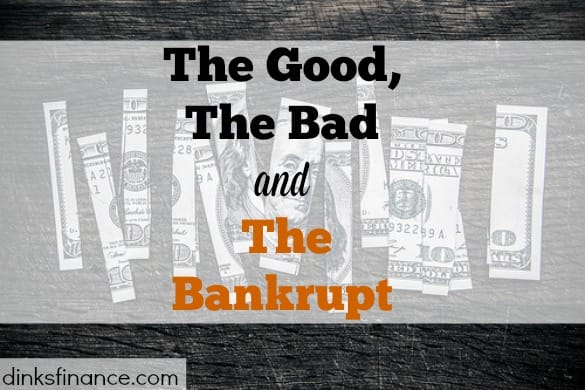
The Good, The Bad, and The Bankrupt

bankruptcy tips, bankruptcy advice, declaring bankruptcy


Declaring Bankruptcy has (historically) been the equivalent of being locked away in a Financial Jail.  However, with the current and past economic crisis, it has recently become a more frequent financial trend.  Historically, people who have filed for personal bankruptcy may have felt that they were locked away and waiting to be freed from a difficult financial situation.  I did some research and found out that although declaring bankruptcy can be short term financial stubble; it does not have to be a fall into a long term financial black hole.

The short term effects of declaring personal bankruptcy on your lifestyle, your finances, and your future, are not as devastating as we have known them to be.  If someone is considering declaring personal bankruptcy it is because their debts outweigh their income; and their current monthly income can no longer support their monthly debt obligations.

Before we decide to declare personal bankruptcy we should be aware that there are other options.  As a first step in the bankruptcy process, we should make an appointment with a bankruptcy trustee.  Based on our current debt obligations, along with our current monthly income, the bankruptcy trustee will determine if bankruptcy is the best option for us.  If our monthly income can support it, the bankruptcy trustee may suggest that we file a consumer proposal; as opposed to filing for personal bankruptcy.

A consumer proposal negotiates our current debt obligations to bring down the minimum monthly payment, lower the interest rates, and in some cases forgive a part of our current debts.  If our current income does not support the payments required by a consumer proposal then we will need to declare personal bankruptcy.

It is a myth that if we choose to declare personal bankruptcy we will lose all of our assets.  Our retirement savings plans are not part of personal bankruptcy.  All unsecured debts such as credit cards, loans, overdraft protection, and lines of credit will be included in a personal bankruptcy.  Student loans are not able to be included in a personal bankruptcy.  We are able to keep all of our personal belongings along with our household items.

Very often we will have to open a new checking account at a new financial institution where we do not have any debts.  A new checking account should be opened prior to filing for personal bankruptcy because a credit check is often required to open a new bank account.

Filing for personal bankruptcy is a fresh start.  While we are in bankruptcy we are not allowed to apply for any new unsecured credit and we may also be required to enrol in a minimum of two debt counselling courses.

Our bankrupt status will remain on our credit bureau for 7 years; it is not there for the rest of our financial life. Once our bankruptcy is finished, the next step is to start to rebuild our credit.  This can be done by applying for a secure credit card with a low limit.  The bankruptcy trustee will assist us with this.

Before we decided to file for personal bankruptcy, it is important that we fully understand the short and long term effects on our personal and financial life.  Declaring bankruptcy is a setback but it is no longer the equivalent of financial exile.

Photo By Casey Serin

When Do We Have Enough Money?

money tips, money advice, financial tips

Last week Michele made a comment on our post titled A Financial Burden: Do Children Equal Debt? that parents do not become financially responsible for their children for the rest of their lives.  Of course, it is a parents’ choice to financially support their children past the age of majority.  But very often is the case in both my professional, as well as personal life that parents do continue to financially support their children into adulthood.

A while back I asked my Dad why parents send money to their adult children. I personally don’t understand the concept…at all.  I have worked two jobs since I was sixteen and I don’t understand the concept of not working for money.  My Dad told me that “A parent feels they are doing what is in the kids’ best interest. A parent never wants to see their child suffer.” I agree that no one wants to see a family member struggle, but at the same time everyone has financial difficulties throughout their life. Handing money to an adult whenever they need it isn’t really helping them stand up on their two feet.  An adult will never learn financial responsibility if they can always rely on their parents to hand them money whenever they call.

Let’s look at an example from my personal life.  My Step Witch has two adult daughters, the oldest is in her 40’s, and the youngest is in her late 30’s.  Over the past 8 years of my Dad’s relationship with the Step Witch I have seen her hand money over to her two adult children every single time they have asked for it.  She even takes the money to them.  My sister Tara and I call it “Dial a Dollar”.  Her daughters call her up for money and she withdraws it from the ATM and brings it right over to them.  These two adults don’t need a savings account when they have mommy to financially support them.  It must be nice to not have a stable job, and still have instant access to unlimited money.

I have seen my step witch’s two daughters ask for money for everything from Christmas gifts for their (several) children, weekly cigarettes, for student loans from a degree that was never completed, airfare for (past) boyfriends, and more recently court fees because the oldest daughter wants her children back.  In my opinion, if the court has already deemed you as an unfit mother then there is no reason on spending $5000 to appeal the decision.

What is an appropriate age when children should no longer ask their parents for money?

In my family the answer is while we were in school. My father sent me $300 a month to help with my living expenses, and my parents also had an education savings plan for me.  Please don’t get me wrong. I didn’t have my education handed to me on a silver platter. I worked full time while I was in school and my GPA suffered because of it.  The point is that I made it work. In my family, when things don’t go as planned you make it work.

(Photo By Borman)

You cannot copy content of this page