Wealth and the Quality Of Your Marriage

Its no secret that the divorce rate of America’s millionaires is quite low. Since it takes time to accumulate a million dollars, it seems fair to say that there is something special about couples that have managed to reach that level of wealth. Some of this success can be attributed to things like marriages tax advantaged status or economies of scale. Some authors like Thomas Stanley of Millionaire Next Door fame have also looked at the personalities and values of millionaires.

But, what this discussion leaves out, is the fact that marriage is a partnership between two people. So, this means the financial success of the marriage is partly due to the quality of interactions the two people have with each other. This obviously pertains to finance because if the quality of ones discussions are bad, then the teamwork that’s required to build wealth doesn’t happen.

So, Deborah Knuckey (previously featured on the DINKs) offers some good tips for improving the financial harmony in your marriage.

1. Treat money and each other with respect.

2. Know what your individual and shared goals are, and what it takes to achieve them.

3. Develop a plan and follow it.

4. Understand how to meet your goals through smart spending and investing.

5. Protect each other by putting together a strong financial safety net.

6. Communicate when concerns arise and work together to find acceptable solutions.

7. Get outside help as required.

The bottom line is that building wealth is greatly facilitated by having a harmonious marriage. The tone and quality of your discussions matter a lot in this process. If you’ve got questions about specifically how to get started on these points, feel free to drop us an email. We’re available at dinksfinanceblog @ yahoo.com.

Best,

James

The New Kids on The Block

Hello All,

One great thing about the blogging community is there’s always lots of new blogs cropping up. Two new noteworthy new ones we’ve found are: One Single Guy and Mark Wu’s The Piggy Banker. One single guy is authored by a 30 something college grad, but unlike some bloggers he’s got an investment property and is totally transparent about his bad habits. On the other hand, Mark Wu’s site is an information clearing house. Its frequently updated and contains great info about deals offered by local banks and credit unions.

Last, but definitely not least, you should check out Adventures In Money Making and Wealth Building Lessons. The author of both of these blogs is a California entrepreneur by the name of Nirav. Nirav has a net worth that is like three times the national average and successfully manages an interesting variety of investments. A lot of people talk about making money, Nirav actually does it.

Best,

James

Get Rid of Your TV, Get a Million Bucks

Usually I don’t think a whole lot of thestreet.com’s articles, they’re mostly commentary directed towards traders, but their recent story on the costs of owning television is really on the mark.

Since we’re discussing ways to save money today, you should definitely check out the article in yahoo finance. The long and the short of it is that getting rid of your television will result in a bunch of incremental savings. Over the course of your lifetime these savings can add up to a million bucks if properly invested.

Another great reason we don’t have a TV!

Best,

James

Stretch Goal

$400,000

Stretching is all part of the goal process. James and I have had the fortune to continually surpass our goals. Even when we really feel that we are making a big stretch, and don’t know where the money will come from, it most often exceeds our expectations. This year alone we’ve passed our goals several times over.

Alas, we’ve sat down and really considered what our finance goals for the end of the year should be, considering that we’d already reached this twice. We thought it was best to stretch ourselves a bit more than what feels comfortable.
Our year end stretch goal is a networth of $400,000. If we were playing it safe we’d say $392,000. We may not have a clue as to where that extra $8k will come from, but it feels great to go after it.

Here are some of the actions that we are taking to reach this goal:

  • Switched extra mortgage payments to our higher interest mortgage loan
  • Switched extra mortgage payment currently going toward our investment property, plus positive cash flow, to our highest interest loan
  • Switched Miel’s extra $100 that has been going towards student loans to the higher interest mortgage
  • Added to the monthly extra principle payment on the higher monthly mortgage
  • Miel will continue to max out her retirement contributions
  • James will work on maxing out his ROTH IRA (Miel has already done so)
  • Continue to get ING interest on extra cash
  • Miel paid an extra $650 toward home equity payment today
  • Work on ways to economize within our household
  • Seek opportunities that would add to our bottom line

As you can see, many of our moves have gone towards paying off our highest interest mortgage. The reasoning behind this is that while the stock market is treating us well, it probably isn’t the best time to dump all of our extra money into a market that is at a high. If there are market fluctuations we can always shift extra payments towards buying stocks if we think the price warrants it. There are definitely money making opportunities out there, and we just have to keep our eye out for them.

Another thing is that it is a reasonably small goal with an end in sight. This mortgage is $20k and we could reasonably pay this off faster than our main mortgage or student loans, and the interest is higher as well. Thus, the quick victory will both feel good and allow us to pay off our highest interest loan.

We’ll keep you posted as we make progress!

Miel & James

America’s Richest Men

Hello All,

I just got a good tidbit from a friend.

Today’s New York Times has a cool graphic showing the biographies of America’s richest men over the past two centuries. Each biography is interactive and tells you how the men made their fortune. If you’re interested in wealth like us, you might consider cruising on over to the Times and checking out the graphic.

Best,

James

Our July Net Worth

The past three weeks have been kind to us. Our networth has increased from 356 thousand to 367 thousand, a gain of nearly 3.2% percent in one month. That’s not bad. As is our custom I wanted to say a bit about where the money came from.

Before that, I just wanted to give a brief comment. There is a LOT of misinformation about the proper processes of building wealth. For example, Kiyosaki’s Rich Dad’s seminars are coming the the DC area and will be selling a philosophy, not a set of effective tools to achieve real wealth. To counter some of the nonsensical misinformation on the web, we include commentary to give you a frank discussion of each step in the process of our wealth building. This is important because without being transparent about your finances, you’ll never know whats working or what’s not working in terms of building wealth.

Okay, without further verbiage, where did our 3% growth come from? – In a word: stocks. Our TIAA and CREF and Schwab accounts are doing very well and have accounted for nearly all of the $11,000 gain we achieved this month. While 3% isn’t very much, it suggests our decision to invest heavily in stocks and mutual funds has been vindicated.

Thank goodness for capital markets. The juicy details of our bucks are below.

Bonds 101 – Part 1

A couple of days back, we mentioned we were considering breaking out of our usual investment patterns to stay motivated. Following this idea, today I’m writing about bonds – no, not the athlete – we’re talking about the asset class.

What are bonds? Bonds are fancy IOUs. When you buy a bond, you are lending your money in return for a fixed rate of interest and the return of your capital when the bond matures.

Bonds come in a variety of diverse forms. They vary depending on the type of organization that needs to borrow money, e.g. whether a government, a corporation or some other type of entity. Also, the type of bond you can buy depends on the price of the bond, the creditworthiness of the issuer, the date when the bond matures and the structures of the interest and principal repayments. This all sounds very complicated, but most of the concepts are actually pretty straightforward.

One concept regarding bonds that you should definitely know is the role of interest rates. Interest rates have a BIG impact on the value of bonds. For example, lets assume you bought some bonds with a coupon of 6% (e.g. they pay 6% interest). Lets say that interest rates increase to 8%, your 6% bonds then decline in value relative to new bonds that pay 8%. – Think about it, would you rather have a bond that pays 6 or 8%? – The answer is obvious. The 8% bond is more valuable and people won’t want to pay top dollar for your 6% bond, thus causing the price of the 6% bond to decline. In short, you can’t ignore interest rates.

You’ll probably want further details, so you might consider popping over to yahoo finance. There have a number of highly relevant articles on this topic. Also stay tuned here at DINKs. We’ll be covering more of the basic issues of bonds, including how not to get ripped off when you buy them.

Best,

James

Mental Accounting – Avoiding Money Mistakes


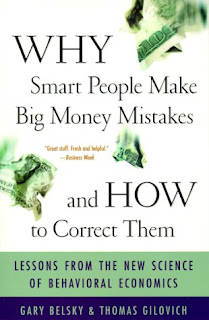
My latest finance book has been Why Smart People Make Big Money Mistakes and How to Correct Them, by Gary Belsky & Thomas Gilovich

They cover quite a bit of good material in their book, so I’ll be focusing on one area at a time to reflect on my thoughts. They look at the behavior behind economics, which is an interesting approach to your average finance book.

I was interested in their analysis of how people tend to mentally manage different pots of money in their head. For instance, you put you tax return in one pot and your salary in another. Some money is seen as fun money, and other as untouchable. They give several examples of why this isn’t the best way to think of money. By stepping back and thinking of all money as the same, you are less likely to blow money on something just because you feel you have some extra fun money.

Their suggestion was to put any extra money into an account for three months and then decide what to do with it. Their idea is that once it has been in your account for a few months you’ll be more attached to it there, and won’t feel as apt to go out and blow it. I’d have to say that I think they are on to something. When I started reading this book in May (I’ve been in grad school with a lot of other reading), I had a tax return and some other money in my account. It was true, that the longer it sat there the less I wanted to spend it. In the end I invested part in an index fund and part in my Roth IRA.

Another example of a similar situation is how people might bend over backwards to save a little money on one place, but when making a larger purchase you might not go across the street for that same dollar value in savings. Both amounts of money are the same in the end, no matter which way you get it.

Lastly they look at times when you are less likely to sell something you hold value to, even if you are better off selling. This might be the case for a house or an inheritance you keep in the bank just because you don’t want to risk losing it.

The basic idea is to consider how you mentally account for money. Feel free to leave a comment and let us know how might mentally manage money.

Cheers,

Miel

Getting A Financial Education

Hello Everyone,

As you probably know, its very important to have a working knowledge of basic personal finance. In fact, if you have a good grasp of the fundamentals of personal finance, you’re likely to have more bucks at retirement, you’ll experience fewer stressful money problems and you’ll contribute to the nations overall economic growth (clicky). In short, it’s to your advantage to become financially literate.

The good news is that getting educated is easy. All you need is the ability to read and do simple math. To get started, I would recommend doing two things. First, find a good source on the world wide web that will cover the main topics. Yahoo finance has a comprehensive set of articles you might consider. Second, get a good primer. I recommend Personal Finance for Dummies by Eric Tyson. Tyson’s book is really first rate. It’s amusingly written and full of great information. In fact, this book is so good that I lent it a friend, and when he didn’t return it, I bought another copy. Seriously, get it.

All this reading should take 1o to 20 hours of your time. That might sound like a lot, but if it results in less stress and more money at retirement, then it’s an excellent return on your investment.

Best,

James

9 Handy Ways to Save Money

Lots of people talk about building wealth through investing. But, before you can start investing in real estate or stocks, you’ll need to save money. To help get you started on the saving path, Jane Bryant Quinn reccomends 9 handy ways you can sock away a little bit extra.

1) Save all your cash gifts: Everytime grandma gives you $5, try socking it into your bank account.

2) Pay Yourself First: Pretend that your savings is a bill. Set aside a specific amount and treat it like a bill. When you pay your other bills, include a check to be sent to your own deposit account or set up direct deposit from your checking to your savings account. This will help build discipline and allow the power of compound interest to work in your favor.

3) Trim Your Spending By 5 Percent: This is easier said than done. If you eat out, try staying at home or buying budget brands when you go shopping. You might also try focusing on specific areas of your spending that are problematic. For example, we were able to successfully tame our monstrous power bill by being careful about our energy useage.

4) Don’t Spend Your Next Raise: Instead of spending your next raise try setting up an automatic deduction from your paycheck so your extra cash goes straight into your savings account. My better half, Miel, is really successful at doing this. She’s put her raises straight into her investment and retirement accounts using this method. Its great because when you use automatic desposit, you never miss the money.

5) Pay Off Your Mortgage Faster: Sign up for a bi-weekly payment plan or make an extra payment each year. You’ll build up your equity sooner, and this is a great form of forced saving.

6) Refinance Your High Interest Loans: If you have a high interest car or student loan, try refinancing it get a lower interest rate. In the case of some student loans, you can do this with a single phone call.

7) Pay Cash For Everything: If you pay cash, you’ll be less likely to spend your money than with a credit card. This main idea here is that mental accounting is very different when using plastic money. Its been well demonstrated that consumers spend more when using credit cards then when paying cash.

8) Stop Buying Books: If you’re like us DINKs you spend a fair amount on books. If you want to save money, stop buying books! Instead go to the public library. The library many not have the latest and greatest copy of Harry Potter, but it will definetly have more books than most people could possibly read in a lifetime.

9) Pay off Your Car and Save The Payment Money: A lot of people trade in their cars after they’ve paid them off. Instead of doing this, try to make make repairs as they are needed. Hold onto your car for a couple of years and save your car payment money instead of forking it over to the auto dealership. Two years of payments, at compound interest, can make a substantial difference in your networth over time.

Happy Saving!

– James

You cannot copy content of this page