If you’ve read my previous posting on the downsides of actively managed mutual funds, you’ll know that I’m not their greatest fan.
Even if you don’t care what I have to say, you might be interested to hear what John Bogle has to say about mutual fund governance. If you’re a fan of mutual funds, or more importantly, if you own some, it’s a MUST WATCH.
After watching our monthly payments on our mortgage slowly increase Miel and I have just about had enough of it. We’ve decide to refinance the debt on our apartment to change from an adjustable interest rate to a fixed interest rate.
We’ve figured that every 1/4 point increase costs us about $50.00 a month. Given that Ben Bernake is focused on combating inflation through interest rate increases, we think that the chances are good for our mortgage to increase by a lot in the near future.
However, since we are both busy getting married, we’ve decided to revisit this when we get back after our Honeymoon! Stay tuned for further details!
I like Jim Cramer. He’s done a lot for the investing public. I’ve listened to his podcasts and a lot of people call in and complement him for inspiring them to learn more about stocks.
There are some problems associated with his popularity. For example, a few months ago, Cramer made some vague statement regarding Hansens Natural Soda (HANS). Cramer’s comment was misinterpreted, and the price of the stock dropped by 12 dollars after his comments were aired. Hansens was otherwise a great company and reported blowout earnings the following quarter. What this suggests is that because Cramer is so popular, his predictions sometimes become self-fulfilling prophecies. E.g: he says the price is going up, so everybody buys the stock and the price goes up. Cramer says sell and the price goes down. This is totally independent of the intrinsic value of the stock in question.
The second major problem is that Cramer makes too many predictions. Since he has a media organization, Cramer needs to produce content, so he gives a lot of opinions. The major problem is that a thorough securities analysis can take week. It includes reviewing the companies SEC filings, taking with customers, surveying the companies market, and interviewing corporate management. In fact a lot of the big wall street investment houses take up to 6 months to come up with reliable opinion of only a few stocks. Cramer makes hundreds of picks a week. Some of these have been wrong. In fact, one study has show that the long term track record of Cramers choices was about as good as flipping a coin, in otherwords, that it wasn’t any help at all.
All, in all, I’m awarding a grade of B/B- to Cramer. He is good entertainment, especially on his television show, but his value as a stock picker is limited.
We have Comcast as our internet service provider. Our one year promotion with them just lapsed, and they raised it from $29.99 to $57.95. Miel decided she wasn’t having it and called up Comcast. She of course got the run around from the first billing person and headed straight for the big guns of disconnection. This is where you have all the power. When they know you are willing to cancel service based on some discrepancy in the billing, they’ll do what they can to keep you. This is where they are willing to give you better terms all around, whether it be a credit card or service provider.
Miel talked her down to another year at the current promotional rate of $34.95. That’s a savings of $276 over the next year in less than five minutes of negotiations. Better us than Comcast.
I’m not a fan of actively managed traditional mutual funds. While these products have done very well for millions of Americans, its been my experience that they have numerous drawbacks.
Lets discuss two of the usually touted advantages of mutual funds: 1) professional management and 2) diversification.
1) Professional Management Can be Overrated:
The main idea behind turning over one’s finances to a professional is that through superior education and experience, the professional will be better able to make financial decisions than the average consumer. There are several problems with this.
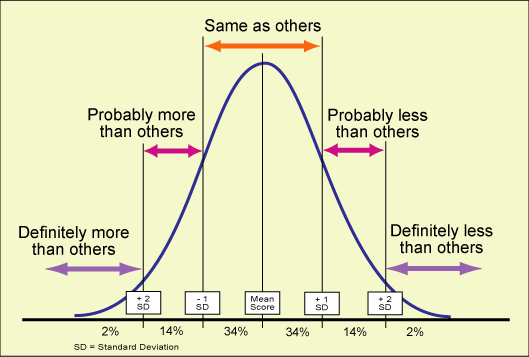
Mutual fund performance falls out like a bell curve. If you took statistics in college (or high school), you know what a bell curve looks like. If not, it looks like the figure below:
What this means is that some funds are at the tail end of the curves, e.g. their return is really good, or their returns are really lame, depending on the manager. Most of the funds are somewhere in the middle (e.g. in the “same as others area”.
This is all well and good, but its important to keep in mind that funds are judged relative to market indices like the S&P 500 or the Russell 2000. For example, the graph’s mean score would be the past 12 months return from the S&P 500.
If most funds are yielding market performance, then imposition of fees means that most funds are automatically moved towards the lame end of the bell curve (the definitely less than others part of the curve). Think about it for a minute. If your fund gives you market performance, say 11%, and you loose 2% in fees then your effective yield is 9 percent. At 9% you are automatically underperforming the market. Lame.
Don’t think that because you have a no-load fund you aren’t paying fees. Fees are like death and taxes, there is no way around them. The only questions is how much you’ll pay.
The long and the short of this is due to the realities of market performance coupled with fees, professional management can be overrated.
2) Diversification Means You Will NEVER hit a Home Run:
This second point is critical. If you invest exclusively in mutual funds, you will never, never, never get Peter Lynch’s ten bagger stock. Your fund may do well, but you’ll never hit a stock like Microsoft or Dell or Home Depot that gains 400% or 500% over a few years.
Now, most people will never catch one of these stocks on the upswing. But, ask yourself this, if you are going to expose yourself to the risks of the stock market, why not give yourself the chance to become truly wealthy? Why settle for being just average?
3) Corruption and Lack of Transparency:
For what its worth, the mutual fund industry is still relatively new. Its really only been around since the 1970s. What this means is that mutual funds aren’t as heavily regulated as older investments like stocks and bonds. For example, since the 1930’s there have been several waves of scandals and subsequent regulatory tightening relating to the trading of stocks. This just hasn’t happened yet for the mutual fund industry. I think this relatively unregulated atmosphere is why the recent late trading scandal related to Putnam investments occurred.
Lack of transparency is also an issue here. How many people do you know who can quickly tell you how the unit price of mutual fund shares is determined? It requires some specialized knowledge and probably the use of computer to aid calculation. Stocks are easier, just look in the newspaper or check your issue on-line.
Scandal and lack of transparency are drawbacks, but my personal feeling is that most people are generally honest, so these are secondary points. The two major drawbacks are the performance and diversification issues mentioned here.
Best,
James
P.s. To be fair, I should tell you that I signed onto to be a participant in a class action lawsuit against Smith Barney’s aggressive growth fund. I was a holder of a limited number of shares of this fund in 2002 and 2003.
I got a funny email from Nigeria in my email this morning. The “widow” of the former dictator, Sani Abacha was offering to share $20,000,000 in a confidential transaction with DINKS finance. We got a good laugh from it, but then we thought we’d blog about some top money moves people should AVOID making!
1) DON’T GET DIVORCED.
If you get divorced, you’ll have to sell off your assets, pay lawyers fees, pay your former spouse alimony and you’ll loose out on the benefits of marriage. Divorce is one of America’s major preventers of wealth. DON’T DO IT.
2) DON’T PLAY THE LOTTERY.
Think about it, the lottery has to bring in more money then it pays out. If it did not do this, it would not be economically profitable to run them. What this means, is that lotteries are systems which guarantee that every dollar you spend can be expected to have a negative return in the long run (e.g. you will loose money). This is just dumb! Don’t play the lottery!
3) DON’T BUY USELESS STUFF.
Stuff from the Disney store, teletubbies paraphernalia or anything out of those airline skymall magazines is JUNK. Don’t buy it. The major problem with buying junk is that it actually has a negative return on your financial situation. The more stuff you buy, the more storage containers you need to buy to hold your stuff. When you finally decide to get rid of it, you may need to pay someone to take it off your hands. End result: useless stuff, no money.
Have a good one! As always feel free comment or drop us an email!
As you may know, Miel and I have an investment property in Washington DC. We both enjoy owning real estate, but we recently got stuck with a special assessment in the amount of $1160.25. In the grand scheme of things, $1160.25 is a LOT of money. So, I thought I would review the profitability of our investment to determine how we are doing.
Just a quick update, there are at least two components to total return when looking at real estate: 1) income 2) capital gains.
Regarding income: After some number crunching, I came up with the following figures from my IRS submissions
Note all the figures given here are basically the same as those reported to the IRS. To be entirely fair, some of the expenses for 2004 and 2005 were a bit higher than those reported here, but not more than three or four hundred per year. I only reported expenses I could substantiate.
Regarding capital gains: I bought the place in 2003 with a cost basis of $130,000. When I last checked in 2005, similarly situated properties were going for $235,000. (It might be worth less now, but we can all dream, so I like the 235k figure). Between the cost basis and last valuation, I refinanced and took out $32,000 in equity. So the pre tax capital gains are (($235,000 – $130,000) – $32,000) or $73,000.
My total return since 2003 has been therefore: $78,336.
Of course, this is a rough figure. The first few months of 2006 have seen interest expenses increase, as well as higher energy bills and lastly the special assessment mentioned earlier.
All in all though, it appears that our real estate venture has done well.
Best,
James
p.s. as always, feel free to leave comments or drop us an email if you’d like to chat!
While surfing the net, I came across an interesting website. The site is called “AnnOnLine.com” and it was run by Ann Devlin, who is a talk radio personality in Pennsylvania. For a few years in the early 2000’s Ann had a number of interesting characters on her show, which was engineered and broadcast specifically for the internet.
How is this relevant to personal finance? Well, if you spend a lot of time on the net, you’ll see that some information is more useful than others. Ann’s site has some first rate interviews with smart finance personalities, so its worth spending a bit of time listening to some of them.
Since your time is probably limited I recommend you listen to: Gregory Curtis
Our previous posting on our bank and investment accounts got me thinking about Dividend Reinvestment Plans (DRIPS).
If you don’t know what at DRIP is, it is essentially a direct investment account that allows you to purchase shares in companies without the help of a broker or other financial intermediary. Most also allow you to reinvest your dividends without an additional charge, hence the name, dividend reinvestment plan. Most DRIPS are direct investment plans where you buy your desired shares from the company via snail mail or the internet.
I like dividend reinvestment plans. I like them a lot.
There are several advantages to investing through DRIPS.
1) Low Investment Minimums: Lets face it, most people don’t have a lot of money to invest. According to the census bureau, the average American family had a net income of $44,000 per year. After taxes, food, housing, transportation and miscellaneous expenses, there often isn’t much left over for investing. The great thing about DRIPS is that many of them have minimum investments amounts in the $100 or $250 range. These smaller amounts are more realistic for most people.
2) Low Transaction Fees: Like Warren Buffet says, fees and and emotion are the enemy of investors. Most traditional brokerage accounts and financial products charge fees higher than those levied by the average DRIP plan.
For example assume that you have $500 to invest. If you were to purchase shares in the S+P 500, you’d be looking at a transaction cost of $50.00 through Vanguard (The Vanguard Group is known for their low fees). Fifty dollars on an investment of $500 is 10 percent! You would immediately loose 10 percent of your investment if you directly purchased your funds through a brokerage account. On the other hand, an equivalent investment in a DRIP security would cost you maybe 8 or 10 dollars. In sum, DRIP plans are generally a lot cheaper than traditional transaction schemes.
You might be wondering who pays for the management of DRIPs. Usually the company whose shares you buy foots the bill. They do this because investors tend to be customers and executive managers prefer a wider shareholder base to reduce equity volatility and to limit the influence of large insitutional stockowners.
3) Free Money: Some DRIP plans offer discounted shares. Basically what this means is you send in your payment and you automatically purchase shares at some percentage reduction from the prevailing market price. Before you start getting excited, I should tell you that the discounts are usually three to five percent. Not much, but enough to cover the effects of inflation. With these kinds of plans, any market return you get is a real return (e.g. it takes inflation out of the picture).
Finally, getting rich seems to be about controlling expenses and maximizing return. DRIPS are perfect ways to do both.
To take action, you might want to consider the following websites: