I rarely post videos from TechTicker. Usually their content isn’t worth writing home about. Well, yesterday’s story was about the SEC, the IRS and the SIPC. Evidently these agencies have been slow and inflexible about making Madoff victims whole. They have lost significant portions of their wealth (or all their wealth), yet these agencies are not letting up. Now, don’t you think this is little like kicking somebody after they are down? Its definitely bad manners and probably also bad policy.
So I was sitting on the metro riding home today and was leaving through somebodys leftover USA Today. The finance section had a piece on inflation. The article basically said that because the Feds are racking up huge bills, the government will have a powerful incentive to create inflation.
The thing about it was, that they cited this swiss economist, Marc Faber. Faber is famous for having made the prediction that hyperinflation was a 100% certainty for the US. The thing is, the newspaper was the USA today. I always kinda figured that Faber was only quoted by internet freaks and hard core gold bugs. I was surprised that a reputable paper like the USA Today quoted the guy.
So it seems that the mainstream press, not just bloggers are starting to take the inflation issue seriously.
So, I don’t know what you’re planning on doing about this, but I’ll tell you this much. When and if inflation gets to around 10 to 12% I’m planning on loading up on long term debt instruments. Preferably something like 30 year t bills or an investment along those lines.
The truth is that high levels of inflation are a historically anomaly. For most of the last 70 years interest rates have been way lower than 10%. In fact, a really high interest rate would be a great opportunity, especially if one thinks about it as an opportunity to lock in a high return with low risk. It’s a signficant money making opportunity and one that could greatly enhance our wealth. So, what will be on the menu will be things like 5 year CDs and long term treasury obligations.
The latest from the HuffingtonPost is that ponzi schemer Bernie Madoff has received a sentence of 150 years in prison. He’s likely to be sent to hard core state insitution in New York. The length of his sentence indicates that, in all probably, he will die a prisoner of the state.
Communication is a key element of our relationship. We had some problems early on because James really didn’t know how to articulate himself in a healthy and affirming manner to Miel. Now, we meet nearly every Saturday morning to keep things moving forward.
Usually what we do is lounge around in our pjs and drink coffee (yummy!) while we’re talking. Most of the time we discuss finances, but we usually address a whole range of things. For example, a couple of weeks ago, we talked about starting this blog. Also, we’ve chatted about managing our wedding, defined savings goals, reallocated our budgets – pretty much anything that needs discussing.
Sometimes James still doesn’t know how to articulate himself, but at least we DINKS have found a time where we’re both free to keep our communication open.
Here is where we have our meetings (usually its a LOT more messy)!
Happy Saturday morning. I wanted to share with folks an interesting idea that my sister is starting to implement in her family.
My twin sis and her husband are starting a no shopping Sunday policy. This basically means that they will plan their week around not having to grocery shop, or shop in general. While obviously there may be occasional times when something must be purchased, most of the time this can likely be avoided.
They are leaving the option open to spending for entertainment, but living in beautiful Portland, Oregon there are many a free activities to be had in the beautiful outdoors.
While they tend to have a nice home cooked meal for dinner, they may have to sort out brunch, as I know they enjoy this pleasure from time to time. Since this policy is more about spending time together as a family and less about the absence of spending money, then brunch might get a pass.
The upsides to this, means eliminating a day of shopping or running associated errands. It also means avoiding long grocery lines and best yet, spending time with family.
I’m still sorting out if this is reasonable for us to try as well. Overall we definitely have more of an urban lifestyle, stopping by the market on the way home or running out to the corner store as needed. It can be a great way to live frugally, as you tend to only buy what you need. This allows you to save more money for investments. I also tend to be so busy that some times it is harder to manage to get grocery shopping done earlier in the week. Though I’d have to say that with the short lines on Saturday afternoon that might just save enough time to make it worth while.
I’ll let folks know how it works for my sister’s family as well as our potentially. Overall I think it is a great way to reject consumerism and focus on what is really important once a week.
Evenly, the recession is effecting even the super rich.
The Wall Street Journal’s blog has a nice write up of why the numbers of super rich are declining.
For what its worth, one way to get serious about building wealth is to model ones behavior after the patterns of people who do have money. One thing they tend to do is look for money making opportunities. It’s a great habit to get into, and we as DINKS try to do it often. Keeping an eye on the investment and spending trends of the wealthy is an important part of this.
Most Americans are pretty familiar with Flexible Spending Accounts, designed by the government to provide some tax relief for health and child care related expenses. While this intervention seems understandable on the outset, there are a great many of the actual details related to FSAs that aren’t geared towards benefiting consumers.
Use it or Lose it. By far the biggest issue around FSAs is the stipulation that funds must be used within the annual year established by your employer or health care provider. This means that you are forced to spend what you’ve elected for deductions, otherwise this money goes into a great FSA abyss.
Predetermined Limits. While these are set by individuals, one must decide before the beginning of the program year how much they will need to deduct. This means getting out the crystal ball for your family’s health care needs and predicting what you will spend for the year. Obviously there is the likelihood of either over or under estimating this depending on whether your expenses were less than expected, or a medical issue came up part way through the year.
No Flexibility. Despite what the name implies, should you discover part way through the year that your expenses might be more or less than expected, you have no ability to change course once you’ve decided on your deductions for the year.
Geared towards Pharmaceutical Industry. Since it is a use or loose system, this means that hundreds of thousands of dollars are spent by those who have elected to deduct too much. They end up buying life time supplies of bandaids and Costco sizes of cough syrup.
An example of how this all goes wrong in the system can be seen by my dear twin sister. Since my sister was pregnant at the time of her annual elections, she estimated what her expenses would be for a hospital birth. As it happened, they ended up opting for a home birth where there was actually not a dime out of pocket for the delivery from trained midwives. While a great experience and outcome on the one side, this has left my sis with $2k worth of FSA that she has to spend before her annual plan soon comes to a close. Not enough to consider lasik surgery, she is left with buying glasses she isn’t really in need of and stocking up on medical supplies. Obviously this is better than sending her hard earned money back to the feds, where this goes we still don’t know, but it isn’t a good option.
On the flip side, if one gets pregnant right after their annual election period, that means they would not be able to deduct any of their expenses.
Childcare Expenses. Another part of FSAs are for childcare related expenses. While I’m not as familiar with all of the issues around this, I am aware that the maximum limits set for $5k annually, when the average is $8k with many paying closer to $20k. Obviously this is outdated and needs to be updated according to reasonable limits and then adjusted for inflation.
Redesign. My main suggestion for FSAs, which is really a no brainer, is to establish a truly flexible spending account system for health care expenses where one could put a little away at a time and then have those expenses available for anyone within the family years out into the future. I believe that this would save the health system a great deal of resources, as well as cut back on the difficulty faced by so many with unexpected or high health care expenses.
Readers: If you have experiences or suggestions around FSAs we would love to hear them.
I’m swamped preparing for my comprehensive exams. Rather than bore you with a discussion of probability distributions and link functions, I thought I’d hit on one of my older, but favorite posts. So, without further ado, here are my thoughts on mutual funds…
I’m not a fan of actively managed traditional mutual funds. While these products have done very well for millions of Americans, its been my experience that they have numerous drawbacks.
Lets discuss two of the usually touted advantages of mutual funds: 1) professional management and 2) diversification.
1) Professional Management Can be Overrated:
The main idea behind turning over one’s finances to a professional is that through superior education and experience, the professional will be better able to make financial decisions than the average consumer. There are several problems with this.
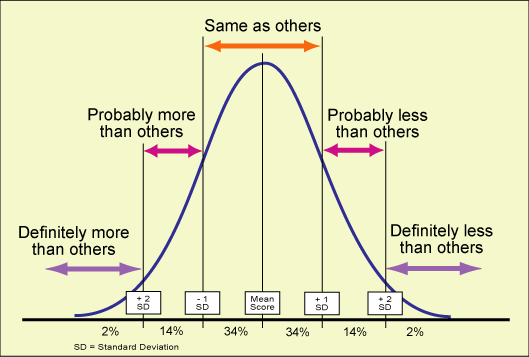
Mutual fund performance falls out like a bell curve. If you took statistics in college (or high school), you know what a bell curve looks like. If not, it looks like the figure below:
What this means is that some funds are at the tail end of the curves, e.g. their return is really good, or their returns are really lame, depending on the manager. Most of the funds are somewhere in the middle (e.g. in the “same as others area”.
This is all well and good, but its important to keep in mind that funds are judged relative to market indices like the S&P 500 or the Russell 2000. For example, the graph’s mean score would be the past 12 months return from the S&P 500.
If most funds are yielding market performance, then imposition of fees means that most funds are automatically moved towards the lame end of the bell curve (the definitely less than others part of the curve). Think about it for a minute. If your fund gives you market performance, say 11%, and you loose 2% in fees then your effective yield is 9 percent. At 9% you are automatically underperforming the market. Lame.
Don’t think that because you have a no-load fund you aren’t paying fees. Fees are like death and taxes, there is no way around them. The only questions is how much you’ll pay.
The long and the short of this is due to the realities of market performance coupled with fees, professional management can be overrated.
2) Diversification Means You Will NEVER hit a Home Run:
This second point is critical. If you invest exclusively in mutual funds, you will never, never, never get Peter Lynch’s ten bagger stock. Your fund may do well, but you’ll never hit a stock like Microsoft or Dell or Home Depot that gains 400% or 500% over a few years.
Now, most people will never catch one of these stocks on the upswing. But, ask yourself this, if you are going to expose yourself to the risks of the stock market, why not give yourself the chance to become truly wealthy? Why settle for being just average? You can create significant wealth in a relatively short period of time if you did try to spot one of these stocks. But it goes both ways as you could be wiped clean.
3) Corruption and Lack of Transparency:
For what its worth, the mutual fund industry is still relatively new. Its really only been around since the 1970s. What this means is that mutual funds aren’t as heavily regulated as older investments like stocks and bonds. For example, since the 1930’s there have been several waves of scandals and subsequent regulatory tightening relating to the trading of stocks. This just hasn’t happened yet for the mutual fund industry. I think this relatively unregulated atmosphere is why the recent late trading scandal related to Putnam investments occurred.
Lack of transparency is also an issue here. How many people do you know who can quickly tell you how the unit price of mutual fund shares is determined? It requires some specialized knowledge and probably the use of computer to aid calculation. Stocks are easier, just look in the newspaper or check your issue on-line.
Scandal and lack of transparency are drawbacks, but my personal feeling is that most people are generally honest, so these are secondary points. The two major drawbacks are the performance and diversification issues mentioned here.
Best,
James
P.s. To be fair, I should tell you that I signed onto to be a participant in a class action lawsuit against Smith Barney’s aggressive growth fund. I was a holder of a limited number of shares of this fund in 2002 and 2003.